Houston Islamic Arts Festival 2026 at the Ismaili Center
Plan your November 21–22 visit to Houston’s Islamic Arts Festival. See which exhibits are free, when the seminar runs and how to book Sunday workshops.
The 13th Houston Islamic Arts Festival takes place Saturday and Sunday, November 21–22, 2026, from 10:30 a.m. to 5:30 p.m. local time at the Ismaili Center, 2323 Allen Parkway. The visual art display and live demonstrations have free entry. Sunday’s two-hour classes cost $30 each for participants aged 12 and over, and Saturday’s architecture seminar has its own registration link. Start with the Islamic Arts Society’s festival programme and the venue’s weekend event listing before choosing a session.
What the weekend programme includes
The exhibition and demonstrations are the easiest way to build a flexible visit. The venue lists more than 200 works by more than 50 artists and describes a mix of contemporary and traditional art. The display and sales page is the organiser’s reference for the exhibition. You can look at art without buying anything. If a work interests you, ask who made it, when it was made, how it should be displayed and which materials the artist used. Asking about the work before asking about price can make a short visit feel more like a conversation with a maker.
| Programme | Houston local time | Where and how to attend |
|---|---|---|
| Visual art display | November 21 and 22, 10:30 a.m.–5:30 p.m. festival window | Ismaili Center, free display entry |
| Calligraphy and ebru demonstrations | Both days, 10:30 a.m.–5:30 p.m. | Third floor, free entry. Art purchases are separate. |
| Architecture and gardens seminar | Saturday, November 21, 1–2 p.m. | Second-floor Black Box Theater. Use the seminar’s own registration. |
| Gilding and Sini calligraphy classes | Sunday, November 22, two hours per class | Second-floor Black Box Theater. Each class is $30, ages 12 and over. |
The venue’s event page links to registration for the weekend. Individual sessions may have separate admission and capacity. The Fareed Ayaz and Abu Muhammad qawwali listing, for example, gives Friday, November 20, at 7:30 p.m. as its scheduled start. That performance sits outside the Saturday and Sunday daytime hours. Use the named event and its local date when booking or sending plans to someone. Harris County’s Commissioners Court agenda separately records the weekend event in a request for a recognition resolution.
The third-floor demonstrations reward a close look
The live art demonstration programme lists ebru and Arabic calligraphy on the third floor on both days. It says visitors can try ebru with an artist’s help. Arrive with room in your schedule, as watching the entire sequence gives you more to take away than seeing only the finished sheet. Ask which stage controls the final pattern and what the maker can change after the colours are set on the surface.
In ebru, pigment floats on a prepared bath, a tool can draw through it, and the design transfers when paper touches the surface. UNESCO’s entry for Turkish ebru, inscribed in 2014, describes the technique and its connection to bookbinding. Watch for how a droplet spreads and how a line turns when the tool changes direction. Once you have seen a sheet lifted in Houston, the Metropolitan Museum of Art’s marbled folio gives you a separate example of the craft on paper. The folio belongs to the museum’s collection and serves as a reference for seeing the technique’s result.
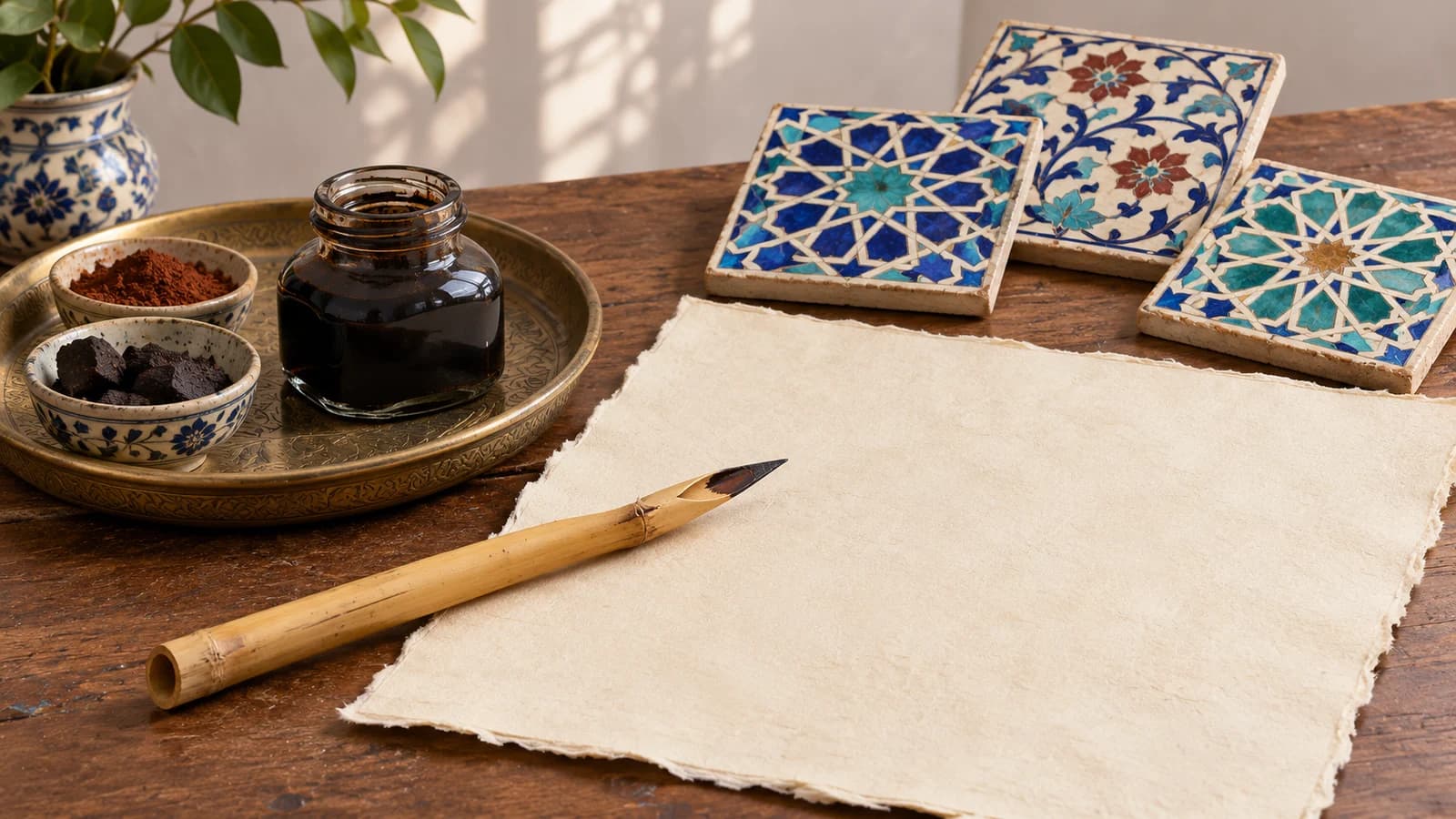
The organiser lists multiple scripts in the calligraphy programme. A useful question for a demonstration is how much of a line comes from the width of the cut reed and how much from the angle of the hand. Compare the movement used for a long stroke with the movement used to place a dot. Then look for the space the artist leaves between forms. The guide to Ottoman calligraphy practice sheets shows how such movements become visible through repeated exercises. You can also ask a calligrapher how the position of a sample on the table helps a student follow the teacher’s motion.
Saturday’s seminar connects the building and gardens
The architecture and gardens seminar is scheduled from 1 to 2 p.m. on Saturday in the second-floor Black Box Theater. The organiser names Emily Moore of DLR Group and Jeff Aten of Nelson Byrd Woltz Landscape Architects as the speakers, with Omar Samji moderating. The event page links to a registration form. If the seminar is the reason for your visit, make that reservation the centre of the day and put the flexible exhibition time before or after it.
Start by finding the entrance and following the route toward an open space. Note where the view narrows down a passage and opens onto a larger room or garden. A useful question for the speakers is how they decided which parts of a garden should invite people to stop and which should guide them onwards. Find out whether they were working with a historical reference, a local material, or a practical demand of the site. These details are easier to remember if you revisit one spot after the talk and see how the answer changes what you notice.
Architecture, gardens and ornament work at different distances. A repeated motif may register as a large pattern across the room and as a series of individual lines as you approach it. The site’s guide to arabesque foliage and scrolls gives readers a way to follow a repeating form. A study of human and animal figures in Islamic art broadens the visit beyond any single material, place or convention.
Sunday has two paid studio classes
The Sunday workshop page lists gilding calligraphy and ornaments with Harout Bastajian and Chinese-style Arabic, or Sini, calligraphy with Moina Sajjad. It describes each class as 120 minutes, $30 and open to ages 12 and over. Both are listed for the second-floor Black Box Theater. The organiser provides separate class forms and a payment link. Check the time and available space for the exact class before paying or arranging your travel.
Gilding is an opportunity to see how work on a surface changes when light becomes part of the composition. For Sini, the central topic is Arabic writing shaped by a Chinese calligraphic tradition. The script name describes an artistic way of handling the written forms. For either class, ask whether materials are supplied and whether you can take a piece home. If you are accompanying a younger child, consider the demonstrations and exhibition instead and ask the organiser about age guidance for any other activity you plan to use.
Free and paid activities can fit in the same visit. A pair of visitors can start with the display, then one can attend a booked class while the other stays upstairs for the demonstrations. Agree on a time and a place to meet before splitting up. Budget the full two hours for a workshop. A class participant may want extra time afterward to check instructions for transporting a finished piece, especially when a surface is wet or delicate.
Arrival, parking and access
The main address is 2323 Allen Parkway, Houston, TX 77019. For drivers, the Ismaili Center’s visitor instructions give 2290 West Dallas Street as the entrance to its underground parking. They describe free parking and elevators from the garage to Level 1. Check day-of instructions for event routing if you are being dropped off. The building’s regular hours appear on the same visitor page. For the festival itself, the special event listing is the source for the weekend window, especially on Sunday when the regular building hours shown separately are different.
The venue says its loan wheelchairs are available on request while supplies last and that personal photography excludes the prayer hall. It also lists restrictions on strollers in that hall and says large bags can be inspected. Contact the organiser through the event page if you need an accessible route to a specific room, seating at a session, or help planning around a timed class. If moving between levels takes extra time, aim to finish a floor before crossing to the next one and keep the location of the elevator in your notes.
A plan for a short visit and a longer one
With an hour, choose a small section of the visual art display and one third-floor demonstration. Take a moment between the two to compare materials. On a decorated piece of paper, for instance, a separate border may surround a written line. At the demonstration you can watch how the artist keeps an edge or overlaps two colours. At the end, choose one work or process to read about later. A small set of examples can give a first-time visitor a clearer memory of the day than rushing through every room.
With half a day, use a timed event to anchor the plan. For Saturday, place the 1 p.m. seminar between two shorter visits to the galleries or gardens. On Sunday, put a booked studio class first and leave the demonstrations to the time before or after it. The programme is part of a November season with different events and institutions, as the guide to the 2026 International Day of Islamic Art explains. Confirm the session name and date on the organiser’s listing, then write down the correct street entrance, floor and local start time for your own visit.