Andalusi Ivory Pyxides from Umayyad Córdoba
Compare the Louvre’s dated al-Mughira pyxis with two distinct Met examples, and learn what their ivory, inscriptions, carvings and missing lids actually reveal.
An Andalusi pyxis is a small cylindrical box, usually made from elephant ivory, rather than a lid or a sculpture. In tenth-century Córdoba and its nearby palace city of Madinat al-Zahra, such boxes belonged to a world of courtly possessions and gifts. The surviving objects are not interchangeable: one has a dated inscription naming its recipient, while others have lost their lids and therefore any inscription that a lid might once have carried. Comparing actual museum records is a better starting point than treating every carved cylinder as the same famous object.
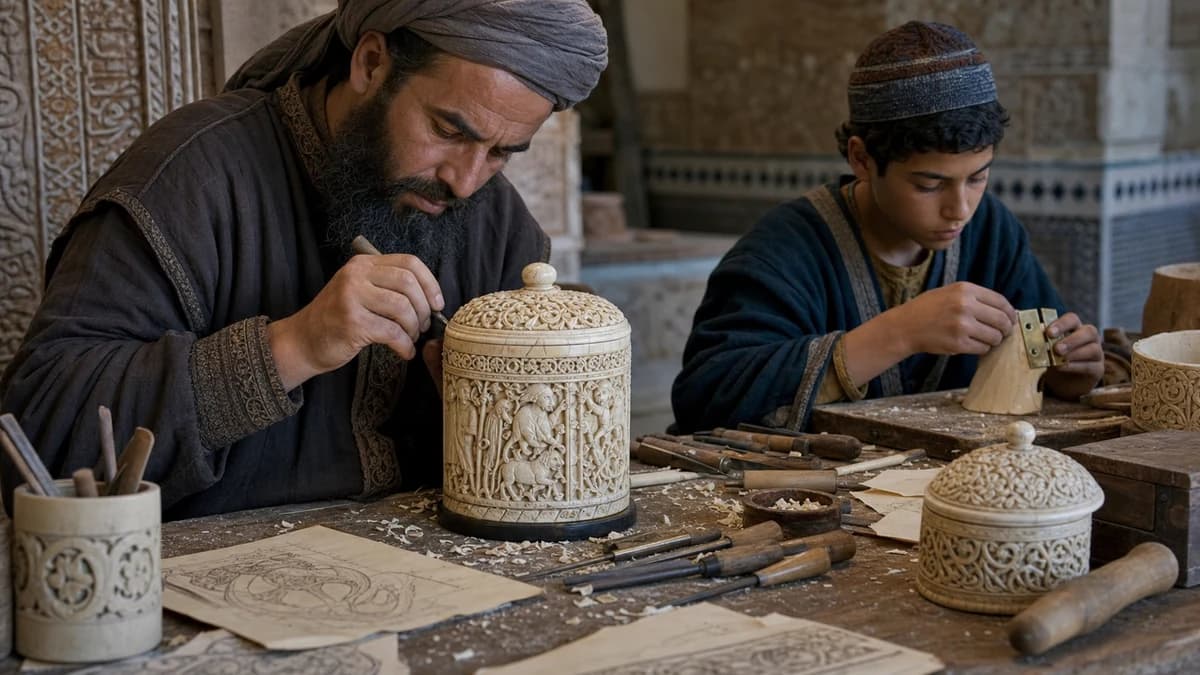
The cover image is an original AI-assisted ivory workshop reconstruction, not a photograph or copy of a surviving pyxis.
What is an Andalusi ivory pyxis?
The word pyxis names a container with a cylindrical body and a lid. In this setting the material is elephant ivory, which could be carved into a compact object with unusually fine relief. A pyxis could hold valued personal goods. The Metropolitan Museum’s account of its tenth-century cylindrical box associates vessels of this group with aromatics and cosmetics used by Umayyad nobility. Another Met pyxis at the Cloisters is described as a secular container for jewellery and cosmetics. These museum descriptions support the general function of the type; they do not prove the precise contents of any individual surviving box.
The domed lid is a useful identification clue, but preservation matters. Both Met examples discussed below lack their original lids. The museum infers a domed lid for each by comparison with other Andalusi pieces. A reconstructed silhouette should therefore be labelled as an inference, not as a direct observation. The Louvre object, by contrast, preserves a lid whose inscription provides a date and a name. That difference changes how confidently we can describe each piece.
Why did Córdoba and Madinat al-Zahra matter?
Córdoba was the center of the western Umayyad polity. The Umayyad rulers proclaimed a caliphate in 929, and their nearby palace city of Madinat al-Zahra became a setting for the display of authority. The Met’s survey of Umayyad art in Spain connects the court to luxury objects, including carved ivory boxes. UNESCO’s Medina Azahara record identifies the mid-tenth-century city as the caliphate’s seat and describes its surviving architecture, infrastructure and ornament. The setting helps explain why a costly, portable and carefully decorated container could also communicate status.
That context is not a workshop signature on every object. Attribution can rest on an inscription, a museum’s catalogue judgment, stylistic comparison or a combination of these. The Louvre lists Madinat al-Zahra as the origin of its al-Mughira pyxis. The Met labels one other pyxis as made in Córdoba and a smaller box simply as from Spain. Those are three catalogue claims with different degrees of specificity. They should stay distinct even when the objects are viewed together as Andalusi court art.
For the larger political chronology, see our guide to the early Muslim entry into Iberia. It covers the beginning of the much longer Andalusi history, rather than treating tenth-century court production as a direct consequence of a single event in 711.
The Louvre’s al-Mughira pyxis: a dated, named object
The Louvre catalogue for the Pyxis of al-Mughira identifies it as object OA 4068, dated 968 CE / 357 AH, and from Madinat al-Zahra. It records elephant ivory worked by carving and engraving, an overall height of 18 cm and a diameter of 11.8 cm. Most importantly, the Arabic inscription around the lower edge of its lid names al-Mughira as the son of the “commander of the believers” and records the year 357. Here the date is evidence on the object itself, not a modern stylistic estimate.
The dedicatory wording gives a recipient, but it does not tell us exactly what was placed inside, who handed the object to him, or which single political message every carved scene carried. A later interpretation may connect its human, animal and vegetal images with dynastic power; that remains an interpretation of imagery, distinct from the inscription’s explicit date and recipient. Smarthistory’s object study discusses possible readings of the scenes and the box’s courtly context. Its imagined scene of perfume containers is a teaching device, not an excavated inventory of the pyxis’s original contents.
The present Louvre catalogue also lists the object’s current location as Louvre Abu Dhabi on long-term loan. The collection owner and the place of display are different facts. Readers checking the piece in person should consult the catalogue’s current location before planning a visit.
Two different pyxides at the Met
The Met’s Cylindrical Box (Pyxis), accession 30.95.175, is a Spanish ivory box dated broadly to the tenth century. It measures 6.7 cm high and 8.3 cm in diameter. Its lid is missing. The Met says comparable Andalusi boxes usually had domed lids and infers that this example probably did too. Nothing in its object record identifies it as the al-Mughira pyxis or supplies a 968 inscription. The famous named and dated example belongs to the Louvre collection, as its own catalogue makes clear.
The Met also holds a larger Pyxis at the Cloisters, accession 1970.324.5, catalogued as made in Córdoba and dated about 950–975. It measures 11.7 by 10.5 cm overall. Its domed lid is likewise missing. The museum suggests that a comparable lid would probably have carried a date and owner’s name, but this is a comparison, not a transcription from a surviving lid. The record describes birds, lions and gazelles among scrolling vines and notes connections to later European Romanesque decoration.
The distinction can be checked quickly: the Louvre object is named for al-Mughira and has a dated inscription on its surviving lid; the Met’s 30.95.175 is a much smaller anonymous tenth-century box; and the Cloisters’ 1970.324.5 is another larger, undated example with its own relief program. None of those catalogue entries warrants transferring the Louvre inscription to a New York object.
How did material and carving shape the design?
Elephant ivory gave artisans a dense, workable surface for small-scale relief. The cylindrical body and the lid offered different visual zones: a broad band around the side and, when preserved, a narrower edge for a dedication or other writing. On the Louvre box, the inscription runs around the lower perimeter of the lid, while carving and engraving cover the body. On the Cloisters example, the museum emphasizes a dense arrangement of animals and vine scrolls. The container was a functional object, but careful carving made every turn of the cylinder present another part of the design.
It is tempting to turn the shape into a detailed production recipe. The available catalogue records do not document every cut, tool or person involved. The safest account separates visible form and recorded material from plausible reconstruction. A carved ivory wall and lid are observable; the sequence of workshop steps in the cover illustration is illustrative. The V&A’s Islamic Middle East collection page identifies another pyxis from Madinat al-Zahra, dated around 969–970, showing that this was a broader group of courtly objects rather than a single isolated commission. That page does not make the V&A piece identical to either museum example discussed here.
Costly raw material and refined workmanship also imply access to resources, but they do not identify the maker’s personal status or the precise transaction by which a particular box changed hands. Object histories are often incomplete. This is why an inscription that actually survives is stronger evidence for a recipient than a general account of how courts gave gifts.
What can the writing tell us, and what remains uncertain?
On the Louvre pyxis, the dedication offers three unusually firm pieces of evidence: the named recipient, his stated relationship to a ruler and the date in the Islamic calendar. The catalogue’s Gregorian equivalent is 968. Its inscription is in Arabic and described as Kufic script. Those are catalogued features that readers can verify independently of any proposed interpretation of the pictures.
Missing writing creates a different evidentiary situation. Because the two Met lids are gone, they cannot currently provide a donor, recipient, workshop name or year from their own lid inscriptions. A curator can compare their proportions and carving with dated objects, but the result is an approximate date or attribution. This is not a flaw in the object; it is the ordinary limit of an incomplete survival. A museum label that says “probably” is doing useful work and should not be silently rewritten as certainty.
The distinction matters for search as well as scholarship. A query for “al-Mughira pyxis 968” should lead to the Louvre object. A query for “Met Andalusi ivory pyxis missing lid” may refer to one of the New York boxes. Readers deserve object numbers, dimensions and institutions alongside broad labels so they can tell which claim attaches to which artefact.
How should we read animals and courtly images?
Lions, gazelles, birds, vines and human activity can be decorative, symbolic or both. The Cloisters record identifies its animals and scrolling foliage as characteristic of this dense Andalusi design. The Louvre object’s figural scenes invite more specific interpretations; Smarthistory explains one reading involving courtly authority and dynastic rivalry. Such readings are arguments based on the imagery and historical setting, not words supplied by the lid inscription. They should be presented as proposals, especially where several motifs could bear more than one meaning.
Figural carving on these secular court objects also challenges a blanket claim that all Islamic art avoids people or animals. Its context is specific: a luxury container made for courtly use, not a rule for every building or religious object. Our museum-based guide to people and animals in Islamic art compares media and settings instead of applying one rule everywhere. For the vegetal scrolls that organize many carved surfaces, our arabesque guide explains the design vocabulary in more detail.
What survived, and how far did the style travel?
What survives is a selective record. A box may keep its body while losing its lid; a lid may preserve a dedication that a body alone cannot supply. Later collecting and museum acquisition moved the pieces far from their tenth-century setting. The three catalogued objects above now belong to separate collection histories. A modern comparison is valuable precisely because each institution identifies what it physically holds and what it infers.
The Met’s Cloisters record points to an influence on Romanesque ivories and manuscripts. This should be understood as a line of artistic comparison, not proof that one surviving pyxis directly served as a model for a particular later work. Cross-cultural circulation also appears in scholarship on tenth-century Iberian ivory carving. Our Umayyad court art guide concerns a different region and earlier setting, but helps readers compare how court patronage could use figurative and vegetal art without flattening those settings into one tradition.
The strongest conclusion is modest and concrete. An Andalusi pyxis was a usable luxury container. Its form, material and decoration tell us about skilled craft and courtly taste. A surviving inscription may establish a recipient and year. A missing lid leaves those details open. The Louvre and Met records together reveal both the richness of tenth-century Umayyad ivory carving and the limits of what any single incomplete object can prove.
Sources
- Louvre, “Pyxide au nom d’al-Mughira” (OA 4068) — primary catalogue for the dated 968/357 inscription, material, dimensions, Madinat al-Zahra attribution and current display location.
- Metropolitan Museum, “Cylindrical Box (Pyxis)” (30.95.175) — primary record for the smaller anonymous Spanish box, missing lid, dimensions and suggested contents.
- Metropolitan Museum, “Pyxis” (1970.324.5) — primary record for the Cloisters box’s Córdoba attribution, date range, dimensions and relief motifs.
- Metropolitan Museum, “The Art of the Umayyad Period in Spain” — historical and artistic context for the court and its luxury production.
- UNESCO World Heritage Centre, “Caliphate City of Medina Azahara” — primary site record for the palace city’s date, political role and surviving archaeology.
- Victoria and Albert Museum, “Islamic Middle East” collection highlights — identifies a distinct pyxis dated about 969–970 and attributed to Madinat al-Zahra.
- Smarthistory, “Pyxis of al-Mughira” — art-historical interpretation of the Louvre object’s images; used as interpretation rather than evidence for its undocumented original contents.


