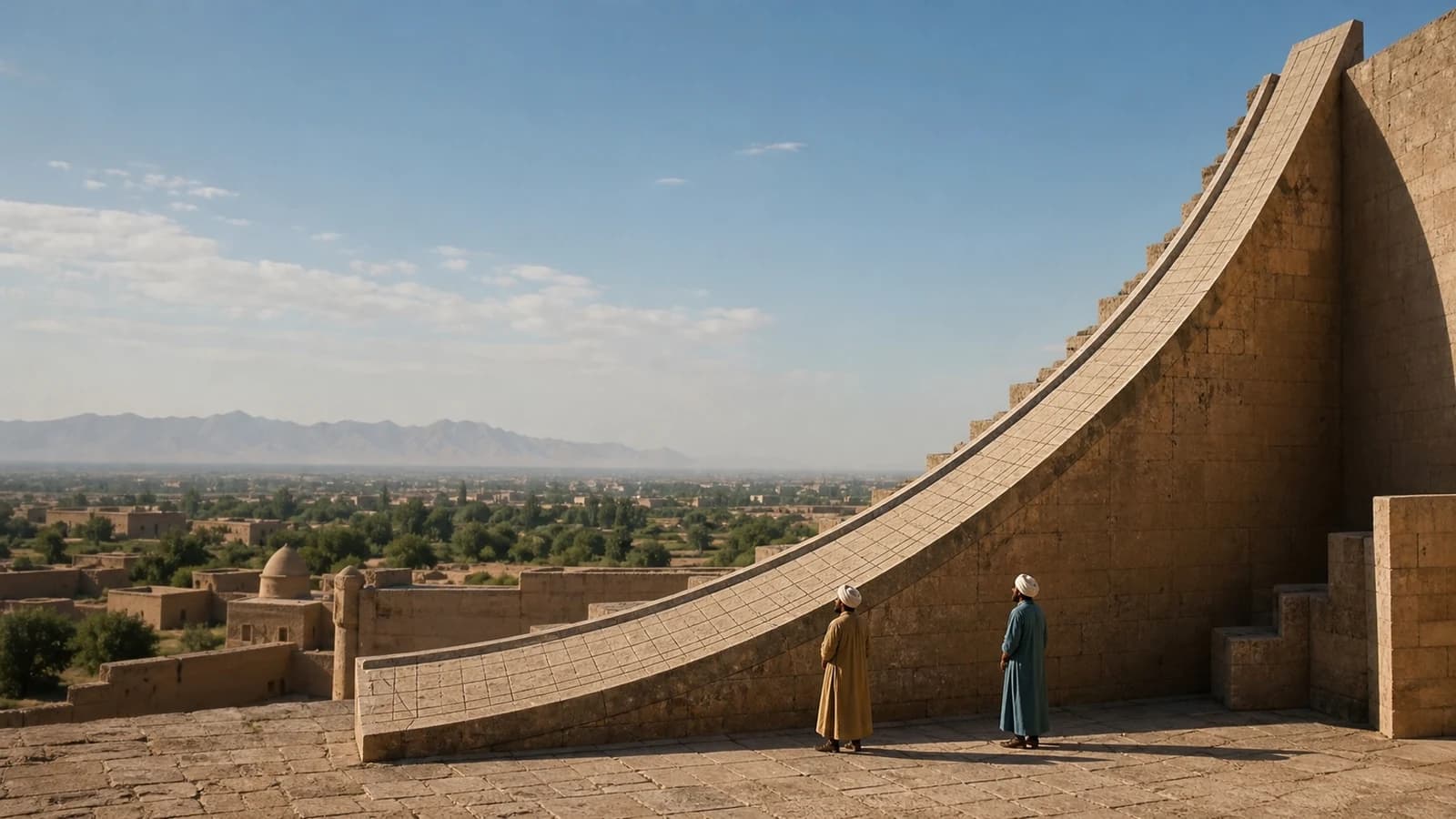
Al-Khujandi’s Giant Sextant at Rayy Explained
How a monumental meridian instrument measured the Sun’s altitude, what al-Khujandi sought at Rayy, and why scale alone did not guarantee accuracy.
The instrument known as the giant mural sextant, attributed to Abu Mahmud al-Khujandi at Rayy near the end of the tenth century, represents a specific engineering response to the need for precise astronomical measurement. This device was aligned within the meridian plane to track solar positions. It utilized a large radius to spread angular divisions over physical space, thereby reducing visual estimation errors in reading shadow edges. However, the accuracy of these measurements was inherently limited by atmospheric refraction, structural movement, and the definition of shadow boundaries. Because the physical structure is lost, modern understanding relies entirely on textual descriptions and later scholarly interpretation rather than direct evidence.
Instrument Scale and Geometry
A sextant traditionally spans sixty degrees. Al-Khujandi’s device was a large mural quadrant or sector fixed to a wall or platform, distinct from the later handheld maritime sextant. The design choice to increase the radius meant that each degree occupied more physical distance. This scaling allowed for finer subdivisions of the arc. By spreading the markings, the instrument theoretically reduced the error associated with determining the exact point where the solar shadow met the scale. The structural integrity of such a large fixed element was critical, as any flexing or settling would compromise the angular precision intended by the design.
Observational Methodology
The primary function of this instrument was to estimate the obliquity of the ecliptic, the angle between the earth’s equator and its orbital plane. Al-Khujandi employed solar altitude measurements taken at the summer and winter solstices to derive this value. He compared the sun’s highest altitude at these two points in the year. This method required the instrument to remain perfectly aligned with the local meridian throughout its use. The calculation depended on the assumption that the sun’s declination changed symmetrically around the solstices, a simplification that requires contextual historical analysis to understand its validity.
Physical Limitations of Observation
Even with a large scale, several physical factors constrained accuracy. Atmospheric refraction bends sunlight, altering its apparent position, particularly near the horizon but also at meridian transit depending on atmospheric conditions. The shadow cast by the sighting edge or gnomon is never perfectly sharp due to the sun’s finite disk size, creating an umbra and penumbra that introduce ambiguity. Furthermore, large architectural structures are subject to thermal expansion and settling. These environmental variables meant that no amount of scaling could eliminate error without sophisticated correction models, which were part of the ongoing scholarly debate.
Historical Context and Evidence
The establishment of such an observatory in Rayy implies a context of patronage and intellectual support for large-scale science. However, details regarding the specific patrons remain cautious inferences from the broader historical record. Al-Khujandi’s result was interpreted as suggesting that the obliquity of the ecliptic was decreasing over time. This interpretation must be viewed within the historical context of earlier measurements by Ptolemy and other predecessors. The claim of change requires careful scrutiny, as it may reflect an attempt to correct perceived errors in ancient data rather than a definitive proof of physical change. Our current knowledge is reconstructed from later copies of his work and secondary sources, not direct observation.
- Verify the instrument was a fixed mural device, not a portable tool
- Check if alignment methods account for thermal expansion
- Assess whether refraction corrections were applied in original records
- Contextualize the interpretation of changing obliquity against earlier baselines
The cover image is an original AI-assisted observatory reconstruction, not an archaeological reconstruction of al-Khujandi’s lost instrument.
Sources
- McGill RASI: al-Khujandi — biographical encyclopedia entry and instrument evidence.
- MacTutor: al-Khujandi — mathematical and observational context.
- UNESCO: Heritage Sites of Astronomy and Archaeoastronomy — monumental instruments and astronomical heritage.


