Ibn Yunus and the Hakemite Tables of Fatimid Cairo
How Ibn Yunus turned observations into extensive tables for astronomy and timekeeping, and why later anecdotes should not overshadow his numerical work.
Ibn Yunus was an astronomer active in Fatimid Egypt during the late tenth and early eleventh centuries, dying in 1009. His major work, al-Zij al-Kabir al-Hakimi, is often referred to as the Hakemite Tables. This text incorporates his own observations alongside selected earlier records and tables useful for astronomical calculation and solar timekeeping. Historians value its records of celestial events, but they read them within the methods, instruments and textual conventions available to Ibn Yunus rather than judging them as modern observational data.
Nature of the Zij
A zij combines trigonometric parameters, computational instructions, and numerical tables into a single functional unit. Ibn Yunus’s work follows this tradition, providing constants for planetary positions and methods to apply them. The structure emphasizes practical calculation rather than purely astrological prediction. Local coordinates were significant in these computations, reflecting the specific geographic context of Cairo. Understanding the distinction between surviving evidence and later written prescriptions is essential for interpreting the text accurately.
Eclipse and Conjunction Records
The hakemite tables include detailed eclipse records and conjunction data that extend into the early eleventh century. These observations help historians trace celestial mechanics over a long timeframe. The entries record observations made without modern telescopic equipment. Their value depends on the wording, circumstances and manuscript transmission of each report, so modern precision should not be projected backward onto every number. The distinction between direct observation and later copies must remain explicit when evaluating the reliability of specific entries.
Patronage and Context
The compilation occurred under the patronage of the Fatimid caliph al-Hakim. This support facilitated the accumulation of observational data, though the exact scope remains subject to manuscript evidence. Later biographical anecdotes regarding Ibn Yunus are often legendary embellishments rather than historical fact. Scholars must treat these colorful reports with caution, focusing instead on the text itself and the institutional context of Fatimid Cairo that enabled such work.
Manuscript Transmission
The original manuscripts survive only partially, mediated by subsequent copies and modern critical editions. This transmission process introduces variations that require careful comparison of different traditions. Reconstructing the accurate version depends on evaluating textual fidelity rather than assuming uniformity. The survival of these tables highlights the importance of preservation efforts in maintaining scientific knowledge across generations.
- Verify parameter values against multiple manuscript witnesses to ensure accuracy
- Distinguish clearly between Ibn Yunus’s observations and earlier sources he used
- Assess how Fatimid patronage influenced the scope of data collection
- Evaluate modern editions for their adherence to textual fidelity and completeness
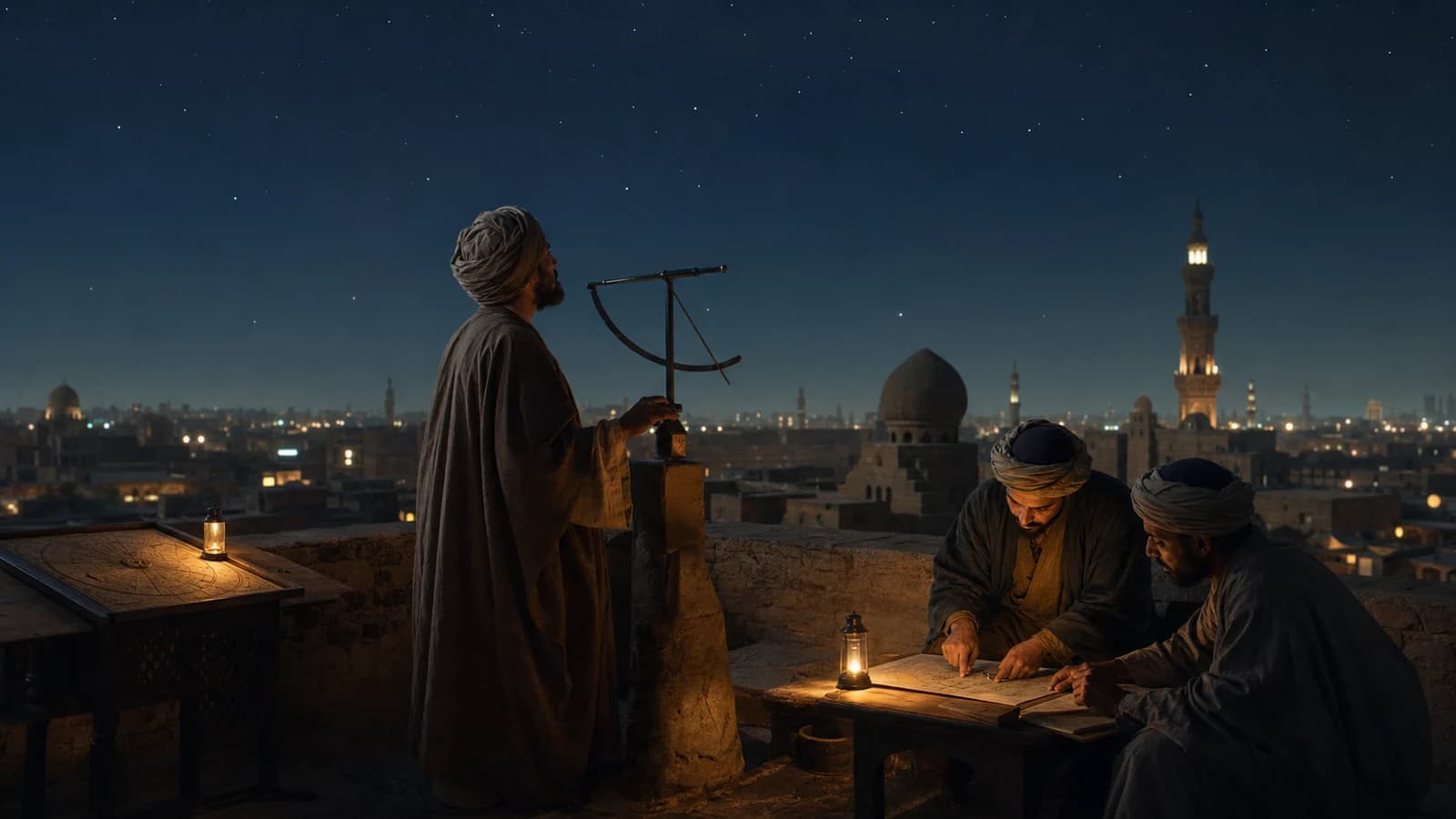
The cover image is an original AI-assisted Fatimid Cairo reconstruction, not a portrait or depiction of a documented observing session.
Sources
- MacTutor: Ibn Yunus — biography, observations and tables.
- Biographical Encyclopedia of Astronomers: Ibn Yunus — scholarly entry and bibliography.
- UNESCO: Heritage Sites of Astronomy and Archaeoastronomy — historical observing and table-making context.


