Uyghur Heritage Language for Children: Literacy and Family Guide
A research-based guide for Uyghur families and community schools covering home language, Arabic-script literacy, mixed proficiency, curriculum, assessment and child safeguarding.
A child can understand Uyghur at home yet answer in another language, speak fluently but not read Arabic script, or read prepared texts without comfortable conversation. These are normal differences in heritage-language development, not proof that a family has failed. Effective teaching begins with each learner's actual listening, speaking, reading and writing profile. It connects meaningful family communication with explicit literacy instruction, age-appropriate literature and consistent practice. This guide draws on diaspora education and Kazakhstan schooling research while distinguishing community goals, school policy and evidence about individual learners.
Key points
- Listening, speaking, reading and writing develop unevenly and should be assessed separately rather than reduced to fluent or not fluent.
- Uyghur Arabic-script literacy needs systematic sound-letter, word, spelling and reading practice; conversation alone does not produce it automatically.
- A sustainable program needs trained teachers, sequenced materials, attendance records, child protection, family feedback and transparent finances.
- The goal can be additive multilingualism: maintaining Uyghur while children gain full access to the languages of school and wider society.
Understand the heritage-language learner
Heritage learners differ from both first-language pupils in a Uyghur-medium school and adult foreign-language beginners. They may know family vocabulary, pronunciation and cultural references but lack academic words and literacy. Placement should sample real skills instead of using age, surname or parental confidence as a proxy.
Ask about languages used with each caregiver, siblings, friends, school, media and religious settings. The aim is not to police families but to find opportunities. A child who avoids speaking may need safer conversation and peer relationships, not more public correction.
Build Arabic-script literacy explicitly
Uyghur's modified Arabic alphabet represents vowels more explicitly than ordinary Arabic orthography, but right-to-left direction, joining forms and spelling still require instruction. Teach a planned sequence with handwriting, decoding, word recognition, sentence reading and meaningful texts. Do not assume Qur'anic letter familiarity equals Uyghur reading.
Romanization can support search, keyboards or early comparison, but it should not silently replace the target script when the program's goal is Uyghur literacy. Label the romanization system and move learners toward original-script reading with enough time and accessible type.
Home routines that protect relationships
Regular conversation, stories, cooking, songs, voice messages and calls with relatives give language a purpose. Choose routines families can sustain rather than an all-or-nothing rule that turns every interaction into correction. Adults can model new words and recast a sentence without refusing to understand a child.
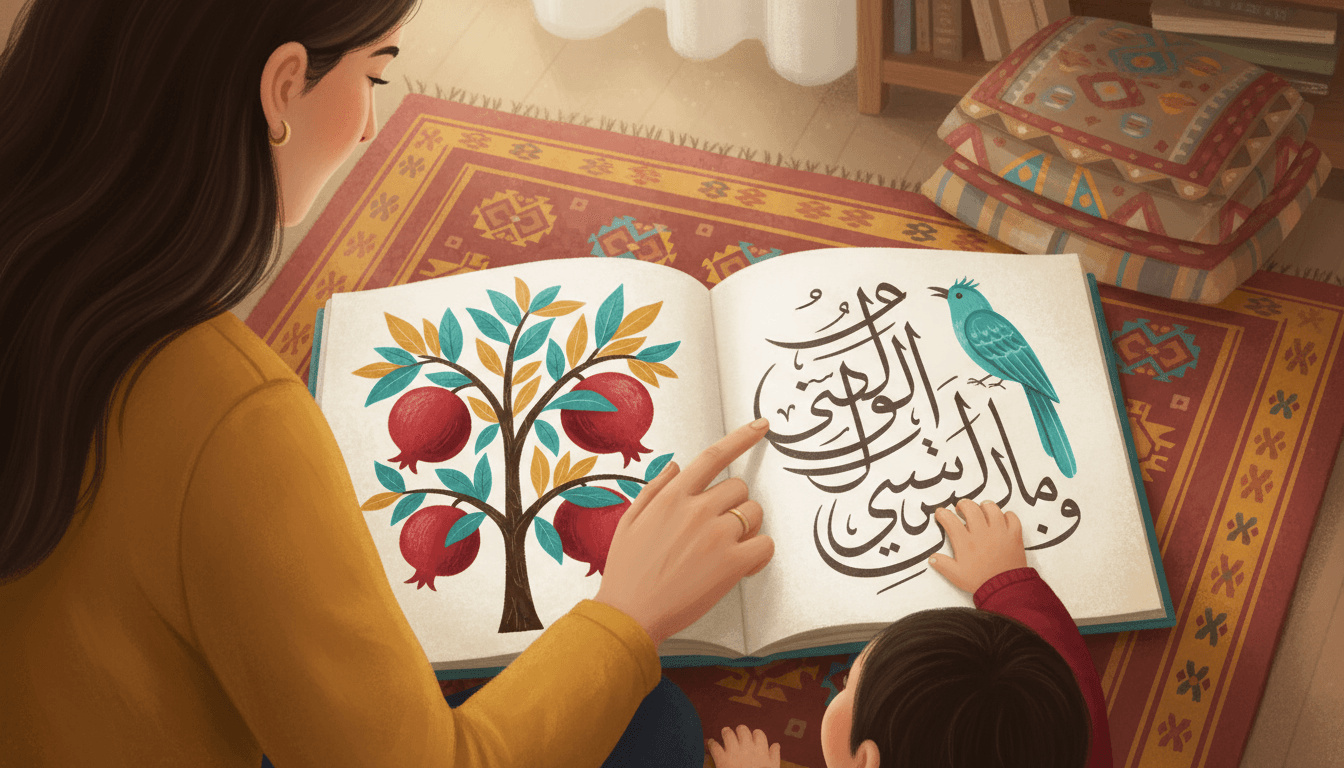
Read together even when the adult is also learning the script. Audiobooks or recorded relatives can pair sound with text. Protect consent and privacy when sharing family recordings with a class or platform. A child's mistakes should not become public entertainment.
Curriculum and teacher support
A curriculum maps outcomes across terms and levels: oral interaction, vocabulary, decoding, fluency, comprehension, writing, literature and cultural inquiry. A collection of holiday worksheets is not a sequence. Teachers need preparation for mixed ages, multilingual classrooms and learners with different literacy backgrounds.
Research on non-formal Uyghur education in Türkiye and community-school work shows why institutions matter. Programs should publish attendance expectations, safeguarding contacts, fees and learning aims. Volunteer energy is valuable, but burnout and turnover require shared lesson plans and mentoring.
Assessment without shame
Use short, repeated tasks: follow instructions, retell a story, read new words, read a passage, write a message and discuss a book. Compare a learner with their own earlier work and a clear progression. One high-stakes recital rewards memorization and confidence more than broad language ability.
Share results privately with child and family and agree on the next attainable step. Avoid ranking children publicly by ethnic authenticity. Where a learning difficulty is suspected, seek qualified assessment that understands multilingual development instead of assuming exposure to several languages caused the problem.
Measure program health and continuity
Track enrollment, regular attendance, retention, teacher stability, reading growth, family satisfaction and safeguarding incidents with minimal personal data. A large registration number may conceal low participation. Report methods and denominators so donors and families can interpret results.
Connect learners with literature, music, history and digital archives through same-language resources, while keeping claims sourced and age appropriate. Long-term success is not one perfect speaker; it is a community where children can choose to use, read, create and transmit Uyghur alongside their other languages.
How to read the evidence
Separate primary records, academic research, organizational reports and official statements. Record the source's date, place, method and scope. Evidence about one object, performance, interview or country does not by itself establish a permanent characteristic of an entire community.
Related reading
- Uyghur Diaspora Schools: Language, Faith and Cultural Survival
- Uyghur Language and Scripts: Arabic Alphabet, Latin and Cyrillic
- Uyghur Literature and Poetry: Oral Traditions, Print and Diaspora
- Uyghur Digital Archives: Preservation, Metadata and Rights
Sources
These sources have different evidentiary roles. Their inclusion makes claims checkable and does not imply acceptance of every interpretation in a source.
- UCLA National Heritage Language Resource Center — Uyghur Heritage Language Education — University resource on community language classes, heritage-language learners and challenges across the Uyghur diaspora.
- Journal of Language, Identity & Education — Cultural survival for Uyghur immigrants in Turkey — Peer-reviewed study of non-formal education, language maintenance and cultural transmission in Istanbul.
- Nazarbayev University — Uyghur-language instruction under trilingual education — Repository record for a Kazakhstan case study of Uyghur-medium schooling and trilingual education policy.
- Marmara University — Religious education activities of Uyghurs in Türkiye — Academic study of named diaspora institutions and education activities in Türkiye since 2016.
- UHRP — Humanitarian Needs Assessment of the Uyghur Diaspora — Advocacy research on education, language, livelihood, family separation and support needs across diaspora communities.
- Library of Congress — ALA-LC Uighur romanization table — Current cataloguing authority for a defined Uyghur romanization system; not a universal personal-name rule.


