How Zellij Tilework Turns Cut Tiles into Geometric Mosaics
Understand zellij through individual glazed pieces, fitted star patterns and dated works from Fez and the Alhambra, including modern craftsmanship and historic repairs.
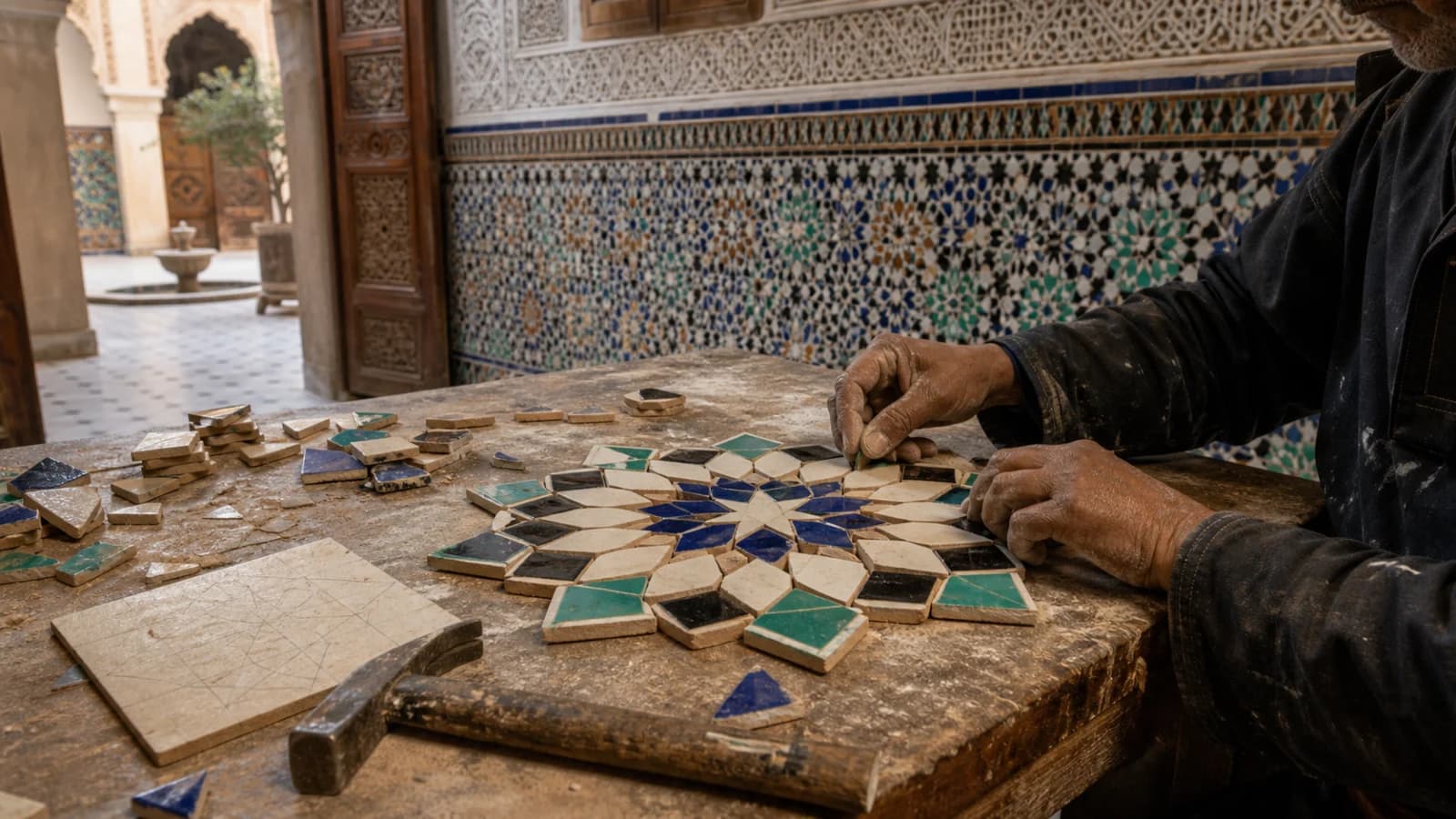
Zellij is tile mosaic made by fitting individual glazed ceramic pieces into a larger composition. It is closely associated with Morocco and the architectural traditions of the western Islamic world. Its stars and interlacing bands are built across real pieces and joints: the design is an arrangement of material, rather than simply a picture drawn on a tile.
The spellings zillij and zilij also occur in museum publications. For related cut-tile work at the Alhambra in Granada, Spanish records use alicatado. Comparing named works is more useful than treating every star-patterned surface as one technique. A modern Moroccan installation, a medieval Nasrid panel and a later plaster imitation can resemble one another while having different materials and histories.
From a glazed tile to a fitted mosaic
The Alhambra's account of the Sala de la Barca wall covering describes ceramic pieces cut from square glazed tiles. A colored glassy surface covers a clay body. Cutting provides the shapes needed for the composition; assembling those shapes produces the larger pattern. The small piece, the glazed face and the finished panel are therefore three different things to examine.
To understand the assembly, imagine a paper version. Choose a star center, cut matching surrounding polygons and lay them together without overlapping their edges. Now change one polygon's width. Its neighbors must move or leave a gap, and that change can disturb the next star. This exercise explains why accurately fitting the connecting pieces matters as much as drawing the most conspicuous motif. It is a demonstration of the assembly problem, not a reconstruction of a documented medieval workshop procedure.
A painted geometric tile offers a different arrangement: multiple colored shapes can lie within a single ceramic support. In a cut-tile mosaic, part of the drawing is carried by the boundaries of separate pieces. Start by asking where the physical joints lie. Do they surround the small colored shapes, or does an intact square tile carry several shapes within its face? Surface pattern and ceramic format should be recorded separately.
That distinction also prevents confusion with mosaic as a broad category. Our examination of Khirbat al-Mafjar's architectural mosaics concerns a different setting and material history. The word “mosaic” describes assembly from pieces; it does not by itself identify Moroccan glazed tilework.
Reading one composition in the Sala de la Barca
The Alhambra assigns the Sala de la Barca tile dado to Muhammad V's work in the Comares Palace around 1369. Its description identifies white bands forming octagons, with black or blue eight-point stars inside. Four black and four green pieces surround the stars. These details belong to this particular composition, not to a compulsory palette for all zellij.
Read it in two passes. First follow the white bands and locate their octagonal enclosures. Then look at the colored pieces within each enclosure. The band organizes the field, while the star supplies a center. Counting the star's points alone misses the role of the surrounding pieces and the shared connections between neighboring units. A complete description needs both the recognizable motif and the network that links it to the next one.
The exercise also makes color's structural role easier to see. If you mentally give every piece the same color, some boundaries remain legible through joints, but the white-band route becomes harder to follow. Color can group separate pieces into one apparent line or distinguish a center from its surroundings. This is an observation about how the recorded composition can be read, rather than evidence for a universal symbolic meaning of white, green, black or blue.
An octagon, an eight-point star and eight surrounding pieces are different counts. Keep the outline, the central motif and the pieces around it separate when comparing photographs. Similar numerical descriptions can refer to different levels of a design.
How a repeating design fits a particular wall
A repeat is not the entire architectural problem. A panel has a width, a height, edges and neighboring surfaces. The Alhambra's Dar al-Árusa panel account, describing a survival from the palace on the Cerro del Sol, emphasizes the choice of a design and its proportions for a given architectural space. The frame and the field have to work together.
Consider a simple layout exercise: place three equal star-centered units inside a rectangle. Widen the rectangle slightly while keeping the units unchanged. You must now decide whether to enlarge the border, alter the spacing or change the unit's scale. Each decision changes the relationship between the center and the edge. This illustrates the fitting problem discussed in the museum's account; it does not establish which option the maker of a lost panel actually selected.
The Mexuar panel description, published in April 2011, gives a more specific geometric case. It identifies a square-and-octagonal framework formed by superimposing a diagonal square grid on another square grid. The central field combines eight- and sixteen-point arrangements, while narrower bands carry interlacing colored ribbons. The museum describes the ceramic elements as cut or molded monochrome glazed pieces.
This last detail limits sweeping claims about manufacture. A museum's record of molded pieces should not be replaced with an assertion that every element was cut by the same method. For the geometry behind repeat units, see our separate guide to circles, grids and repeating stars. Here the question is how the composition takes physical shape and occupies its allotted surface.
Fez and the continuity of architectural craft
Fez provides an architectural setting for the craft, rather than a date for every tile that survives there. UNESCO's Medina of Fez record places the city's major Marinid development in the thirteenth and fourteenth centuries and recognizes the survival of architectural knowledge and decoration trades. The medina entered the World Heritage List in 1981. That is an inscription of the historic city; it should not be presented as a separate UNESCO inscription of zellij.
In an April 2017 account, Met researcher Courtney A. Stewart describes the Bou Inania madrasa, built around 1350, with polychrome zellij, carved stucco and cedar woodwork. She also identifies the continuation of mosaic tilework in the Hassan II Mosque in Casablanca, completed in 1993. The two buildings make the distinction between a continuing visual vocabulary and the age of an individual installation concrete.
Compare the materials before comparing the stars. A tiled lower wall, a carved plaster surface and a wooden ceiling can all use patterned ornament, but they are made and maintained differently. A photograph of the whole courtyard may compress these layers into one decorative impression. Looking at their boundaries restores the distinction between ceramic assembly, plaster carving and woodworking.
Continuity does not mean that every later maker reproduced every earlier operation without change. It means the named buildings provide evidence for related forms and materials in different periods. Dating a building, dating a surviving panel and identifying a repair remain separate questions.
What the Met's 2011 Moroccan Court demonstrates
The Patti Cadby Birch Moroccan Court is a documented modern work that makes those layers visible. The Met's educator publication, Unit 3, credits its onsite creation in 2011 to the Naji family and Arabesque, Inc., from Fez. The walls place colored cut tilework below carved stucco, with carved wood in the upper register. The installation also includes acquired Nasrid marble columns dated approximately 1350–1400.
The courtyard therefore combines contemporary craftsmanship with older objects. Its tilework should not be labeled a medieval room transported intact from Morocco or Granada. Equally, calling it modern does not make its craft process imaginary: the museum identifies its makers, construction date and materials. A reliable account can acknowledge both the historical models and the newly made architectural setting.
In Julia Rooney's April 2015 gallery account, the court's tastir pattern uses 70 different shape types, individually cut and assembled into eight- and sixteen-point stars. Seventy describes the types used in this installation. It is neither the number of pieces in every panel nor a formula that all zellij must follow.
The example shows why a complete panel can involve far more than one star template. Centers, connectors and boundaries contribute to the field. When discussing complexity, identify what was counted: star points, repeated centers, individual pieces or distinct piece types. Mixing these categories produces impressive numbers without a clear description of the work.
Similar stars can belong to different material traditions
Cut ceramic mosaic is not confined to the western Islamic world. The Art Institute of Chicago's Twelve-Point Star, accession 1925.40, is dated to the late fifteenth century and attributed to Iran or Central Asia. Its record identifies glazed fritware tiles cut and reassembled as a mosaic. It also notes that other surviving star tiles from the period were commonly fired as single pieces.
This comparison separates the outline of a finished object from the way it was made. A star-shaped object can be one ceramic piece or an assembly of smaller pieces. Conversely, an assembly can contain a star that is only one part of a much larger rectangular field. The outer silhouette cannot resolve the material question by itself.
The Chicago work includes flowers and scrolls in turquoise and cobalt. Geometric structure and vegetal ornament can thus operate at different levels of the same work. Our article on arabesque leaves and scrolls explores the latter vocabulary. Broader claims that all Islamic art excludes imagery also require qualification, as our museum examples of people and animals explain.
The Chicago record proposes a pulpit, a grand hall or a madrasa as possible settings for the mosaic. Those alternatives remain possibilities. Neither its star shape nor its material supplies a definite original building, and calling it Moroccan zellij would discard the museum's stated regional attribution.
When a tile-like surface is a historic restoration
Appearance becomes especially misleading after restoration. A 2021 study by Pilar de Hoyos Alonso, Isabel Sánchez Marqués and Fernando Guerra-Librero in Cuadernos de la Alhambra examines the Sala de los Reyes dado. In 1858–59, Rafael Contreras replaced damaged tiling with plaster reproductions imitating the original glazed ceramic decoration. Persistent moisture continued to damage the replacements.
The authors discuss the 2011–12 conservation work on both surviving original material and the nineteenth-century reproductions. The later layers had themselves become part of the hall's history. The case demonstrates why an apparently continuous geometric surface may contain more than one material and more than one period of intervention.
For a visitor, the useful question is which parts are original ceramic, which are later additions and what the conservation record establishes. A matching design does not establish matching material. Nor can a photograph alone identify the source of deterioration or justify a treatment. Cosmetic similarity and the building's moisture problems are separate issues; this article is not a repair specification.
The cover illustration is an AI-assisted craft reconstruction, not a photograph of a particular historic workshop, monument or surviving panel. Use the linked museum and conservation records for the named works. Their dates and material descriptions allow a stronger comparison than the illustrated appearance alone.
Sources
- Alhambra, Sala de la Barca tile dado — cut glazed pieces and the composition associated with Muhammad V around 1369.
- Alhambra, Mexuar tile panel — April 2011 description of piece formation, overlapping grids and interlace.
- Alhambra, Dar al-Árusa tile panel — modules, proportions and the design's fit to architectural space.
- UNESCO World Heritage Centre, Medina of Fez — city history, 1981 inscription and architectural craft continuity.
- The Met, Traveling to Morocco — April 2017 account comparing Bou Inania and the Hassan II Mosque.
- The Met, Geometric Design in Islamic Art, Unit 3 — Moroccan Court materials, makers, 2011 construction and older columns.
- The Met, Anatomy of a Gallery — April 2015 account of the court's 70 shape types and star arrangements.
- Art Institute of Chicago, Twelve-Point Star — accession 1925.40, cut fritware mosaic and qualified regional attribution and original uses.
- Cuadernos de la Alhambra 50, Sala de los Reyes dado restoration — 2021 research on ceramic remains, nineteenth-century plaster imitations and conservation.


