Tiraz Textiles: Inscriptions, Caliphal Workshops and Status
What tiraz textiles were, how their inscriptions recorded rulers and workshops, and why surviving fragments must be read as both cloth and political evidence.
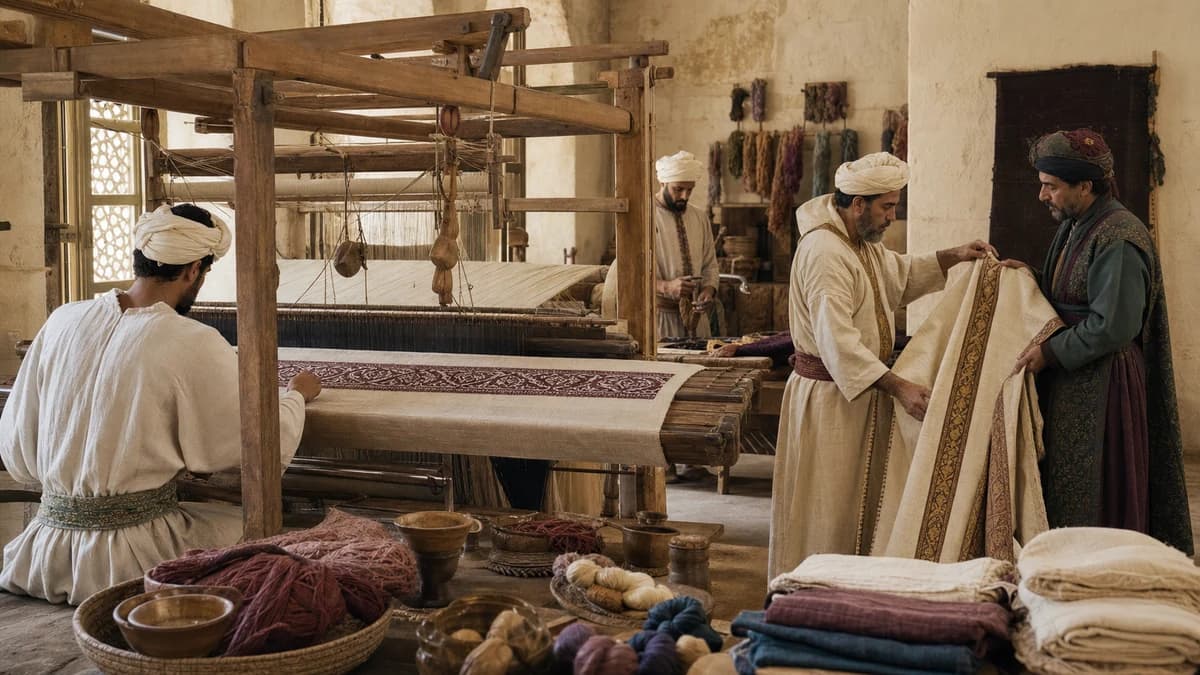
The cover image is an original AI-assisted historical reconstruction, not a photograph of a surviving tiraz textile or named workshop.
What the inscription can record
A tiraz band may include blessings, the name and titles of a caliph or ruler, a workshop, a date and a formula describing manufacture. These details make textiles unusually valuable historical documents. Yet fragments are often incomplete, so editors must distinguish what the cloth actually says from a museum reconstruction of the missing formula.
Arabic script also operated visually. Repeated verticals, elongated letters and contrasting silk could make words legible from a distance while integrating them into the garment’s design. Reading the text and studying weave structure are therefore complementary tasks.
Production was not one uniform system
Sources distinguish official and private production, but the boundary was not always stable. Court-supervised workshops could make prestigious cloth, while commercial weaving centers produced textiles for broader markets. A workshop name in an inscription does not mean every stage—from spinning to finishing—occurred in one room.
Linen and wool grounds, silk tapestry bands, embroidery and dyed patterns all appear among surviving examples. Egypt’s dry conditions preserved many fragments, which can distort the apparent geography of production. Survival is evidence about climate and collecting as well as medieval consumption.
Robes of honor made politics wearable
Rulers bestowed garments to recognize office, service or favor. Wearing such cloth publicly materialized a relationship with the giver. Textiles also moved through diplomacy, inheritance, trade and reuse; a prestigious band could be cut from its original garment or later preserved in a burial or treasury.
This mobility is why “royal textile” should not be treated as a complete biography. Fiber analysis, inscription, archaeological context and later collecting history must be assembled before assigning an object to a specific ceremony.
How to examine a tiraz fragment
- Read only the preserved letters before completing a conventional formula.
- Identify fiber, weave and the technique used for the inscription.
- Separate the date of manufacture from later reuse and acquisition.
- Ask whether the attribution describes a ruler, workshop, region or modern collection category.
Tiraz survives at the intersection of text and touch. Its political message mattered because it was carried on a valuable material, worn on a moving body and seen in public.
Sources
- The Met: Tiraz—Inscribed Textiles from the Early Islamic Period — terminology, manufacture and robes of honor.
- The Met: Tiraz Textile Fragment — an object record connecting inscription, material and date.
- Victoria and Albert Museum: Islamic Middle East Collection — collection context for Islamic textiles and court arts.


