Tashahhud (At-Tahiyyat) in Arabic, Its Meaning and When to Recite It
Read the Arabic and meaning of Tashahhud from Ibn Masʿud and Ibn ʿAbbas. Learn when to recite At-Tahiyyat in the first and final sittings of salah.
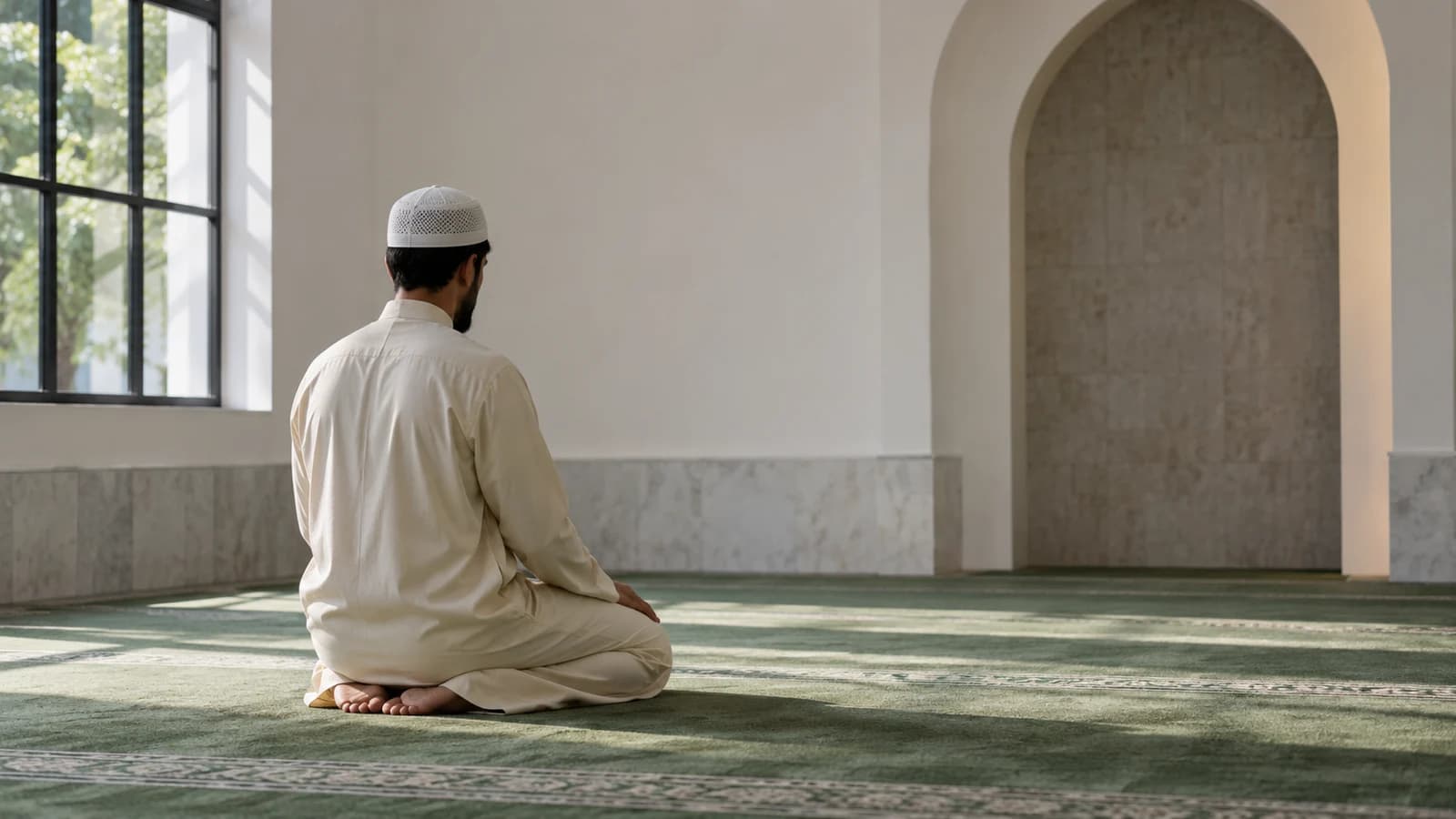
Tashahhud, often called At-Tahiyyat, is the recitation that begins with greetings of honor to Allah and ends with the testimony of faith. Recite it while seated after the second prostration of the second rakʿah. In a prayer with three or four rakʿahs, recite it again in the final sitting. In a two-rakʿah prayer such as Fajr, the sitting after the second rakʿah is already the final one. The two Arabic wordings below come from reports by Ibn Masʿud and Ibn ʿAbbas and each can be read as a complete recitation.
The name tashahhud refers to bearing witness. At-Tahiyyat means “the greetings” and names the recitation by its first word. You may see either term on a prayer card, as well as spellings such as Attahiyyat. The passage is transmitted in hadith. In Sahih Muslim 402a, Ibn Masʿud describes the Prophet Muhammad teaching his companions what to say while seated in prayer. In the Arabic shown here, optional punctuation marks the four parts for reading, and the English renderings explain their meaning.
Ibn Masʿud’s At-Tahiyyat in Arabic and English
In Sahih al-Bukhari 831, Ibn Masʿud reports this wording. The Prophet tells the companions that Allah Himself is As-Salām, the source of peace, before teaching them which greetings the companions should say. The report places an explanation after the third part and then gives the testimony. The four parts of the recitation appear together below. Read each phrase across the Arabic, romanized pronunciation and meaning before moving to the next line.
التَّحِيَّاتُ لِلَّهِ وَالصَّلَوَاتُ وَالطَّيِّبَاتُ At-taḥiyyātu lillāhi waṣ-ṣalawātu waṭ-ṭayyibāt. All greetings of honor, all prayers and all good things belong to Allah.
السَّلَامُ عَلَيْكَ أَيُّهَا النَّبِيُّ وَرَحْمَةُ اللَّهِ وَبَرَكَاتُهُ As-salāmu ʿalayka ayyuhan-nabiyyu wa raḥmatullāhi wa barakātuh. Peace be upon you, O Prophet, and may Allah’s mercy and blessings be upon you.
السَّلَامُ عَلَيْنَا وَعَلَى عِبَادِ اللَّهِ الصَّالِحِينَ As-salāmu ʿalaynā wa ʿalā ʿibādillāhiṣ-ṣāliḥīn. Peace be upon us and upon Allah’s righteous servants.
أَشْهَدُ أَنْ لَا إِلَهَ إِلَّا اللَّهُ وَأَشْهَدُ أَنَّ مُحَمَّدًا عَبْدُهُ وَرَسُولُهُ Ashhadu an lā ilāha illallāhu wa ashhadu anna Muḥammadan ʿabduhu wa rasūluh. I bear witness that no one is worthy of worship except Allah and that Muhammad is His servant and messenger.
The opening assigns the greetings, the prayers and the good things to Allah. Then the supplication turns to peace for the Prophet. The phrase wa raḥmatullāhi wa barakātuh adds Allah’s mercy and His blessings. The next greeting includes those praying and widens further to every righteous servant. In Ibn Masʿud’s narration, the Prophet explains that the words reach every righteous servant of Allah in the heavens and on earth. This is the significance of “us” followed by a wider group in the third part.
The last line begins with a word meaning “I bear witness” and uses it again before naming Muhammad. Its two statements express the shahada, the declaration of faith. The last words in this form, ʿabduhu wa rasūluh, refer to Muhammad as Allah’s servant and messenger. The report in Muslim then speaks about making supplication. That instruction comes after the words of the testimony.
Ibn ʿAbbas’s wording in Sahih Muslim
In Sahih Muslim 403a, Ibn ʿAbbas recalls that the Prophet taught them the tashahhud with the care he took when teaching a surah of the Quran. The comparison describes how he taught it. The source of this recitation is that hadith. Here is the full wording of this report, with the same four-part layout to help you follow it beside the first version.
التَّحِيَّاتُ الْمُبَارَكَاتُ الصَّلَوَاتُ الطَّيِّبَاتُ لِلَّهِ At-taḥiyyātul-mubārakātuṣ-ṣalawātuṭ-ṭayyibātu lillāh. Blessed greetings, prayers and good things belong to Allah.
السَّلَامُ عَلَيْكَ أَيُّهَا النَّبِيُّ وَرَحْمَةُ اللَّهِ وَبَرَكَاتُهُ As-salāmu ʿalayka ayyuhan-nabiyyu wa raḥmatullāhi wa barakātuh. Peace be upon you, O Prophet, and may Allah’s mercy and blessings be upon you.
السَّلَامُ عَلَيْنَا وَعَلَى عِبَادِ اللَّهِ الصَّالِحِينَ As-salāmu ʿalaynā wa ʿalā ʿibādillāhiṣ-ṣāliḥīn. Peace be upon us and upon Allah’s righteous servants.
أَشْهَدُ أَنْ لَا إِلَهَ إِلَّا اللَّهُ وَأَشْهَدُ أَنَّ مُحَمَّدًا رَسُولُ اللَّهِ Ashhadu an lā ilāha illallāhu wa ashhadu anna Muḥammadan rasūlullāh. I bear witness that no one is worthy of worship except Allah and that Muhammad is the Messenger of Allah.
This version adds al-mubārakāt, “blessed,” to the opening and places lillāh, “for Allah,” at the end of that phrase. The two greetings of peace in the middle remain the same. At the end it says rasūlullāh, “the Messenger of Allah.” If a prayer booklet starts with At-taḥiyyātul-mubārakāt and finishes with rasūlullāh, both features fit the wording narrated by Ibn ʿAbbas.
Egypt’s Dar al-Ifta compares the two reports and identifies both as forms transmitted from the companions. When memorizing, keep the beginning and ending of your chosen report together. A useful exercise is to use the two shared greetings as the middle of your practice, then repeat the opening and ending belonging to the same source. If you are learning in a mosque, a prayer teacher can show you which wording is used in your class and listen to your pronunciation.
When to recite Tashahhud in the five daily prayers
Count completed rakʿahs. A rakʿah includes two prostrations. The sitting between them is brief, and the sitting for Tashahhud occurs after the second prostration of the relevant rakʿah. Sahih al-Bukhari 828 describes the Prophet’s sitting in the second rakʿah and again at the end of his prayer. The distinction is easiest to track by asking whether the prayer continues to another rakʿah after you sit.
| Obligatory prayer | First sitting before another rakʿah | Final sitting |
|---|---|---|
| Fajr, two rakʿahs | There is no separate first sitting | After rakʿah 2 |
| Maghrib, three rakʿahs | After rakʿah 2 | After rakʿah 3 |
| Dhuhr, Asr and Isha, four rakʿahs | After rakʿah 2 | After rakʿah 4 |
In Maghrib, complete the two prostrations of the second rakʿah and stay seated for At-Tahiyyat. Then rise for the third. After both prostrations of the third, remain seated for the final Tashahhud. In a four-rakʿah prayer you continue for two rakʿahs after the middle sitting. Fajr ends after only two, so proceed as you would for the final sitting when you recite on the second. These positions concern the regular obligatory units of the five prayers. The Witr prayer guide covers a separate prayer with its own forms.
What changes between the first and final sittings?
The first sitting in a three- or four-rakʿah prayer comes in the middle of the sequence. The final sitting leads to the conclusion. At-Tahiyyat in both places includes the testimony. “First” and “final” therefore describe the position of the sitting. They also help explain why the final sitting ordinarily includes further recitations before the prayer closes.
The Malaysian Federal Territories Mufti Office’s explanation of final sitting discusses iftirāsh, a sitting supported on the left foot, and tawarruk, in which the person sits on the floor with the left leg folded to the side. It describes how jurists apply the postures at different sittings, including a disagreement about the final sitting of a two-rakʿah prayer. The way a person is sitting is therefore an unreliable cue for looking up which words they are saying. Count the rakʿahs and follow the practice of your school when learning posture.
The details of what follows the first Tashahhud can also differ by school. In its Hanafi answer on moving from the first sitting, SeekersGuidance teaches standing for the next rakʿah directly after Tashahhud. Dar al-Ifta’s comparison explains that Shafiʿi jurists recommend a short blessing upon the Prophet in the first sitting. That short blessing is distinct from the fuller Abrahamic formula commonly recited later. These are differences about what follows the testimony in the middle sitting. Both accounts locate Tashahhud itself before rising.
Salawat, supplication and the closing salam
The two greetings of peace within At-Tahiyyat occur before the testimony, while still seated. Salat Ibrahimiyyah, the Abrahamic blessing, is a separate recitation asking Allah to bless Muhammad and his family, with reference to Ibrahim. In Sahih al-Bukhari 6357, the companions say that they know how to greet the Prophet and ask how to invoke blessings upon him. The report supplies the blessing. It helps identify why the words on a prayer card after the testimony may belong to another recitation even though the card prints them together.
In the usual final-sitting sequence, the testimony is followed by blessings upon the Prophet, then a supplication may be made before taslim, the closing salam. The legal weight of the additional recitations differs by school. SeekersGuidance’s Hanafi explanation of the wording calls sending blessings on the Prophet in the final sitting a sunna. A guide to dua and salah explains why a supplication within the ritual and the whole ritual have different names. When looking for the words of At-Tahiyyat alone, stop at the last words of the testimony in the chosen hadith.
How to learn the words and keep your place
Learn the four lines as units with distinct purposes. Begin with the opening that directs greetings and good things to Allah. Add the greeting for the Prophet, then the greeting for those praying and all righteous servants. Complete the recitation with the testimony. Use the romanized line as a reading aid, and work with a teacher or Arabic recitation for sounds that a Latin letter cannot convey well. For example, ḥ in raḥmatullāhi and ʿ in ʿalayka represent different Arabic sounds. Read the meaning before reciting the Arabic so each change of addressee is clear.
Practice thinking through the position alongside the words. Picture the second rakʿah in Maghrib, then rehearse the same words for its final sitting after the third. Compare that with Fajr, where there is one Tashahhud at the close. If what you need is guidance after you have stood up without the first sitting, see the guide to sujud al-sahwi and a forgotten sitting. That question concerns how to respond to an omission. For memorizing the words themselves, choose a report, learn its phrases as a whole and use the number of completed rakʿahs to recognize whether the sitting is intermediate or final.