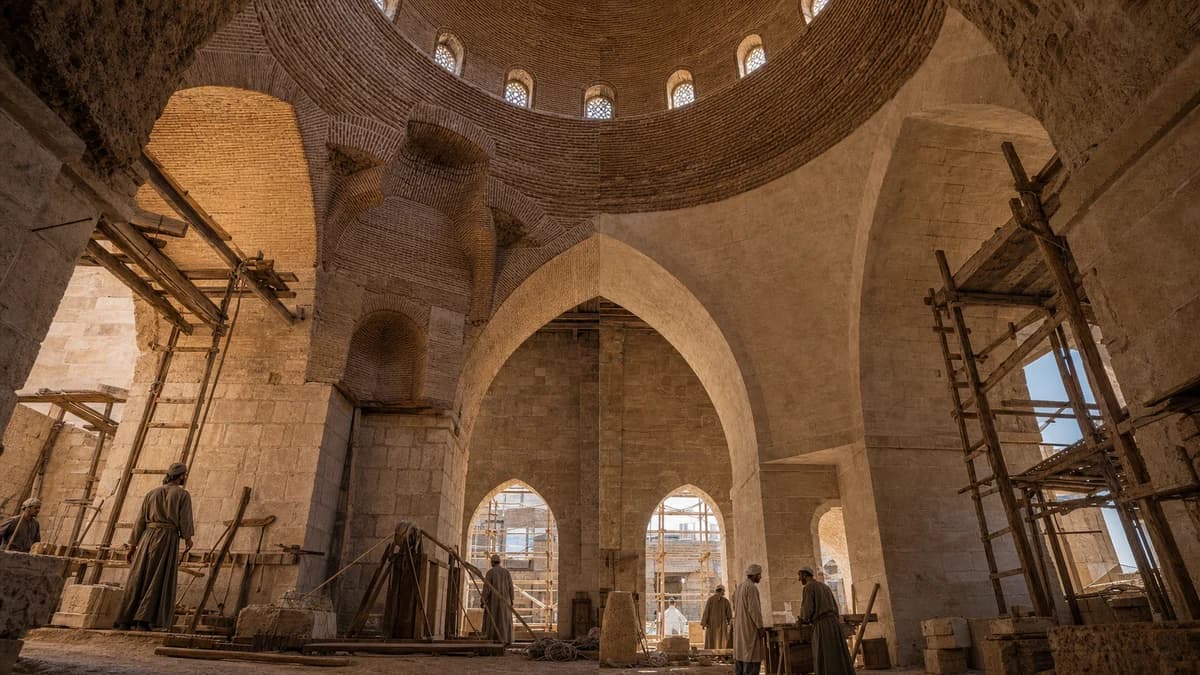
Squinch vs Pendentive: How Domes Rise Over Square Rooms
A visual guide to squinches and pendentives: how each carries a dome over a square bay, how to tell them apart, and why decoration can obscure the structure.
A circular dome does not sit naturally on four straight walls. Builders need a transition that gathers the dome’s load and directs it into the corners or supports below. Two famous solutions are the squinch and the pendentive. They can occupy the same part of a building, but they do not create the same geometry.
The cover image is an original AI-assisted architectural reconstruction, not a photograph or survey of a specific monument.
What a squinch does
A squinch bridges a corner. In its simplest form, a small arch spans diagonally across the meeting of two walls, turning a square room into an octagonal support zone. Builders can stack arches, niches, corbelled courses or faceted cells above that bridge until the outline is close enough to a circle for a dome or drum.
This family of solutions is visually diverse. At the Alai Darwaza in Delhi, for example, arches and squinches mediate between the square bay and the dome. In later buildings the structural transition may be covered by muqarnas, so the eye sees a field of decorative facets while the load is still gathered through a corner support.
What a pendentive does
A pendentive is a curved triangular surface cut conceptually from a sphere. Four pendentives rise from four arches and meet the circular base of a dome. Instead of placing a small bridge across each corner, they create a continuous curving transition between the square bay below and the circle above.
The clean textbook distinction becomes harder in real buildings. Pendentives can be ribbed, painted or hidden by plaster; squinches can become highly curved and elaborate. Ottoman domed architecture also combines several levels of arches, half-domes, piers and transitional forms, so identifying one visible triangle does not explain the whole structural system.
How to tell them apart
- Look below the dome rather than at its decoration.
- If a distinct arch, niche or corbel spans each corner, the transition is probably squinch-based.
- If four smooth concave triangles rise between four large arches, they are pendentives.
- Trace where the load continues into piers or walls; ornament alone can mislead.
A dome may also sit on a drum, an octagon or multiple transition zones. The correct question is not simply “Which shape do I see?” but “How does this sequence change the plan, and where does it send the weight?”
Why the distinction matters
Squinches and pendentives show how builders adapted inherited masonry knowledge to new scales, materials and visual ambitions. Neither belongs exclusively to one faith or region. Byzantine, Sasanian, Islamic and later architectural traditions exchanged and transformed domed construction. Naming the device precisely helps explain that history without claiming that one culture invented every form it used.
Sources
- Smarthistory: The Qutb Complex and Early Sultanate Architecture — a documented squinch in an early Delhi Sultanate dome.
- Smarthistory: Mimar Sinan, Mosque of Selim II — dome supports, squinches and muqarnas in an Ottoman monument.
- Smarthistory: Common Types of Mosque Architecture — comparative architectural context across regions.


