Samanid Epigraphic Pottery: When Kufic Script Shaped the Bowl
How black slip inscriptions, white grounds and carefully paced Kufic letters turned everyday advice and blessings into the main design of eastern Iranian bowls.
Some of the most striking ceramics associated with the Samanid period carry almost no pictorial decoration. A dark Arabic inscription sweeps around a pale bowl, and the words themselves become the composition. These vessels were made in eastern Iran and Central Asia during the ninth and tenth centuries, with important finds from Nishapur and Afrasiyab.
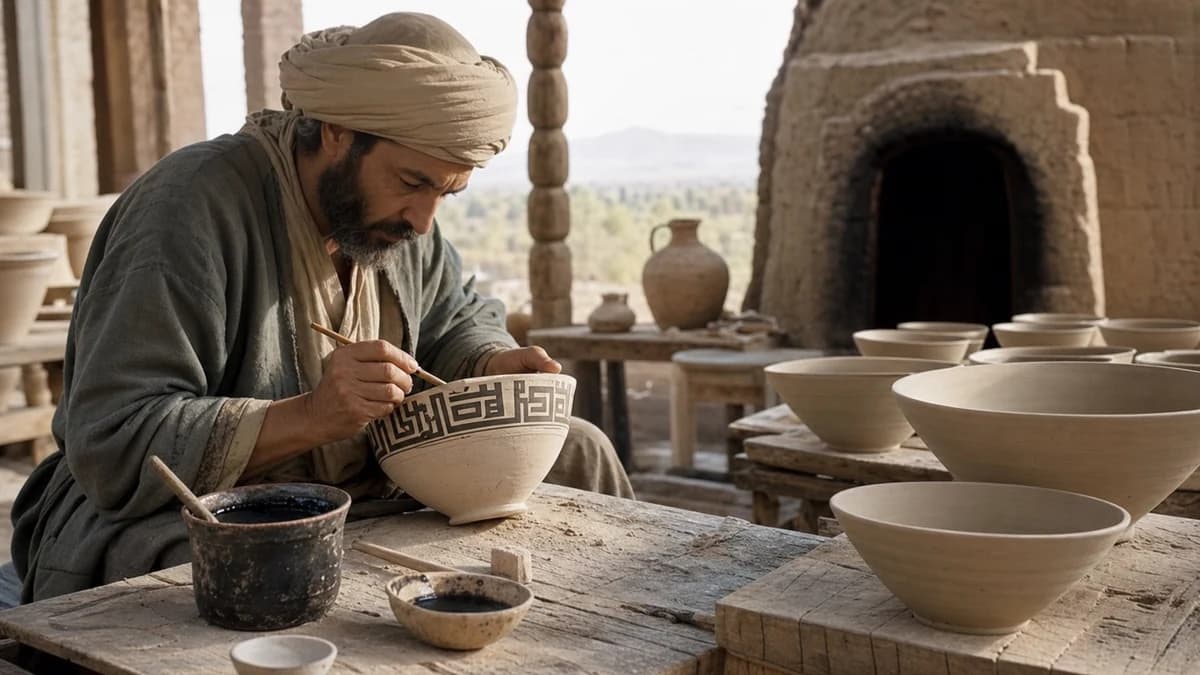
The cover image is an original AI-assisted archaeological reconstruction, not a photograph of an excavated bowl.
Slip made the contrast possible
Potters coated an earthenware body with a light-colored slip, painted the inscription in a dark slip and covered the surface with a transparent glaze. The result could evoke the visual contrast of black ink on paper or white-glazed imported ceramics without requiring a porcelain body.
Technique varied across workshops. Some bowls add red accents, vegetal curls or pseudo-writing. “Samanid pottery” is therefore a useful historical grouping, not proof that every object was commissioned by the dynasty or made in one center.
The inscription controls the whole surface
Letters stretch, contract and turn to fill the circumference. Ascenders create rhythm; spaces can be adjusted so a phrase closes neatly. The bowl’s center may remain empty, allowing the text to frame food before becoming fully visible when the vessel is cleared.
Common messages praise generosity, patience, knowledge or good fortune. A documented Met bowl offers “blessing and well-being to the owner,” arranging its words for visual balance rather than ordinary grammar. Translations differ because early angular script can omit dots and because damaged letters invite reconstruction.
Excavation changed how the pottery is understood
The Met’s excavations at Nishapur recovered ceramics from documented architectural contexts, alongside glass, metalwork and wall painting. Archaeology connects fragments to houses, streets and patterns of use rather than treating intact art-market pieces as isolated calligraphy.
Even so, provenance must be specific. A style associated with Nishapur may also occur elsewhere, while a bowl labeled “eastern Iran” should not be narrowed to a city without evidence.
How to read an epigraphic bowl
- Follow the baseline around the vessel and identify the start of the phrase.
- Distinguish legible letters from decorative extensions and later fills.
- Compare multiple scholarly translations before quoting a maxim.
- Study the body, slip and glaze alongside the calligraphy.
These bowls demonstrate that writing need not be added to an image. Script can establish scale, movement, meaning and visual balance by itself.
Sources
- The Met: Bowl with Inscription — a documented epigraphic bowl and translated blessing.
- The Met: Excavations at Nishapur — archaeological context for ceramics and urban life.
- The Met: Islamic Art and Geometric Design, Unit 6 — educational context for calligraphy as ornament.


