From Samarkand to Baghdad: How Papermaking Reshaped Book Culture
How fiber preparation, sheet forming, pressing and sizing enabled production—and why paper’s spread through Central Asia and Baghdad was not one simple event.
Paper was invented in China and moved through exchange, migration and accumulated craft knowledge across Central Asia. By the early Islamic centuries, paper and papermaking became increasingly important from Samarkand to Baghdad and beyond. The result was not merely a new surface for elegant manuscripts. Paper served administration, correspondence, scholarship, literature and commerce, and its production supported networks of stationers, copyists, binders and booksellers.
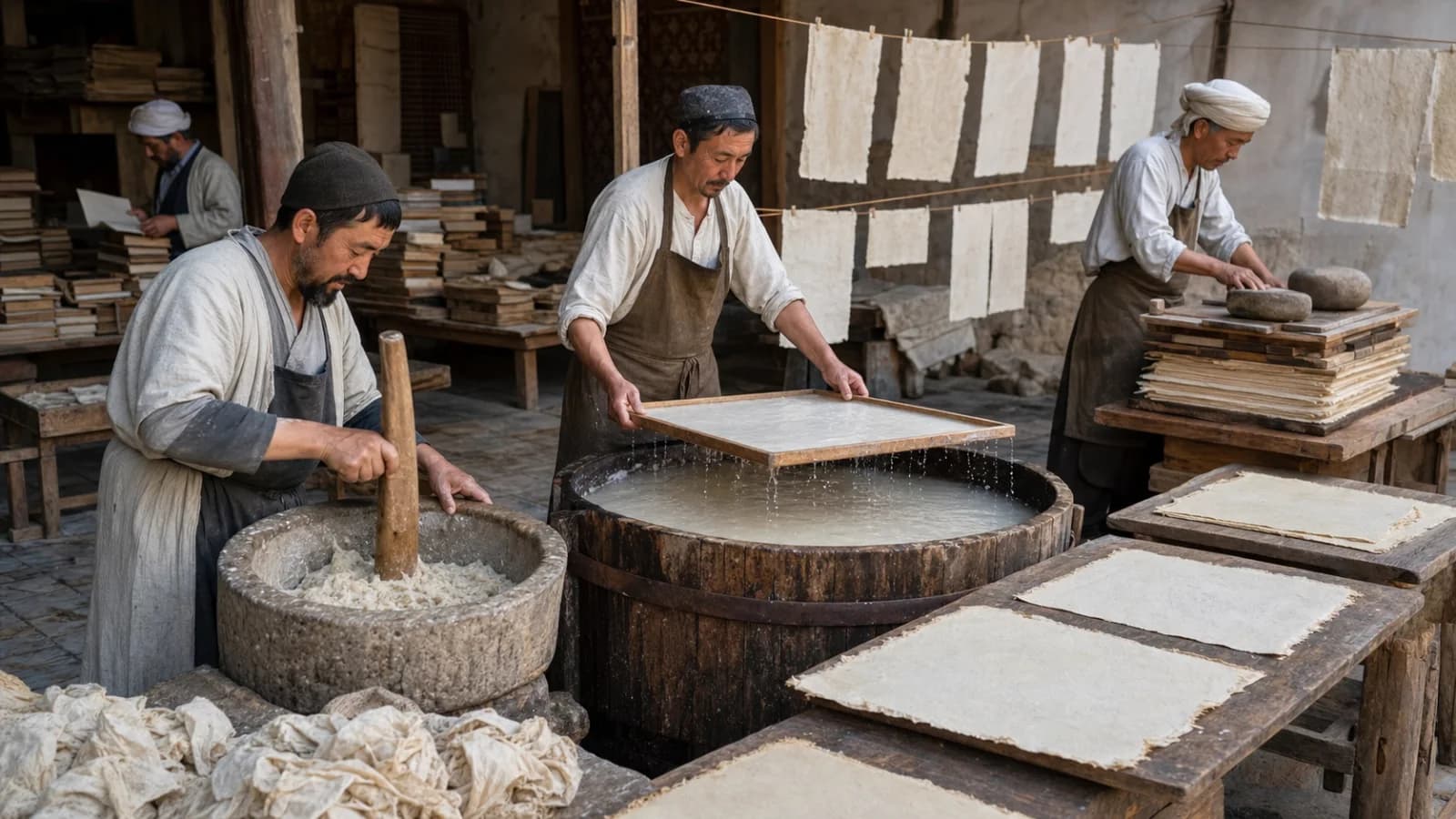
This article uses an original AI-assisted visual reconstruction for educational context. It is not a photograph of a specific Samarkand or Baghdad workshop.
Making a sheet from dispersed fibers
Traditional paper begins by separating cellulose fibers. In many workshops across the Islamic world, worn linen, hemp and other plant-based textiles supplied valuable rag material, although recipes and available fibers varied. The material was sorted, soaked and broken down by pounding. The resulting pulp was suspended in a vat of water. A maker dipped a screen or mould into the suspension, lifted it level and shook it gently so interlacing fibers settled into a thin, even mat.
The wet sheet was transferred from the mould onto a felt or another prepared surface, stacked, pressed and dried. Sizing reduced excessive absorbency so ink would sit cleanly instead of feathering through the fibers. Burnishing could produce a smooth, dense writing surface. Each stage affected the next: poorly beaten fibers formed weak sheets, uneven lifting changed thickness, and unsuitable sizing could make calligraphy frustrating or cause later deterioration.
Why one battle is not the whole story
A popular account says Chinese prisoners captured after the Battle of Talas in 751 revealed the secret of papermaking at Samarkand. The story provides a memorable date, but historians caution against treating one episode as the complete explanation. Paper circulated in Central Asia before 751, and technology normally spreads through craftspeople, materials, experiments and trade over time. Samarkand nevertheless became famous as a major center, and Central Asian makers adapted production to local resources.
Baghdad’s foundation as the Abbasid capital in 762 created enormous administrative and intellectual demand. UNESCO’s Silk Roads program notes serious papermaking in the city by the late eighth century and a later commercial landscape of paper sellers and booksellers. Production spread further west through Islamic lands, reaching North Africa and the Iberian Peninsula and contributing to later European manufacture. This was not a single unchanged recipe moving intact; makers selected different fibers, tools and finishes in each region.
Paper did not make books cheap overnight
Compared with parchment, paper could make expansion of written culture more feasible, but every manuscript still required labor: preparing sheets, ruling, copying, correcting, illuminating and binding. Literacy, patronage, libraries and markets mattered as much as raw material. Papyrus and parchment also did not vanish on one day. Materials overlapped, and users chose among them according to place, purpose, price and convention.
To read an old sheet, look for laid and chain lines from its mould, fiber distribution, surface sheen, repairs and evidence of reuse. These clues reconnect famous texts with anonymous craft labor. Papermaking’s largest historical effect came from this union of humble processes and institutional demand: beaten scraps became standardized surfaces on which governments, scholars and merchants could preserve and move information at a new scale.


