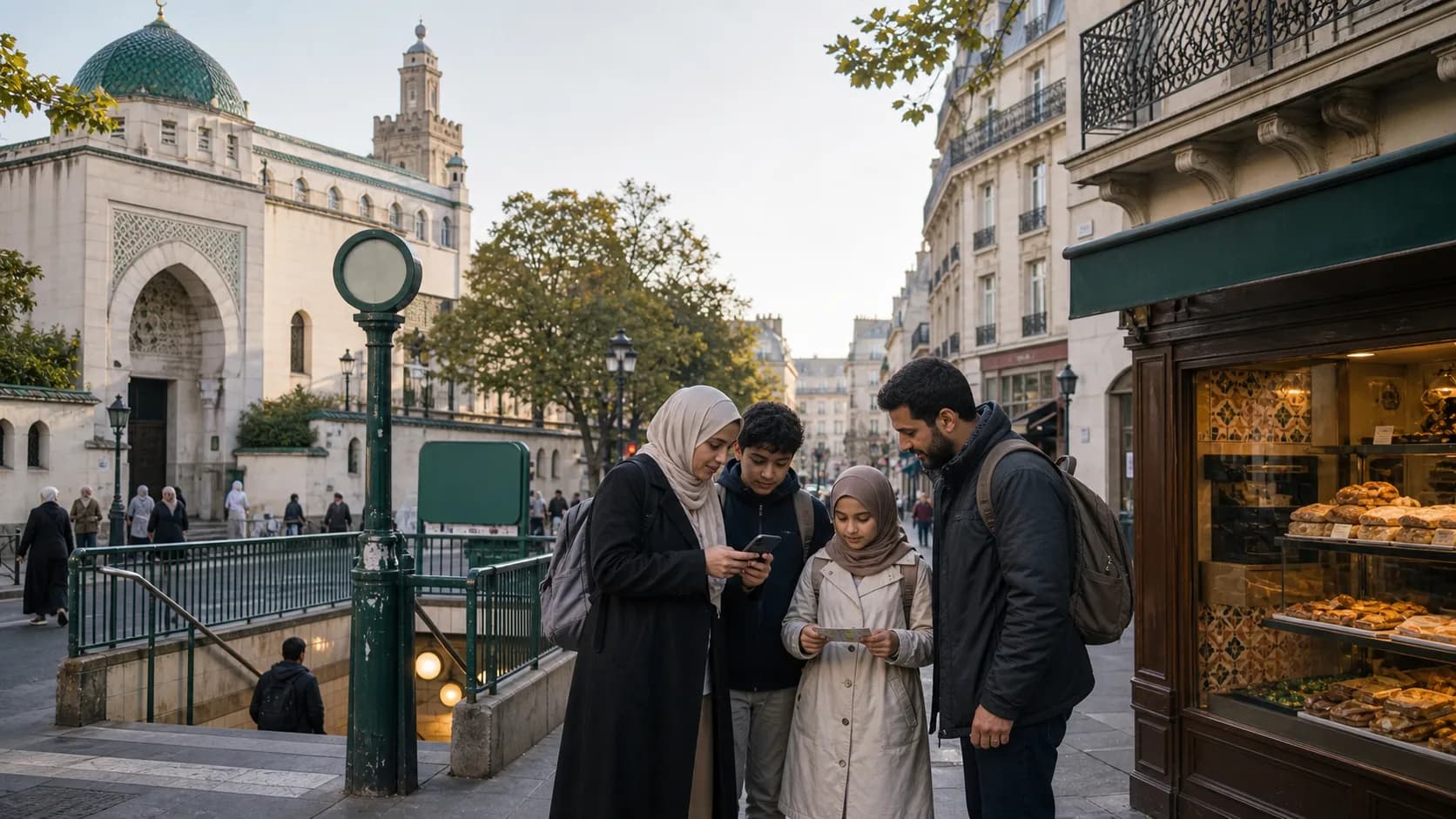
Paris Muslim Travel Guide for Prayer Spaces Halal Food and Metro Planning
A practical Paris Muslim travel guide with mosque anchors, halal verification, RATP ticket planning, neighborhood buffers and a one-day workflow.
Paris can be very rewarding for Muslim travelers, but the city becomes difficult when prayer, halal food and Metro tickets are treated as afterthoughts. A good Paris Muslim travel guide should not begin with twenty landmarks. It should begin with the parts of the day that make the trip work: where you can pray, how you will verify food, and how you will move without losing the next salah window.
Before leaving the hotel, check local prayer times, keep the qibla finder ready, and choose one part of Paris as the main zone for the day. Paris looks compact on a map, but station changes, stairs, crowds, children and restaurant searches can consume the time you expected to use for wudu or a calm meal.
For a first visit, the Grande Mosquée de Paris is the clearest anchor. It fits naturally with the Latin Quarter, Jardin des Plantes, the Seine and several museum routes. That does not mean every Muslim visitor must spend the whole day there. It means the mosque gives the day a reliable center. From that center, choose nearby attractions and one verified meal instead of crossing the city repeatedly.
Make the anchor concrete. The Grande Mosquée de Paris publishes visitor information for the mosque and lists the 5th-arrondissement setting at 2bis Place du Puits de l’Ermite, 75005 Paris. Its visit page also frames visits around daytime opening windows and exceptions such as Friday and Muslim holidays. A traveler does not need to memorize every detail, but checking the official page before the day begins prevents a very common mistake: treating a religious and cultural site as if it were always available like an outdoor monument.
Use one prayer anchor for each Paris day
A prayer anchor is different from a random map result. It is a place you can realistically reach before the next prayer, with enough time for entrance, wudu, family needs and the next move. If your day is near the Latin Quarter or Jardin des Plantes, the Grande Mosquée de Paris can hold the schedule together. If your day is north or west of the city, pick another anchor and avoid building the route around a mosque you will not reach in time.
Friday needs a larger buffer. Visitor hours, local community rhythms and security or crowd conditions can change how the mosque feels on the ground. Avoid booking timed museum entry immediately before or after Jumuah. A useful Muslim-friendly Paris plan usually has fewer stops than a normal tourist list, but each stop is more likely to be completed without stress.
Verify halal food before the Metro ride
Paris has many restaurants that use halal language, but travelers differ in what they accept. Some rely on a restaurant statement. Others look for a certifier or a known butcher supply chain. AVS publishes French halal certification context, which is helpful because it reminds travelers that a halal label and a certification standard are not the same thing.
Build the day around one verified main meal and one simple backup. Around the mosque and nearby neighborhoods, you may find options that fit a relaxed walking route. In other areas, do not take a long Metro ride for a restaurant unless you have checked opening hours, reservation needs and your own halal threshold. A closed restaurant can quietly break both lunch and Dhuhr or Asr timing.
Plan RATP tickets as part of worship planning
RATP publishes official ticket, fare and smartphone-ticket information. For Muslim travelers, the practical lesson is to choose the payment method before the day starts and avoid fragile routes with too many transfers. Paris Visite, single tickets, Navigo Easy and mobile tickets can all make sense depending on the trip length, but the wrong choice creates small delays at exactly the wrong moment.
Paris je t'aime, the city tourism office, also explains visitor travel cards and Navigo Easy in tourist language. Use those pages with RATP rather than relying on a memory from another city. London-style direct bank-card habits, New York-style contactless habits and Paris mobile-ticket habits are not identical. If your family needs a 1-day, 2-day, 3-day or 5-day visitor rhythm, decide that in the hotel lobby, not at a crowded station gate while Dhuhr is approaching.
A simple two-zone Paris map
For a first Muslim-friendly Paris weekend, split the city into zones. One day can be the mosque, Latin Quarter, Jardin des Plantes, Seine walk and a verified nearby meal. Another day can be the Eiffel Tower or western Paris with a different prayer plan. This is not only about convenience. It keeps the halal food decision from pulling you away from the prayer anchor, and it keeps the Metro from becoming the main activity of the day.
Families should write down three fixed points before leaving: next prayer time, main meal, and last comfortable Metro transfer. If any attraction breaks all three, move it to another day. This small discipline is why a Muslim-specific guide is useful. It turns official tourism and transport information into a day that respects worship, food confidence and tired feet at the same time.
A calm first-day version is simple: start with a mosque anchor, add one nearby attraction, reserve time for one verified meal, then use the afternoon for a walk or museum in the same zone. Use a second day for another neighborhood. This style may look less ambitious, but it protects the parts of travel that Muslim visitors usually search for after a generic guide has failed them.


