Nur al-Din's Bimaristan: Medicine in Damascus
How a twelfth-century courtyard hospital joined treatment, teaching and endowed support—and what its surviving architecture cannot reveal by itself.
The Bimaristan of Nur al-Din is a twelfth-century medical and charitable institution in Damascus, established by the ruler Nur al-Din and later expanded to serve as a hospital, pharmacy, and school of medicine.
Architectural Layout and Spatial Organization
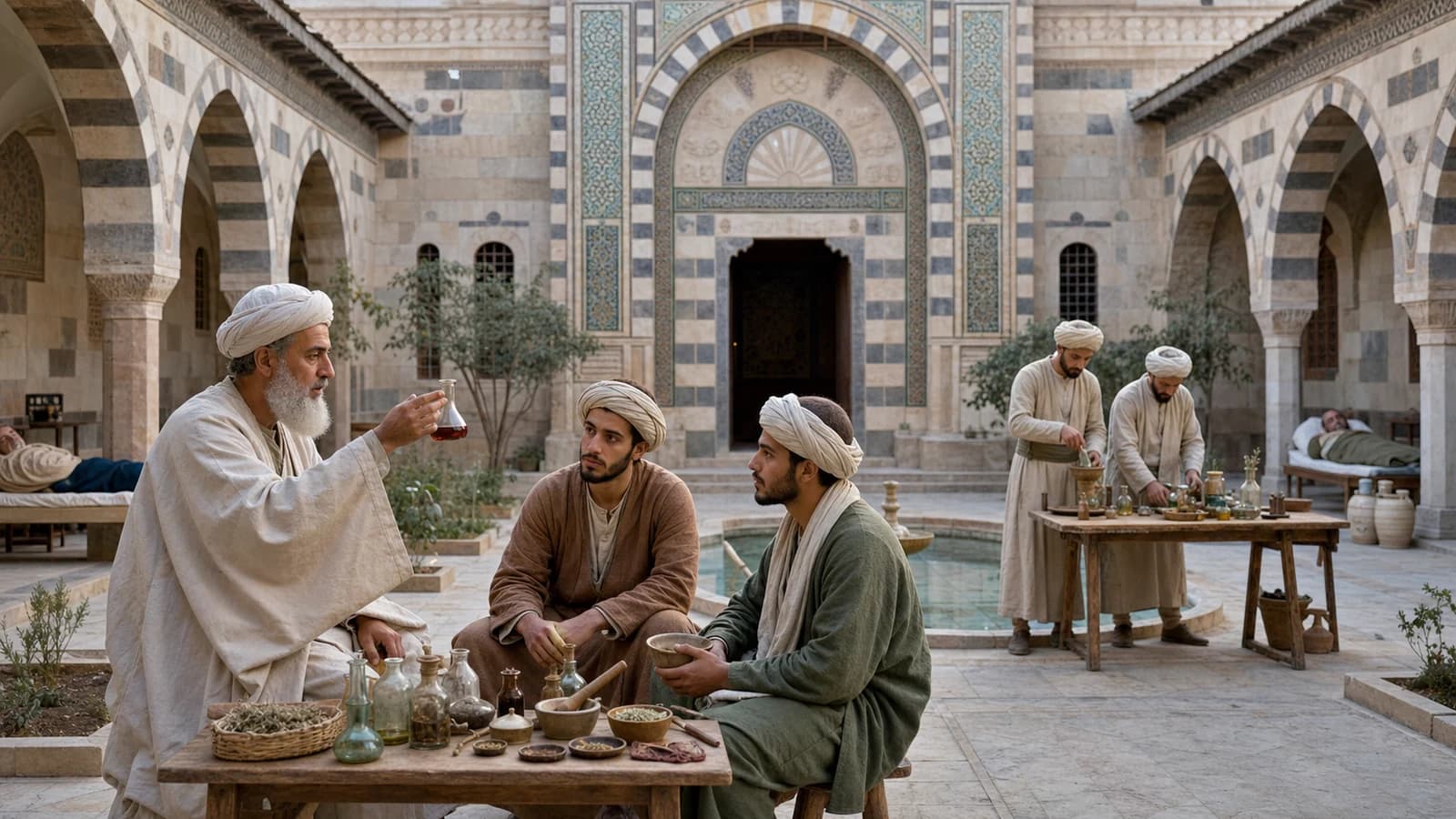
The standing monument in Damascus features a central courtyard-centered plan, a design characteristic of Syrian public architecture of the period. This central open space is flanked by four vaulted halls, or iwans, and several smaller rooms. The iwans served as communal spaces for clinical instruction, patient examinations, and recovery, while the smaller rooms accommodated administrative functions, storage, and specialized care.
Modern visitors must distinguish the restored physical monument from the medieval arrangement of wards and daily routines. Over centuries of use, repair, and eventual conversion into a museum, the internal partitions and functional designations of the rooms changed. While the stone walls and carved portals survive, the precise location of specific wards, such as those for internal diseases or mental illnesses, remains a subject of historical reconstruction rather than direct observation.
Medical Functions and Pharmacy Operations
Historical accounts indicate that the bimaristan functioned as a center for treatment and drug preparation. It housed a pharmacy, or dispensary, stocked with botanical ingredients, minerals, and animal products used to compound remedies. Physicians and assistants prepared syrups, electuaries, and poultices according to established pharmacological texts, distributing them to both admitted patients and outpatients.
The translation of bimaristan as hospital is useful for modern audiences, but projecting contemporary medical systems backward can be misleading. The medieval institution lacked modern diagnostic technologies, standardized professional licensing boards, and public-health surveillance systems. Instead, care was based on humoral theory, and treatment focused on restoring balance through diet, bloodletting, and herbal compounds rather than targeted biochemical intervention.
Instruction, Patronage, and Endowment
The bimaristan served as a teaching institution where senior physicians trained apprentices. Instruction took place in the iwans, where students listened to lectures, studied medical manuscripts, and observed clinical examinations at the bedside. This practical training complemented the theoretical study of classical and regional medical texts, creating a structured environment for the transmission of medical knowledge.
This complex operation was sustained by a system of perpetual charitable endowments, known as waqf. Rather than a one-time building gift, Nur al-Din and subsequent donors deeded income-generating properties, such as shops, agricultural land, and bathhouses, to support the institution. The revenues from these endowments paid the salaries of physicians, cooks, and attendants, and funded the continuous purchase of medicines and food, ensuring the bimaristan could operate independently of direct state treasury allocations.
Evaluating Historical Evidence
Historians rely on diverse sources to reconstruct the daily life of the bimaristan. The travelogue of Ibn Jubayr, who visited Damascus in the late twelfth century, provides valuable testimony regarding the cleanliness, food, and care provided to patients. However, historians treat his account as a subjective travel description rather than a neutral operating manual, as travel writers often highlighted idealized aspects of civic institutions.
- Verify the physical layout by comparing the standing restored walls with archaeological ground plans.
- Analyze the original waqf endowment deeds to identify the specific properties funding the staff salaries and drug supplies.
- Cross-reference the travel descriptions of Ibn Jubayr with administrative records of the period to assess operational consistency.
- Examine surviving medical manuscripts copied at the bimaristan to trace the curriculum and teaching methods of the resident physicians.
In conclusion, the Bimaristan of Nur al-Din represents a sophisticated integration of architecture, charity, and medical education in medieval Damascus. By examining its physical remains alongside endowment deeds and travel accounts, historians can understand how the institution functioned without projecting modern medical frameworks onto the past.
The cover image is an original AI-assisted historical reconstruction, not a photograph of a documented ward or an exact restoration of the Nuri Bimaristan.
Sources
- Archnet: Bimaristan Nur al-Din — architecture, history and site documentation.
- Museum With No Frontiers: Hospital Nur al-Din — date, function and travel testimony.
- Museum With No Frontiers: Bimaristan al-Nuri — survival, museum use and regional context.


