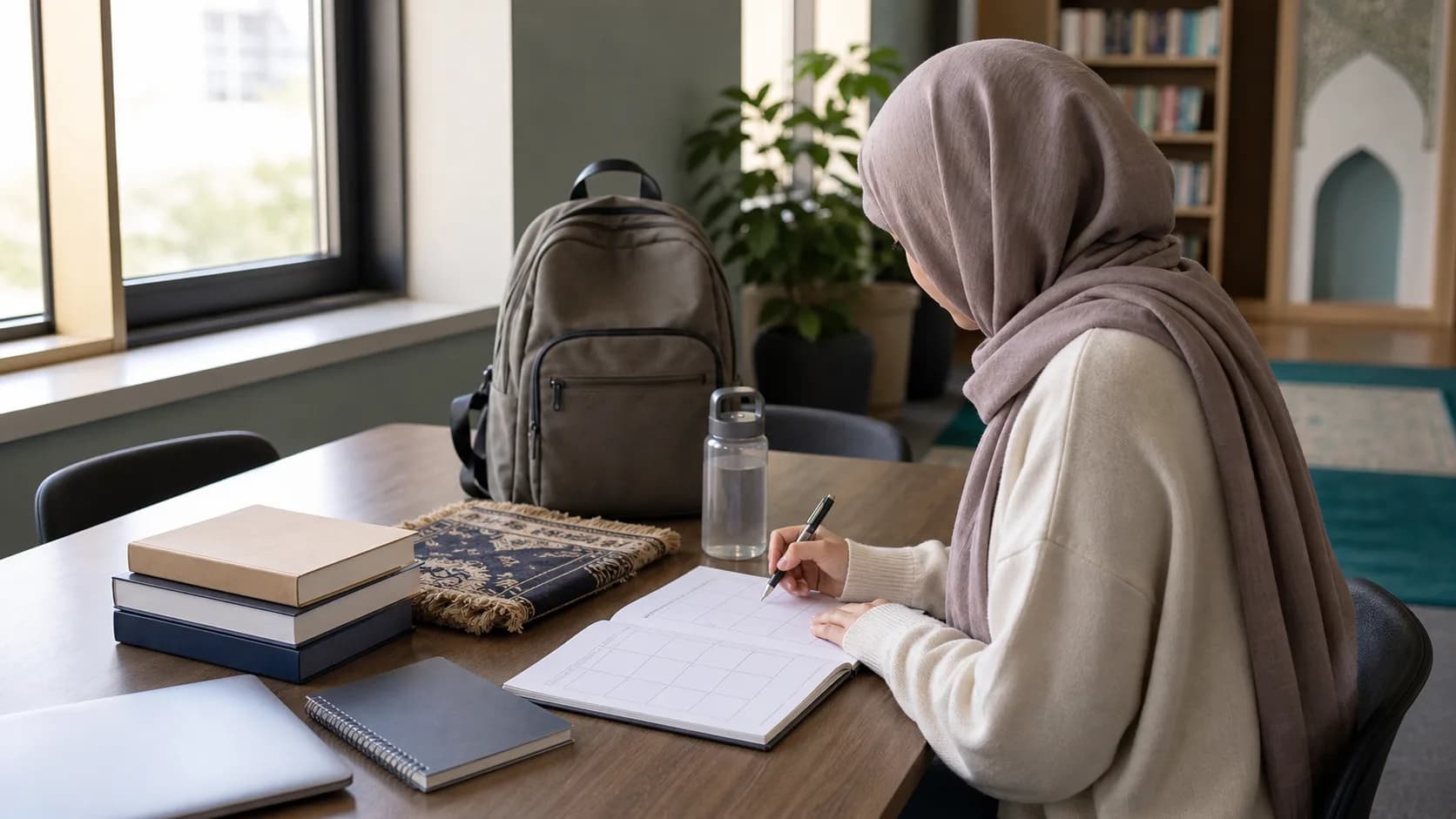
Muslim Student Prayer Guide for School Schedules Rooms and Jumuah
A practical Muslim student prayer guide covering school schedules, quiet rooms, parent emails, Jumuah planning, religious clubs and respectful communication with teachers.
A Muslim student prayer plan should make the school day calmer, not turn every week into a rights dispute. Students need prayer time, a clean place, privacy where possible and a way to handle schedule changes. Parents and school staff need the same thing: a clear request that fits the timetable, supervision rules and local policy. This guide is not legal advice. It is a practical planning document based on public religious-expression sources and ordinary school logistics.
Use prayer times for the school location, then keep the qibla finder ready for a library room, student center, office, club room or quiet corner. A timetable that works in September may not work in December. Dhuhr and Asr can move across lunch, study hall, sports, exams and after-school pickup. Planning should happen before the conflict appears.
The U.S. Department of Education page and PDF are dated February 5, 2026, so this article treats them as the current federal public-school prayer and religious-expression source at the time of writing on July 7, 2026. The Department of Justice religious-discrimination resource, the Equal Access Act text hosted by Cornell, and the ACLU student-rights page add useful context. They do not replace local school policy, but they help families ask better questions.
Start with the timetable, not the argument
The strongest first email is simple. Name the student, the prayer affected, the likely time window, the requested place and the supervision concern. For example: “Dhuhr may fall during lunch or study period this term. Could the student use a quiet clean room for a few minutes, without missing instruction when possible?” This gives the school a concrete problem to solve.
Parents should ask who owns the decision: classroom teacher, counselor, principal, activities director, campus life office or district policy office. Students should know who to tell if the room is locked, the schedule changes or a teacher marks them absent. A plan that depends on one friendly adult can break when that adult is absent.
- Map which prayer actually falls during the school day this term.
- Identify a realistic room: clean, quiet, safe and available without disrupting class.
- Agree how the student checks in and returns without creating attendance confusion.
- Plan Jumuah separately because Friday timing, travel and supervision can be different.
- Keep a short written summary so staff changes do not erase the arrangement.
Treat Jumuah as a separate planning problem
Friday prayer can involve leaving campus, using a larger room, gathering with other students or coordinating transportation. That is different from a short individual prayer during lunch. Families should discuss attendance, safety, travel time, missed class, pickup rules and whether the school has a process for recurring early release or religious observance. The question is not only permission; it is how the student returns to learning without confusion.
Older students may also ask about a Muslim student group or a room for voluntary prayer. Equal-access questions depend on how the school treats noncurricular student groups and other student activities. Do not assume the answer from another school applies. Ask what the general club rules are, who can sponsor the club, when rooms are available and whether participation is voluntary and student-led.
Students should not be put in the position of debating Islam with classmates every time they pray. The plan can be private. Teachers and staff can know enough to manage attendance and safety without broadcasting religious details. If other students harass or interrupt, document the incident and use the school's reporting process rather than asking the student to absorb it silently.
Make the plan resilient during exams and activities
Exams, field trips, sports, assemblies, Ramadan schedules and winter daylight all change the prayer plan. Before a major exam week, ask whether a short break or alternate timing is possible. Before a field trip, ask where prayer could happen and who supervises students. During Ramadan, food, hydration, PE class and prayer can intersect, so families should raise practical needs early and avoid surprising teachers on the hardest day.
A good school prayer plan has four parts: time, place, check-in and backup. Time means the actual prayer window. Place means a clean and safe room. Check-in means the school knows the student is not skipping class. Backup means what happens if the room is unavailable or the schedule changes. This is practical, but it also protects the dignity of worship.


