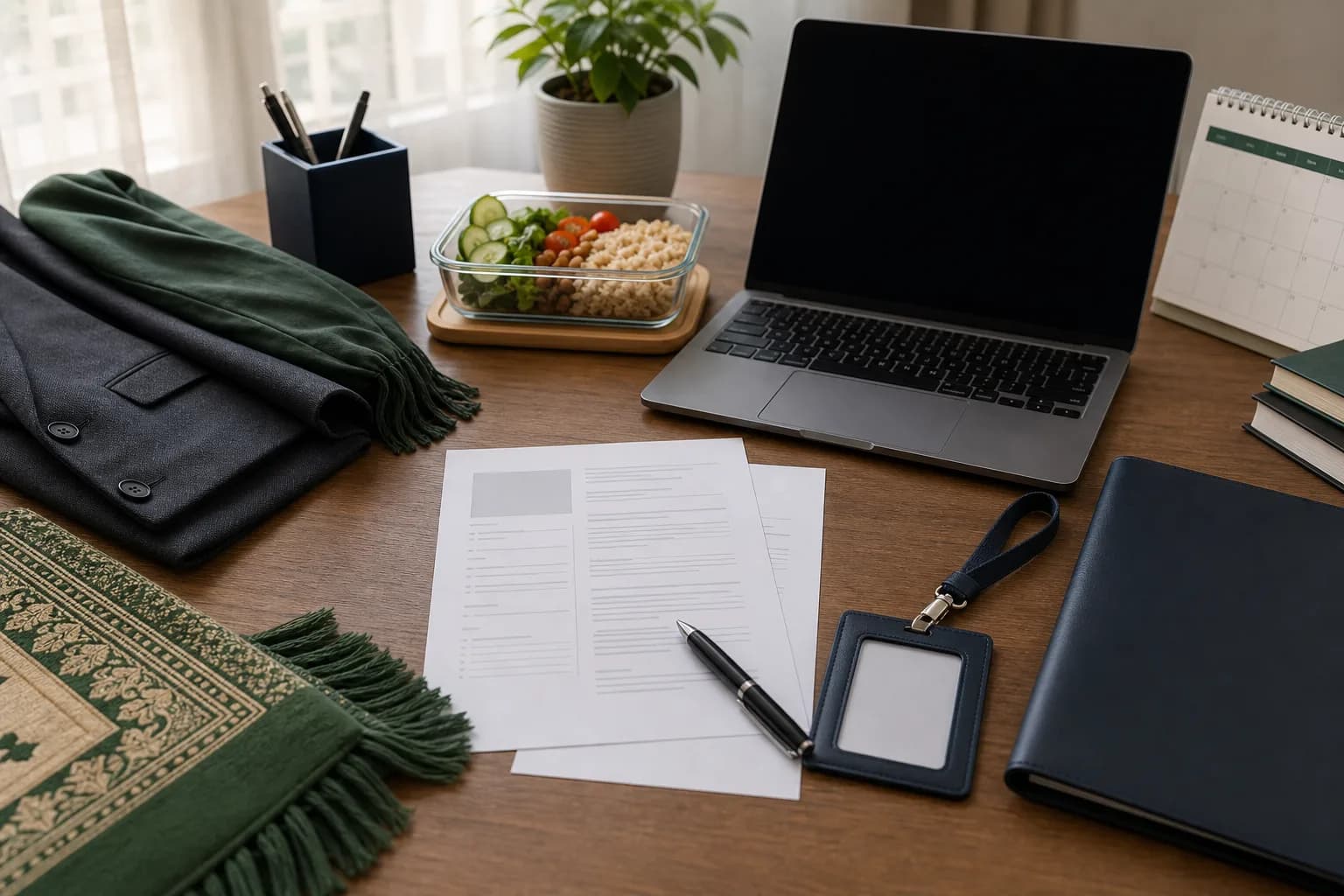
Muslim New Job Checklist for Prayer Accommodation and Documents
A practical Muslim new job checklist covering interview preparation, prayer accommodation, hijab or beard questions, halal lunch, I-9 documents, W-4 forms and job scam caution.
A Muslim new job checklist should start before the first day. The goal is not to make the interview about religion. The goal is to enter the job with documents ready, scam signals checked, prayer needs understood, dress or grooming questions handled calmly, halal lunch planned and first-week communication organized. Many workplace problems begin because the new hire waits until the conflict is already visible: prayer break, Friday timing, uniform rule, lunch event, travel schedule or ID paperwork.
Use prayer times to understand the workday before accepting a schedule, and use the Muslim workplace prayer request guide when a specific prayer-room or break request is needed. This guide is not legal advice. It is a practical preparation document for Muslim job seekers and new hires who want to be professional without hiding ordinary religious needs.
The sources set the boundaries. EEOC pages explain religious discrimination and religious garb or grooming responsibilities. USCIS lists Form I-9 acceptable documents for U.S. employment verification. The IRS explains Form W-4. The FTC job scam page helps applicants avoid fake offers and payment traps. Together they support a checklist that separates three things: real job verification, required paperwork and respectful accommodation planning.
Check the job before sharing sensitive documents
Before sending identity documents, bank details or tax forms, confirm that the job is real. Check the employer website, email domain, interview process, offer letter, manager name, physical or remote work location and whether the request makes sense. Be careful with jobs that ask for money, crypto, gift cards, personal equipment purchases through a strange vendor, or identity documents before a normal hiring process. A Muslim applicant may be eager to find a halal income, but urgency is exactly what scammers exploit.
- Offer check: employer identity, manager contact, role, pay, schedule, location and start date.
- Documents: I-9 documents or local equivalent, tax form, bank details and emergency contact.
- Prayer: daily prayer windows, Friday prayer timing, break policy and private space options.
- Dress: hijab, beard, modest clothing, uniform requirements and safety equipment questions.
- Food: halal lunch plan, team meals, travel days, Ramadan schedule and coffee-break expectations.
For U.S. jobs, I-9 documents and W-4 forms are ordinary new-hire paperwork, but they should be handled through legitimate employer systems. Do not send passport images, Social Security numbers or bank information through casual chat because someone says the payroll system is not ready. If the employer is outside the United States, use the same principle with local documents: understand what is required, who receives it, why it is needed and how it is stored.
Prepare the prayer and dress conversation early
Religious accommodation conversations work better when they are specific. Instead of saying “I need many breaks,” say what is actually needed: a short prayer break around a known window, a clean private space if available, schedule awareness for Friday prayer, or permission to wear hijab, beard, kufi, modest sleeves or another religious item with required safety equipment. The request should be calm, practical and connected to the job's workflow.
Some questions should wait until there is a real offer or schedule discussion. Other questions belong earlier because they affect whether the job can be performed. A warehouse job with safety gear, a restaurant shift during Jumuah, a healthcare uniform, a security role or a client-facing dress code may need early clarity. Keep notes of what was agreed: who approved it, what the arrangement is, when it starts and how to revisit it if the schedule changes.
Halal food is a small issue until it becomes a first-week problem. Plan lunch for the first few days, ask about fridge access if needed, and know how to handle team meals without making the first impression awkward. A simple phrase often works: “I eat halal, so I may bring my own lunch or choose vegetarian when needed.” During Ramadan, ask about schedule or break issues early enough that the manager can plan coverage.
Make the first week boring and documented
The first week should be boring in the best sense. Documents submitted through the correct channel. Prayer windows saved. Lunch packed. Dress expectations understood. Calendar checked for Friday. Direct manager identified. HR contact saved. Accommodation notes written down if needed. The new hire can then focus on learning the job instead of improvising around identity documents, salah, food and policy questions at the same time.
A Muslim new job checklist is not about asking for special treatment before doing the work. It is about showing up prepared: honest documents, verified employer, clear schedule, respectful prayer plan, modest dress handled professionally and halal food managed without drama. That preparation protects both the job and the worship routine that has to continue after the welcome meeting is over.


