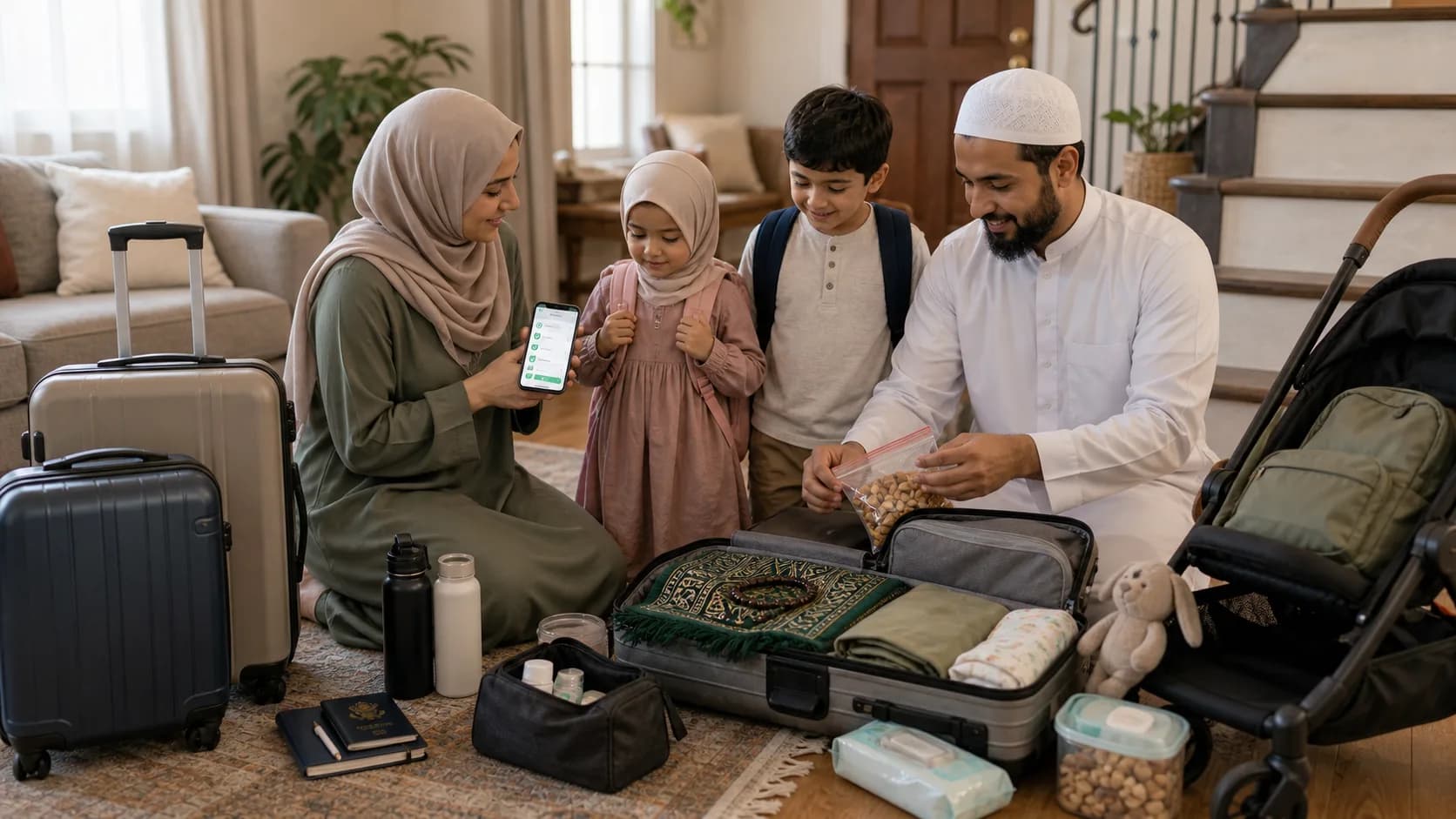
Muslim Family Travel Checklist for Prayer Halal Food and Kids
A Muslim family travel checklist covering children, airport security, prayer timing, halal snacks, seating, child restraints, medicine and family buffers.
A Muslim family travel checklist has to do more than list passports and chargers. Families need the normal travel basics plus prayer timing, halal food, child snacks, stroller decisions, airport security rules, seating, health needs and a plan for what happens when a child is tired at exactly the wrong time. The checklist should reduce decisions on travel day, not create a perfect-looking packing spreadsheet that nobody can follow.
Start with prayer times for the departure, transit and arrival cities, then keep the qibla finder ready for hotels, gates and quiet family rooms. Children change the timing. A solo traveler may be able to pray during a short connection; a family may need a bathroom stop, stroller fold, snack, boarding queue and child comfort reset before the same prayer can happen calmly.
Use official travel pages for the non-religious mechanics. TSA publishes guidance for traveling with children and for baby-food screening. FAA publishes flying-with-children safety guidance. The U.S. Department of Transportation maintains a family seating dashboard, and CDC Travelers Health publishes guidance for traveling safely with infants and children. Those sources do not replace Muslim-specific planning; they support it.
The Muslim-specific layer is what makes the checklist work. A family may need a prayer mat and qibla tool, but also baby food that can pass screening, child medicine that is easy to explain, seats that keep adults near children, and enough time for wudu after a diaper change. TSA, FAA, DOT and CDC answer different parts of the problem. The parent’s job is to combine them into one calm route.
Pack the family carry-on by task, not by person
- Documents: passports, visas, consent letters if needed, hotel address, emergency contacts and copies.
- Prayer: lightweight mat, easy footwear, modest spare layer, qibla app and prayer-time note.
- Food: halal snacks, child-safe food, feeding items and a plan for security rules.
- Health: prescription medicine, fever medicine if appropriate, allergy information and child comfort items.
- Movement: stroller or carrier plan, spare clothes, wipes, small bags and a boarding-time alarm.
Packing by task prevents the common airport problem where every important thing is in a different bag. Put the prayer kit in one reachable pocket. Put child food and medicine where security can inspect it without emptying the whole suitcase. Put documents in one adult’s fixed place and a backup copy in another place. A family travel day usually fails from small frictions, not one dramatic mistake.
Make one adult the document lead and one adult the child-flow lead when possible. The document lead watches passports, boarding passes, visas, seating changes and hotel address. The child-flow lead watches snacks, bathroom stops, stroller folding, medicine, comfort objects and the next prayer window. Solo parents can still use the same idea by separating bags: one pocket for documents, one pouch for child care, one small kit for worship.
Treat seating and child safety as part of worship planning
If children are split from adults, everything becomes harder: snacks, bathroom trips, anxiety, sleep and prayer planning after landing. The DOT family seating dashboard is useful because it pushes parents to check airline policy before the airport. FAA child-travel guidance also reminds families that safety and restraint decisions should be handled before boarding, not argued about in the aisle.
Muslim families should connect seating with prayer and food. If a parent needs to help a child eat, manage halal snacks, wake for Fajr after a red-eye or move quickly during transit, scattered seats create unnecessary stress. Choose seats early when possible, check aircraft changes and keep a backup plan for group movement after landing.
For infants and small children, safety decisions also affect packing. FAA guidance should push the family to think about child restraint systems, seat assignments and what must be carried on instead of checked. CDC guidance should push the family to think about medicines, hydration, destination health risks and when to speak with a clinician. Those decisions belong on the same list as halal snacks and prayer timing.
Make halal food simple enough for tired children
Children do not care that the best halal restaurant is forty minutes away when they are hungry after immigration. Families should plan one main halal meal, one airport or hotel backup and a small snack set that follows security rules and the child’s health needs. For babies and toddlers, TSA’s baby-food page is a reminder that feeding items should be packed for screening and access, not buried for later.
The best family checklist is humble: fewer attractions, more buffers, one prayer anchor, one verified meal and one plan for sickness, delays or a child meltdown. That structure lets the family preserve worship and halal confidence without turning every delay into a crisis. It also gives children a better memory of travel, which is sometimes the most useful dawah inside the family itself.
Before leaving home, run a five-minute rehearsal: where are passports, where is medicine, where is the prayer kit, what will the child eat if the airline meal fails, and which adult handles the next prayer stop? If the family can answer those questions at the door, the airport becomes less chaotic. If they cannot, the checklist has already shown what needs to be fixed.


