Mina’i Ware: How Persian Potters Painted Above the Glaze
How mina’i pottery combined underglaze color, a clear glaze and a second firing for detailed figures, inscriptions and courtly scenes in Seljuk-period Iran.
Mina’i ware is a group of luxury ceramics made in Iran around the late twelfth and early thirteenth centuries. Its Persian name is associated with enamel or color. Potters used more than one painting and firing stage to place a wide palette of figures, patterns and inscriptions on a pale body.
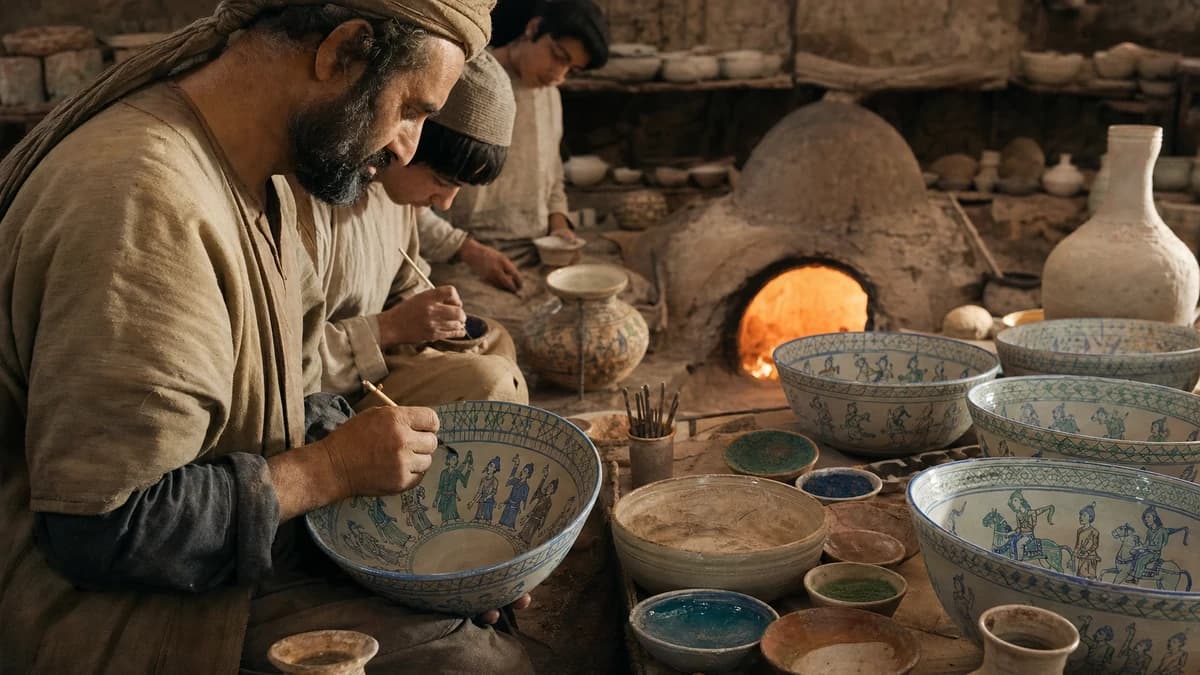
The cover image is an original AI-assisted ceramic workshop reconstruction, not a photograph of a specific museum object.
Color was built in layers
Some pigments were applied before a transparent glaze and fixed in the first firing. Other colors, including reds and gilding, were painted over the glazed surface and fired again at a lower temperature. The second firing protected pigments that could not withstand the heat needed to mature the body and glaze.
This sequence gave painters a broad palette and fine control, but it also created vulnerabilities. Overglaze details sit closer to the surface and may abrade. A bright modern restoration can therefore be mistaken for original paint unless the object is examined scientifically.
Bowls became crowded narrative surfaces
Mina’i vessels often show enthroned figures, riders, musicians, attendants, animals and bands of writing. Some scenes evoke courtly literature or astrology, but not every image illustrates a named story. A halo may mark status rather than sanctity, and generic princely imagery should not automatically be labeled as a portrait.
Painters adapted figures to curved vessels. A central roundel anchors the interior, while seated bodies or inscriptions form rings around it. The vessel turns reading into movement: the viewer rotates the bowl or walks around it.
Kashan is important, but attribution needs evidence
Kashan was a major ceramic center and is closely associated with mina’i production. Signatures, inscriptions and technical comparison support some attributions. Yet the archaeological record is uneven, and an art-market label of “Kashan” may be broader than the evidence permits.
The Mongol invasions are often used as a simple ending date for mina’i ware. Political disruption mattered, but technologies and workshops do not stop everywhere at once. Precise dating depends on inscriptions, excavated contexts and comparison.
How to inspect mina’i ware
- Separate colors beneath the glaze from those painted over it.
- Look for abrasion, repainting and joins between fragments.
- Read inscriptions independently from the figures they surround.
- Use “courtly scene” cautiously unless a particular narrative is demonstrable.
Mina’i ware made ceramic painting behave like a miniature art. Its achievement lies not only in colorful imagery but in the controlled thermal sequence that allowed those colors to coexist.
Sources
- The Met: Mina’i Bowl with Bahram Gur and Azada — object data and narrative interpretation.
- The Met: Bowl with Figures and an Inscription — material and overglaze technique.
- The Met: Mina’i Bowl with Astrological Imagery — another documented use of the technique.


