How Islamic Lustreware Turned Copper and Silver into Shimmer
How potters painted metal compounds over glaze, controlled a low-oxygen firing and produced the thin reflective surface that defines true lustreware.
Lustreware appears to carry a skin of bronze, gold or ruby light, yet the vessel is ceramic rather than solid metal. Potters in ninth-century Iraq adapted metallic decoration associated with glass to glazed pottery. The technique later flourished in Egypt, Syria, Iran and Islamic Iberia, changing with local bodies, glazes, kilns and markets. Its success depended less on a lavish amount of precious metal than on controlling an extremely thin surface layer.
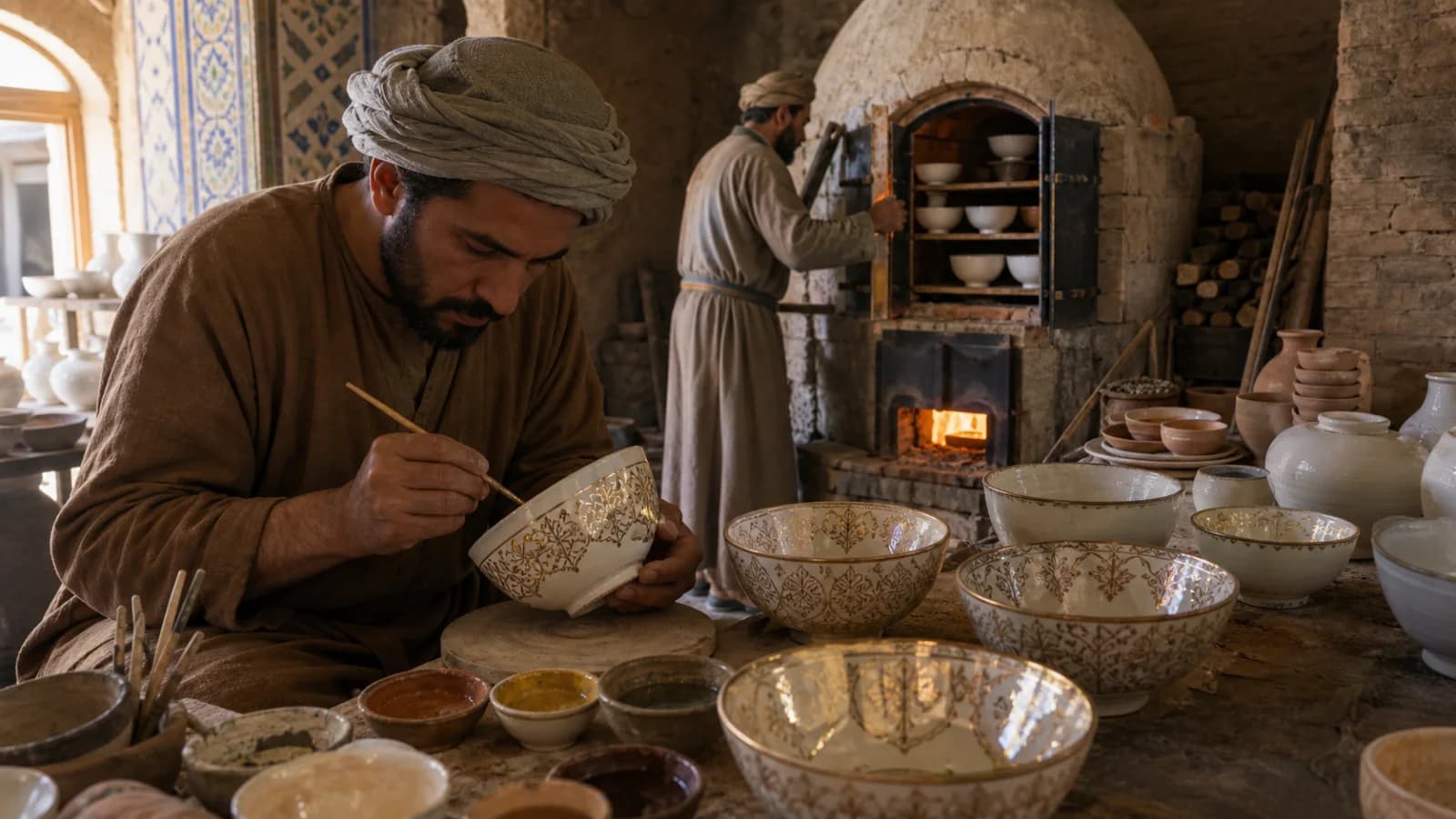
This article uses an original AI-assisted visual reconstruction for educational context. It is not a photograph of a documented workshop or a specific surviving bowl.
Several firings, one reflective surface
First, a pot was shaped, dried and fired. It then received a glaze—often an opaque white tin glaze on earthenware in early Iraqi production—and was fired again. Only after that surface existed did the lustre painter apply a mixture containing copper and silver compounds, together with clay or ochre and an organic medium. The painted decoration could look dull before its final transformation.
The vessel returned to the kiln at a lower temperature in a reducing atmosphere with restricted oxygen. Under the right conditions, metallic compounds were reduced and minute copper or silver particles became embedded near the glaze surface. After firing, the craftsperson rubbed away the earthy residue to reveal reflection. Too much oxygen, heat or time could erase the effect, muddy the color or damage the glaze.
Not ordinary gold paint
True reduced lustre is not a thick metallic coating and should not be confused with later industrial lustre pigments that use different chemistry. Its color changes with particle size, composition, glaze and lighting. One object may appear brown face-on and flash gold at an angle. Scientific analysis can detect the nanometer-scale metal-rich layer, while careful visual inspection reveals whether later gilding or restoration sits above it.
The earliest famous pottery groups come from Abbasid Iraq and include white-glazed forms that respond to imported Chinese ceramics without simply copying them. Production knowledge moved with craftspeople and patronage. Fatimid Egypt, Raqqa, Kashan and workshops in al-Andalus and later Christian Spain developed distinct styles. A straight map of diffusion can oversimplify periods of interruption, reinvention and collaboration.
Reading sheen as technical evidence
Turn a lustre vessel under soft light. Observe where reflectivity survives, whether brushstrokes overlap, and how the decoration relates to glaze cracks and repaired breaks. Worn rims may expose the clay body; overcleaning can remove fragile lustre. Kiln wasters and excavated fragments are especially valuable because they reveal failed firings as well as masterpieces.
Lustreware was a luxury effect made through disciplined risk. Its metallic appearance connected pottery visually with precious vessels, but the technique created its own optical language. The shimmer is not a superficial trick: it is the visible record of pigment preparation, glaze chemistry, kiln atmosphere and a potter’s judgment converging within a narrow margin of success.


