The Maqamat of al-Hariri and al-Wasiti's Paintings
How a celebrated 1237 manuscript joins rhymed prose, social satire, calligraphy and images of travel, markets, mosques and performance in Abbasid Iraq.
The Maqamat of al-Hariri is a celebrated twelfth-century literary work composed of fifty episodes written in ornate rhymed prose and verse, which found one of its most famous visual expressions in the thirteenth-century manuscript known as BnF Arabe 5847. Copied and illustrated by the scribe and artist Yahya al-Wasiti in 634 AH (1236–1237 CE), this specific manuscript represents a complex dialogue between text and image. The stories center on the narrator, al-Harith, and the eloquent, deceptive protagonist Abu Zayd of Saruj, whose linguistic trickery and social encounters provide a satirical commentary on contemporary society.
The Literary Text versus the Illustrated Manuscript
It is critical to distinguish the original literary composition of the Maqamat, written by al-Hariri in the late eleventh and early twelfth centuries, from the illustrated manuscripts produced generations later. Al-Hariri’s text is a masterwork of Arabic philology, designed to showcase grammatical virtuosity, rhetorical wordplay, and moral ambiguity. The illustrations created by al-Wasiti in the thirteenth century are not passive reflections of this text, but rather active visual interpretations that translate linguistic humor into spatial compositions, gestures, and architectural settings.
Furthermore, BnF Arabe 5847 should not be treated as a generic template for all illustrated Maqamat manuscripts. While it is one of the most complete and artistically sophisticated surviving examples, other copies from the thirteenth and fourteenth centuries exhibit different stylistic choices, layouts, and iconographic programs. Assuming that all subsequent illustrated versions are mere copies of al-Wasiti’s work overlooks the regional diversity and creative independence of later scribes and painters working in different urban centers.
Visualizing Social Spaces and Performance
Al-Wasiti’s paintings are renowned for their dynamic staging of human interaction, depicting scenes in mosques, taverns, libraries, cemeteries, and desert camps. These images show characters engaged in animated debate, using expressive hand gestures, tilted heads, and varied postures to convey emotion and social status. The architecture depicted in the miniatures—with its arches, lamps, and decorative tiling—creates a sense of place that complements the narrative action, though these settings are stylized artistic conventions rather than literal architectural plans.
While these illustrations offer rich details of material culture, they cannot be treated as transparent photographic records of daily life in the Abbasid era. The clothing, tools, and interior furnishings depicted reflect the artistic vocabulary of thirteenth-century Iraq and the conventions of manuscript workshops, rather than an objective sociological survey. Historians must read these images as representations of social archetypes and dramatic performances tailored for an elite, literate audience capable of appreciating both visual and textual irony.
Materiality, Calligraphy, and Layout
The physical structure of BnF Arabe 5847 reveals a highly integrated production process where the roles of scribe and illustrator were uniquely combined in the person of Yahya al-Wasiti. The elegant naskh calligraphy is carefully arranged on the page to accommodate the paintings, indicating that the layout was planned systematically from the outset. The pigments used, derived from minerals and organic sources, were applied within precise ink outlines, creating vibrant scenes that have retained much of their intensity despite centuries of handling and storage.
The following checklist provides a framework for analyzing the material and artistic evidence presented by the al-Wasiti manuscript:
- Examine the spatial relationship between the Arabic text blocks and the painted frames to determine how the page layout was planned.
- Analyze the gestures and gaze of the figures to identify how the artist directs the viewer's attention to the narrative climax.
- Identify recurring visual markers used to represent the protagonists, Abu Zayd and al-Harith, across different episodes.
- Distinguish between the original thirteenth-century pigments and any later restorations, overpainting, or paper repairs.
Provenance and Modern Interpretation
The journey of BnF Arabe 5847 from its production in Iraq to its current home in the Bibliothèque nationale de France in Paris reflects the complex history of manuscript collecting, trade, and colonial-era acquisitions. In the modern museum, the manuscript is often celebrated through facsimiles and digital displays that allow wider public access. To interpret this work accurately, curators must balance appreciation for al-Wasiti's artistic genius with an understanding of the sophisticated literary culture of al-Hariri's original audience, avoiding the temptation to view these stylized paintings as simple windows into medieval life.
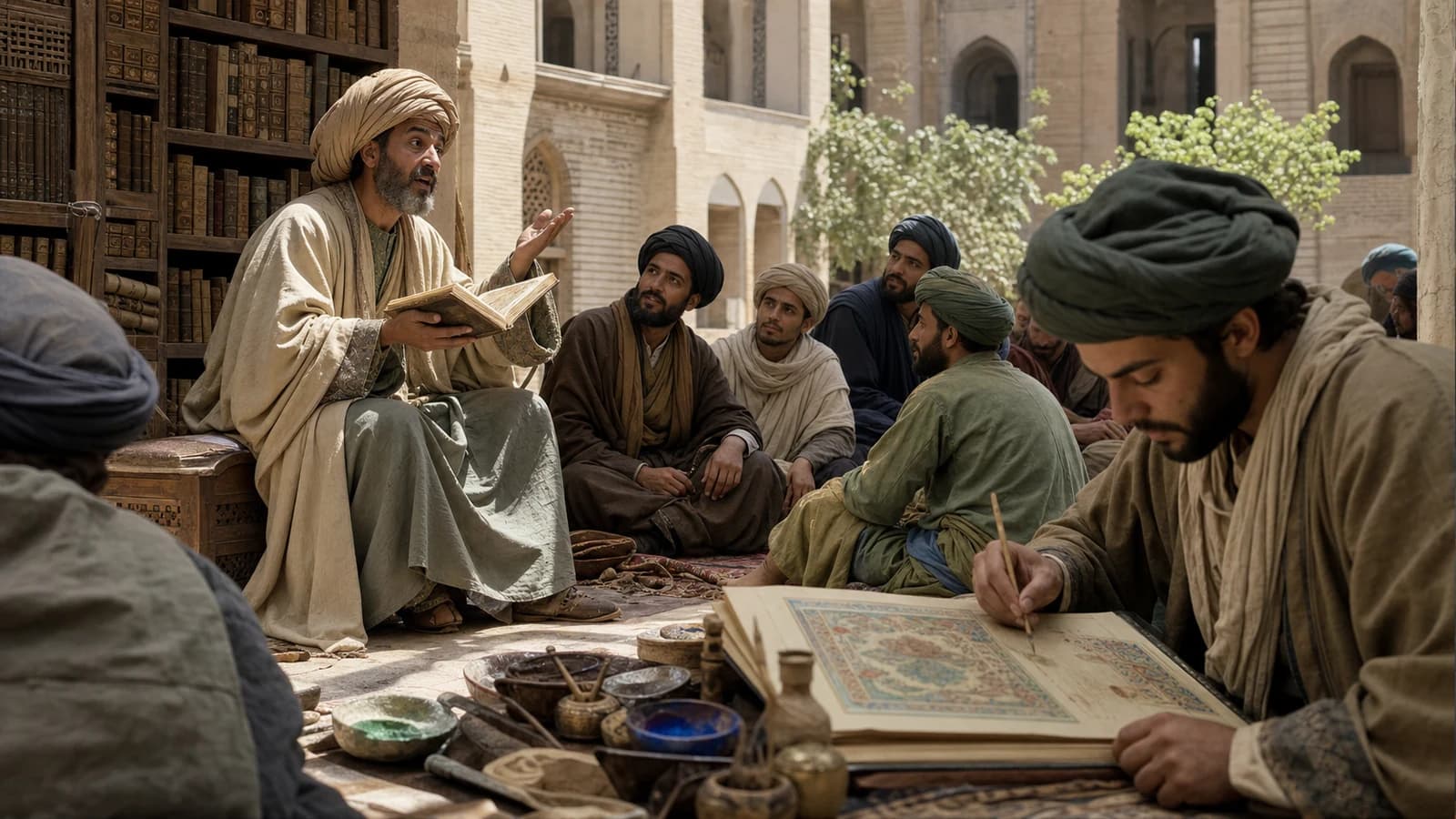
The cover image is an original AI-assisted reconstruction of a manuscript reading, not a copy of al-Wasiti's paintings or a depiction of a documented gathering.
Sources
- Bibliothèque nationale de France: Arabic Manuscript Collections — Arabe 5847, date, place and al-Wasiti.
- BnF Catalogue: Maqamat al-Hariri — manuscript and facsimile record.
- BnF: Les Séances, Manuscrit arabe — scene, library culture and textual transmission.
Related reading
- How Kalila wa Dimna crossed languages
- How the kitabkhana organized manuscript production


