Kalila wa Dimna: How Animal Fables Crossed Languages
How Indian story traditions moved through Middle Persian and Ibn al-Muqaffa's Arabic, then changed again in illustrated manuscripts and new translations.
Kalila wa Dimna is a complex, layered collection of framed animal fables that evolved over centuries through translation, adaptation, and artistic reinterpretation across multiple linguistic and cultural regions. Rather than a single, static book, it represents a fluid literary tradition that traces its roots back to ancient Sanskrit storytelling, most notably the Panchatantra. Translated into Middle Persian and subsequently adapted into Arabic in the eighth century by the writer Ibn al-Muqaffa, the work became a cornerstone of prose and a vehicle for political advice, ethical instruction, and artistic expression.
The Transmission and Adaptation Process
The journey of Kalila wa Dimna is a prime example of cultural translation where texts were rewritten to suit the political and moral sensibilities of new audiences. The Sanskrit original passed through a lost Middle Persian translation before Ibn al-Muqaffa created his highly influential Arabic version. This Arabic text did not merely translate the words but adapted the stories to address advice about ethics and rule, using the clever jackals Kalila and Dimna to explore themes of loyalty, betrayal, and statecraft.
From Ibn al-Muqaffa's Arabic text, the fables branched into dozens of languages, including Persian, Syriac, Greek, Hebrew, Latin, and eventually various European vernaculars. Each translation brought new stylistic changes, moral glosses, and structural alterations. Consequently, modern scholars do not look for a direct, line-by-line survival of a single Sanskrit original, but rather study the variations, omissions, and additions that occurred at each stage of transmission as evidence of changing local contexts.
Narrative Structure and Moral Philosophy
The core of Kalila wa Dimna lies in its nested narrative structure, where characters within a story tell further stories to illustrate specific moral or practical points. The dialogues between the two jackals, Kalila and Dimna, serve as the primary framework for discussing human behavior, court intrigue, and the dangers of gossip and jealousy. Through these animal proxies, the text offers pragmatic advice on how to navigate the perilous environment of a royal court, making it a popular manual of education for princes and administrators.
The manuscript tradition of Kalila wa Dimna is rich with illustrations that depict the animal protagonists in various dramatic situations. These paintings, found in Egyptian, Persian, Ottoman, and South Asian copies, vary widely in style, palette, and composition. While these images are highly valued for their artistic merit, they are not literal zoological studies or historical records of medieval environments; instead, they are stylized representations designed to reinforce the moral lessons of the text.
Material Evidence and Manuscript Wear
Surviving manuscripts of Kalila wa Dimna offer physical clues about how these books were used, read, and valued by their owners. Many copies show significant signs of wear, including thumbprints, water stains, marginal notes, and physical repairs, indicating they were actively read and passed down through generations. The presence of colloquial or dialectal language in some copies suggests that the text was copied by scribes of varying skill levels and was accessible beyond elite courtly circles.
To systematically evaluate the historical and material evidence of a Kalila wa Dimna manuscript, researchers can utilize the following checklist:
- Identify the specific linguistic redaction and compare its chapter order with Ibn al-Muqaffa's standard Arabic recension.
- Analyze the style of the illustrations to determine if they align with regional schools, such as Mamluk Egypt or Timurid Persia.
- Examine marginalia, ownership seals, and colophons to trace the manuscript's provenance and history of readership.
- Assess the physical condition of the paper, ink, and binding to identify historical restorations or modern interventions.
The Legacy of a Shared Literary Tradition
Today, Kalila wa Dimna is recognized as a shared heritage that connects diverse literary traditions across Asia, the Middle East, and Europe. In museum exhibitions, these manuscripts demonstrate how ideas and stories transcend linguistic and political boundaries. By focusing on the material differences between surviving copies, curators can show how each culture made these ancient fables their own, transforming a collection of animal stories into an enduring mirror for human conduct and political wisdom.
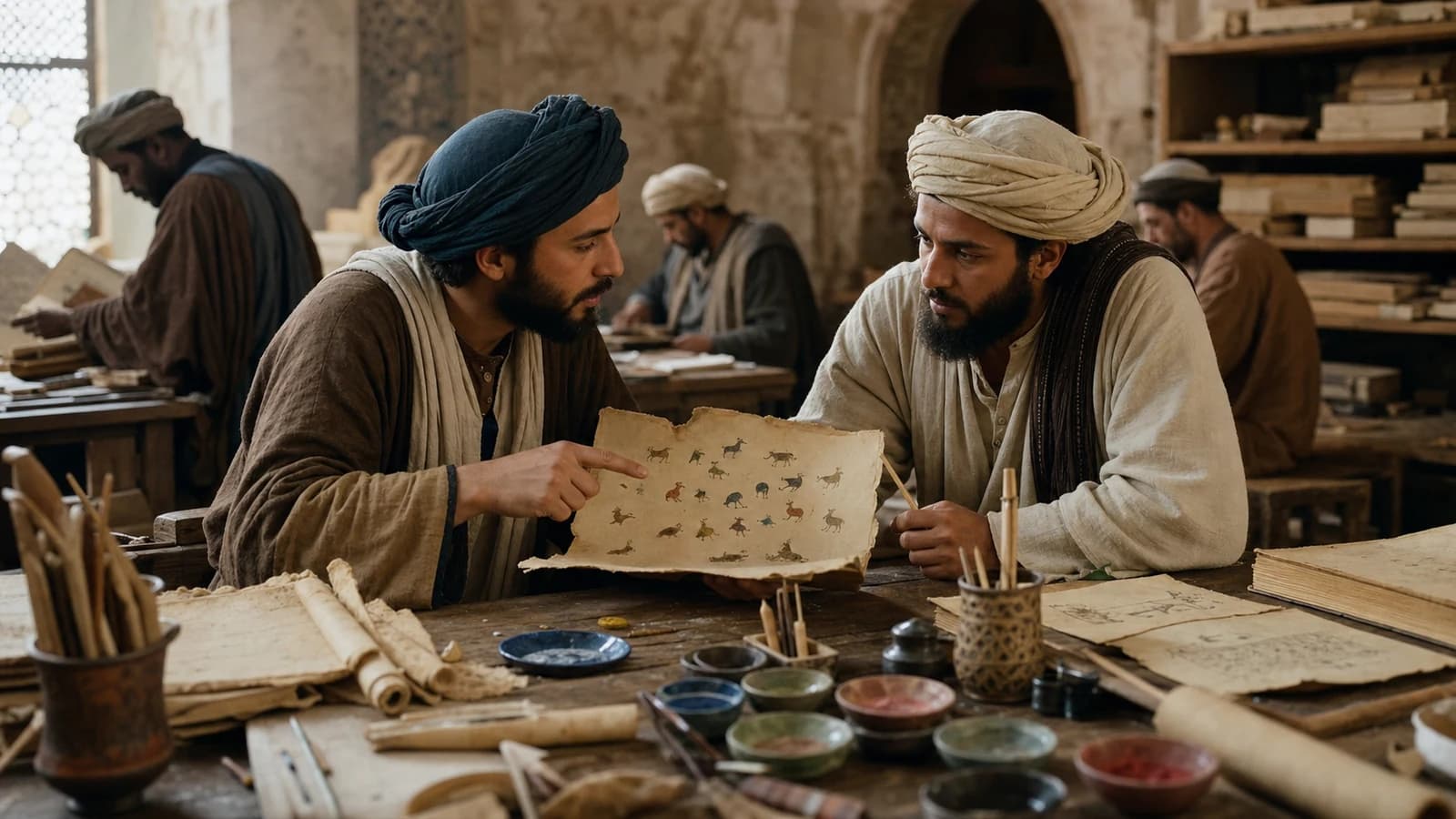
The cover image is an original AI-assisted reconstruction of fable transmission, not a copy of any Kalila wa Dimna illustration or named manuscript.
Sources
- Library of Congress: Kalila wa-Dimna — origins, Arabic translation and used manuscript evidence.
- The Met: Folio from a Kalila wa Dimna — illustration cycle and cross-regional style.
- The Met: Fable of the Lion and the Hare — Persian manuscript and narrative image.


