Hunayn ibn Ishaq and the Craft of Translation
How Hunayn ibn Ishaq compared manuscripts, revised earlier versions and built precise Arabic medical vocabulary without working from a single fixed text.
Hunayn ibn Ishaq was a ninth-century physician, scholar, and translator whose systematic methodology for translating Greek medical texts into Syriac and Arabic transformed the intellectual landscape of his era. Working with a network of scholars, he established rigorous philological standards that moved beyond literal word-for-word substitution to prioritize semantic clarity and contextual accuracy. His efforts, alongside those of his family and pupils, created a vast corpus of medical literature that preserved and adapted Galenic and Hippocratic knowledge for a diverse, multilingual audience.
The Philological Method and Textual Criticism
At the core of Hunayn’s methodology was a commitment to textual criticism that mirrored modern editorial practices. Rather than translating directly from a single, potentially corrupted manuscript, Hunayn sought out multiple Greek witnesses of a text, comparing their variants to reconstruct a reliable archetype. This process of collation allowed him to identify scribal errors, lacunae, and interpolations before commencing the actual translation. His training in Greek, Syriac, and Arabic enabled him to navigate the subtle linguistic shifts between these distinct language families.
Once a stable source text was established, Hunayn rejected the mechanical, word-for-word translation style favored by many of his predecessors. He recognized that literal translation often resulted in obscure, unreadable Arabic that obscured the author’s original medical arguments. Instead, he practiced sense-for-sense translation, reading an entire sentence or paragraph to grasp its complete meaning before rendering it into the target language using natural syntax and appropriate medical terminology.
The Translation Network versus the House of Wisdom
Popular historical narratives often attribute the massive translation movement of the ninth century to a single, highly centralized state institution known as the House of Wisdom, operating like a modern assembly line. Historical evidence, however, points to a more decentralized and collaborative network of scholars, patrons, and workshops. Hunayn operated at the center of a highly skilled family workshop that included his son Ishaq ibn Hunayn, his nephew Hubaysh al-A’sam, and several close collaborators who specialized in different stages of the translation process.
This workshop network relied on the patronage of court officials, military commanders, and the caliphs themselves, who commissioned specific translations for practical medical use or intellectual prestige. Hunayn coordinated these efforts, often assigning initial drafts to his pupils, which he would later revise, correct, and polish. This collaborative model allowed for a high volume of production while maintaining a consistent technical vocabulary across the growing Arabic medical corpus.
The Epistle of Galen and Documentary Limits
Much of what is known about Hunayn’s methods and the scope of his work comes from his own Epistle on the translations of Galen, written to a patron named Ali ibn Yahya. While this document provides invaluable testimony regarding the titles translated, the patrons who funded them, and the linguistic challenges encountered, modern historians treat it with careful critical distance. The Epistle is a self-authored account designed to defend Hunayn’s reputation, demonstrate his scholarly authority, and secure continued financial patronage.
Furthermore, the physical survival of Hunayn’s work presents significant documentary challenges. No original autograph manuscripts written in Hunayn’s own hand are known to survive. Instead, the texts studied by modern scholars are later copies, often transcribed centuries after his death. These surviving manuscripts frequently incorporate scribal errors, marginal glosses that crept into the main text, and deliberate linguistic updates made by later copyists, complicating the task of isolating Hunayn’s original ninth-century phrasing.
An Evidence-Reading Checklist for Hunayn’s Translations
- Verify if the manuscript is a later copy or a rare early fragment to assess potential scribal drift.
- Identify whether the translation is attributed directly to Hunayn or to a workshop collaborator like Hubaysh.
- Analyze the translation style to determine if it employs sense-for-sense rendering or literal word substitution.
- Cross-reference the text with the titles and descriptions listed in Hunayn’s self-authored Epistle.
In conclusion, Hunayn ibn Ishaq’s work represents a sophisticated fusion of philology and medicine that standardized scientific Arabic. By analyzing his collaborative workshop and recognizing the rhetorical nature of his surviving Epistle, historians can move past romanticized myths of a singular translation factory. His legacy lies in a deliberate, critical methodology that bridged linguistic divides through systematic scholarship rather than mechanical transcription.
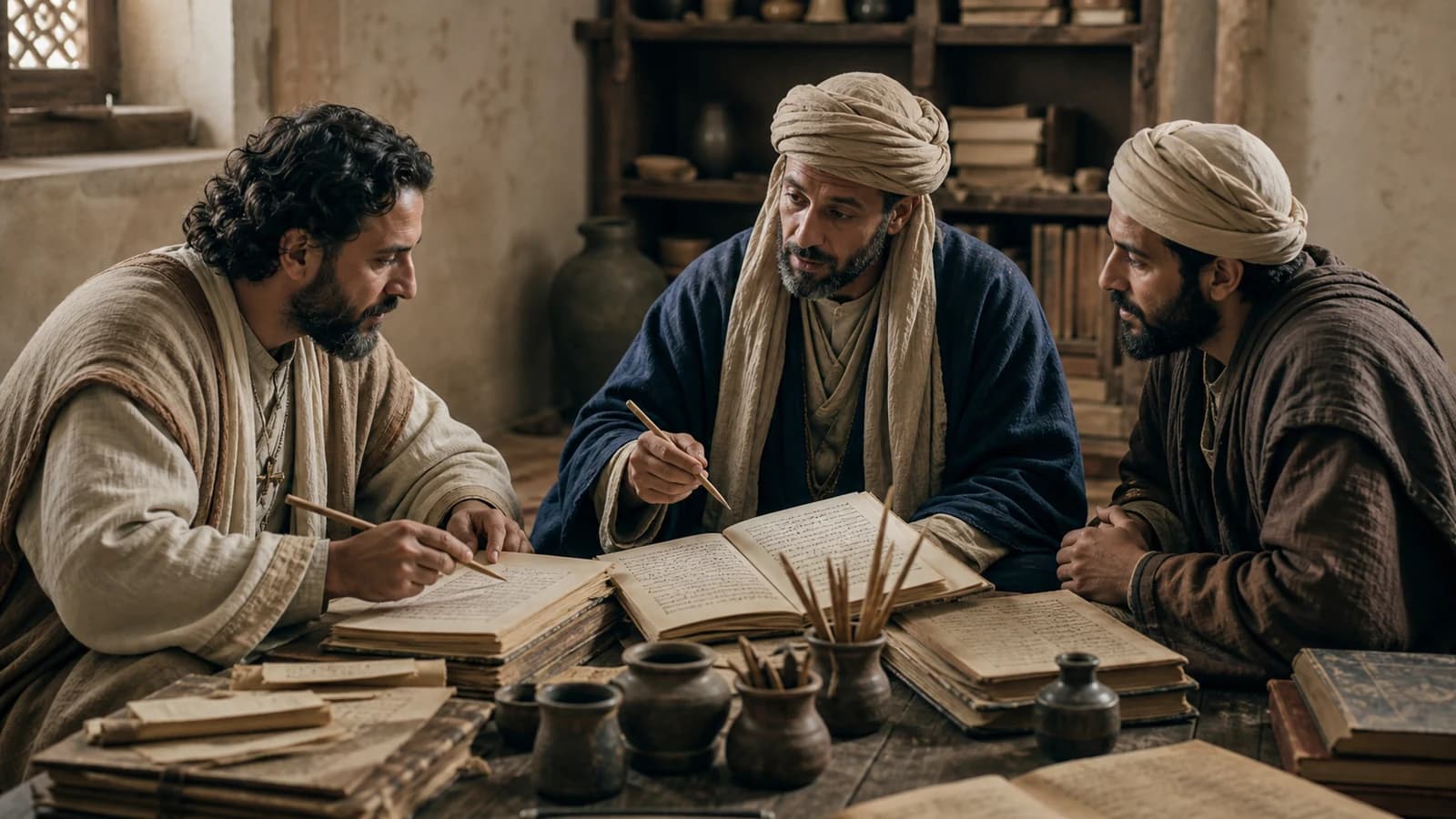
The cover image is an original AI-assisted historical reconstruction of a ninth-century translation workshop, not a portrait of Hunayn or a documented room.
Sources
- NCBI Bookshelf: Why Do We Translate? — primary Arabic testimony and translation context.
- National Library of Medicine: Greek Commentaries — Hunayn, Galen and manuscript transmission.
- PMC: In the Translator's Workshop — textual method and historical interpretation.
Related reading
- How Baghdad's paper trade changed books
- How Islamic manuscript inks were identified


