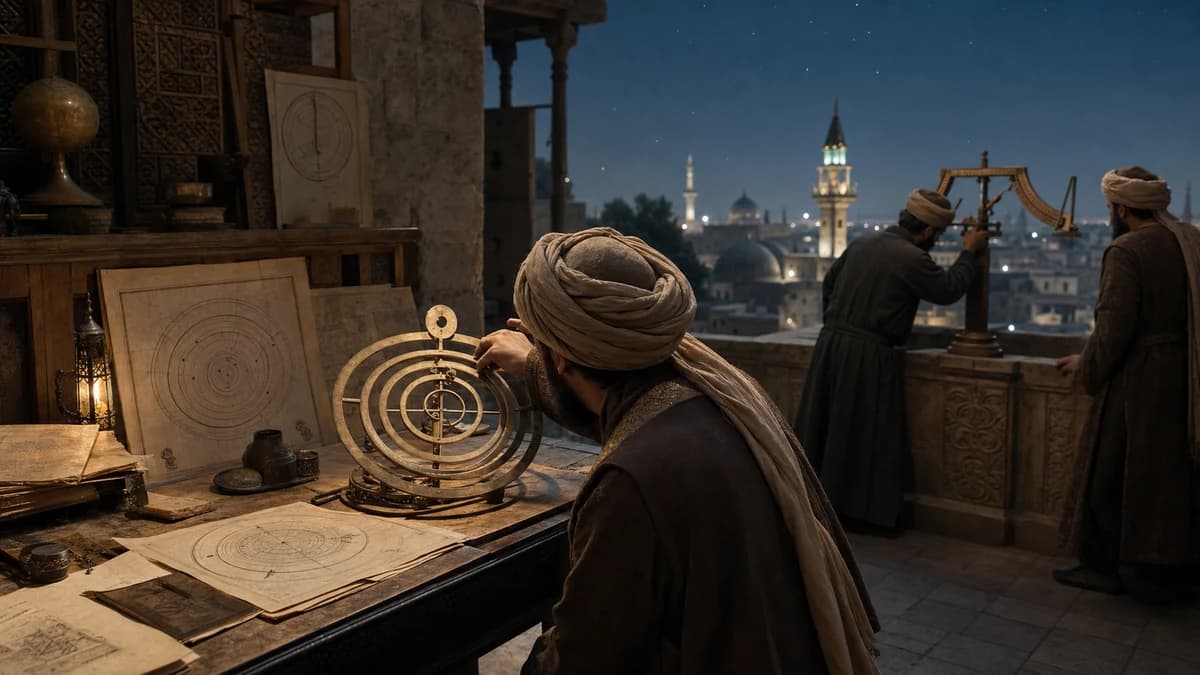
Ibn al-Shatir’s Planetary Model: Reforming Ptolemy in Damascus
How Ibn al-Shatir redesigned lunar and planetary models with linked circular motions, removed the Ptolemaic equant and improved physical consistency.
Ibn al-Shatir was a fourteenth-century astronomer and timekeeper at the Umayyad Mosque in Damascus. He developed new mathematical models for the Moon, Sun and planets that retained a geocentric cosmos while correcting problems he found in Ptolemy’s system.
The cover image is an original AI-assisted astronomical reconstruction, not a portrait of Ibn al-Shatir or a reproduction of a surviving instrument.
The equant created a physical problem
Ptolemy modeled planetary irregularities using combinations of circles, including an equant point from which motion appears uniform even though it is not uniform around the circle’s center. The device predicted observations effectively, but many later astronomers considered it inconsistent with uniform circular motion.
Ibn al-Shatir replaced such devices with linked epicycles. A mathematical construction now called a Tusi couple also appears within this wider tradition of model reform, although each astronomer used geometrical tools in distinct configurations.
His lunar model corrected an implausible distance change
Ptolemy’s lunar model implied a dramatic variation in the Moon’s distance and apparent size that observation did not support. Ibn al-Shatir constructed a new arrangement that reproduced longitude while greatly reducing that unwanted variation.
His planetary models likewise aimed for predictive success and geometrical consistency. They remained Earth-centered. Calling them heliocentric would misunderstand both their mathematics and cosmology.
The comparison with Copernicus is real but unresolved
Some of Ibn al-Shatir’s arrangements are mathematically equivalent to models used by Copernicus two centuries later, particularly for Mercury and the Moon. Scholars have documented the similarity. The precise route by which this knowledge may have reached Renaissance Europe, however, has not been established in a complete chain.
The responsible account neither ignores the resemblance nor invents a missing manuscript journey. Mathematical equivalence is evidence of a relationship worth explaining, not by itself proof of direct copying.
How to read a planetary diagram
- Identify the center of each circle and the point moving upon it.
- Separate a model’s predictive geometry from its physical cosmology.
- Compare lunar, solar and planetary constructions individually.
- State clearly which links to later European astronomy are documented and which remain hypotheses.
Ibn al-Shatir shows that geocentric astronomy was not static before Copernicus. It contained an active program of criticism, recombination and increasingly coherent mathematical modeling.
Sources
- Cambridge University Press: Venus According to Ibn al-Shatir — specialist analysis of a planetary model.
- Cambridge University Press: The Mercury Models of Ibn al-Shatir and Copernicus — documented mathematical comparison.
- MacTutor: Arabic Mathematics — broader scientific and mathematical context.


