Hisba and the Muhtasib: How Medieval Markets Were Regulated
What hisba manuals say about weights, measures, food, crafts and public conduct—and why the muhtasib was more than a simple market inspector.
In many premodern Islamic cities, the muhtasib was an official associated with hisba: supervising public conduct and commercial practice in accordance with law, custom and the ruler’s authority. The office is often translated as “market inspector,” but surviving manuals describe a wider and locally variable field of responsibility.
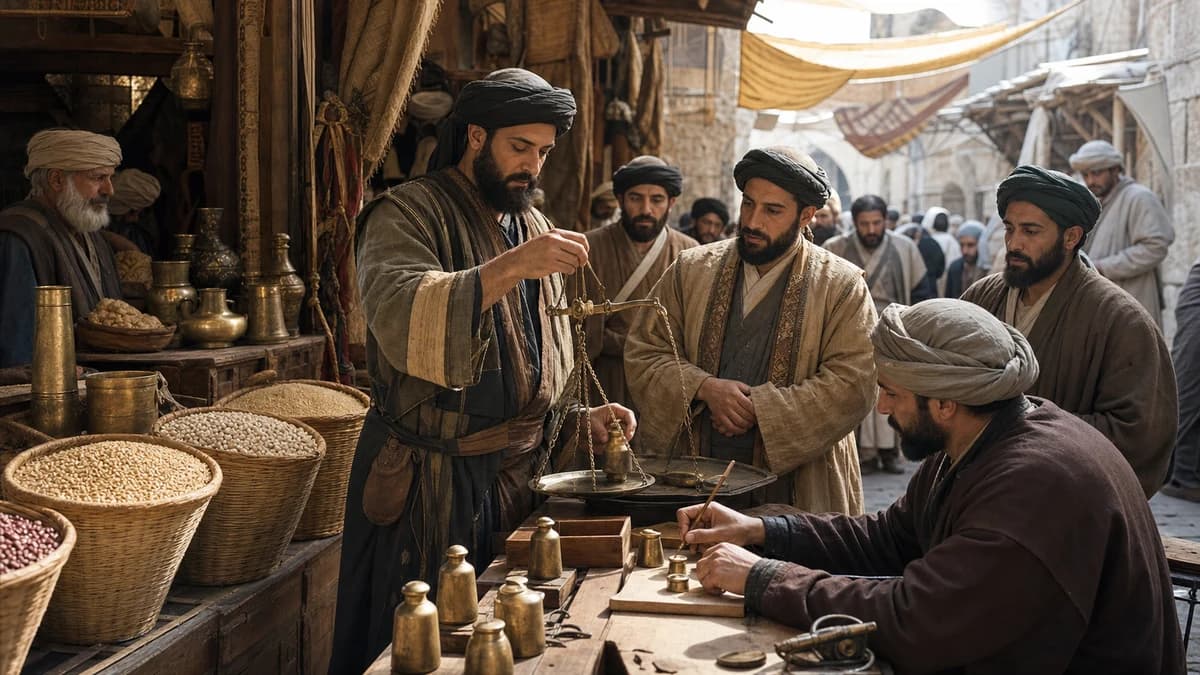
The cover image is an original AI-assisted historical reconstruction, not a portrait of a named official or a scene from one documented market.
Weights and measures made trust visible
Markets depend on shared standards. A muhtasib or supporting staff could inspect scales, measures and shop practices, responding to fraud or dangerous goods. Bread weight, flour quality, meat handling, water, street obstruction and workshop hazards appear in different documentary traditions.
Enforcement was not a modern laboratory system. Officials relied on known measures, skilled assistants, testimony, public reputation and legal procedure. Rules also differed between cities and centuries, so one handbook should not be treated as a universal code for the entire Islamic world.
Craft knowledge mattered
Hisba manuals list specialized trades because detecting poor work required practical understanding. The Met’s Jerusalem research notes detailed textile occupations and the product-based organization of the suq. Regulation therefore intersected with guild-like craft communities, merchants, judges and municipal authority without necessarily matching a modern professional licensing agency.
Food trades received special attention because adulteration and spoilage could harm many people quickly. Yet prescriptive text is evidence of what authors wanted, not proof that every shop always complied.
Street order and moral responsibility
The office could address blocked passages, unsafe structures and behavior in public space. Classical discussions connected hisba with the ethical duty to encourage right and prevent wrong, but actual jurisdiction depended on political institutions and legal culture. The muhtasib did not replace the judge, police, tax collector or craft expert in every matter.
Later governments changed, narrowed or bureaucratized market supervision. It is therefore risky to project a single medieval job description into every Ottoman, Mamluk, Abbasid or modern context.
How to use hisba sources
- Identify the author, city, date and legal setting.
- Separate ideal instruction from documented enforcement.
- Compare rules with archaeology, account books and court records.
- Notice which consumers, workers and hazards the text makes visible—or leaves out.
Hisba literature is valuable because it turns a marketplace from a scenic backdrop into a field of measurable obligations. It shows that public commerce required standards, expertise and continual negotiation.
Sources
- The Met: Jerusalem 1000–1400 — hisba manuals, textile trades and market organization.
- The Met: Trade and Commercial Activity — early Islamic market formation.
- The Met: Jerusalem Exhibition Galleries — specialized suqs and cross-community exchange.


