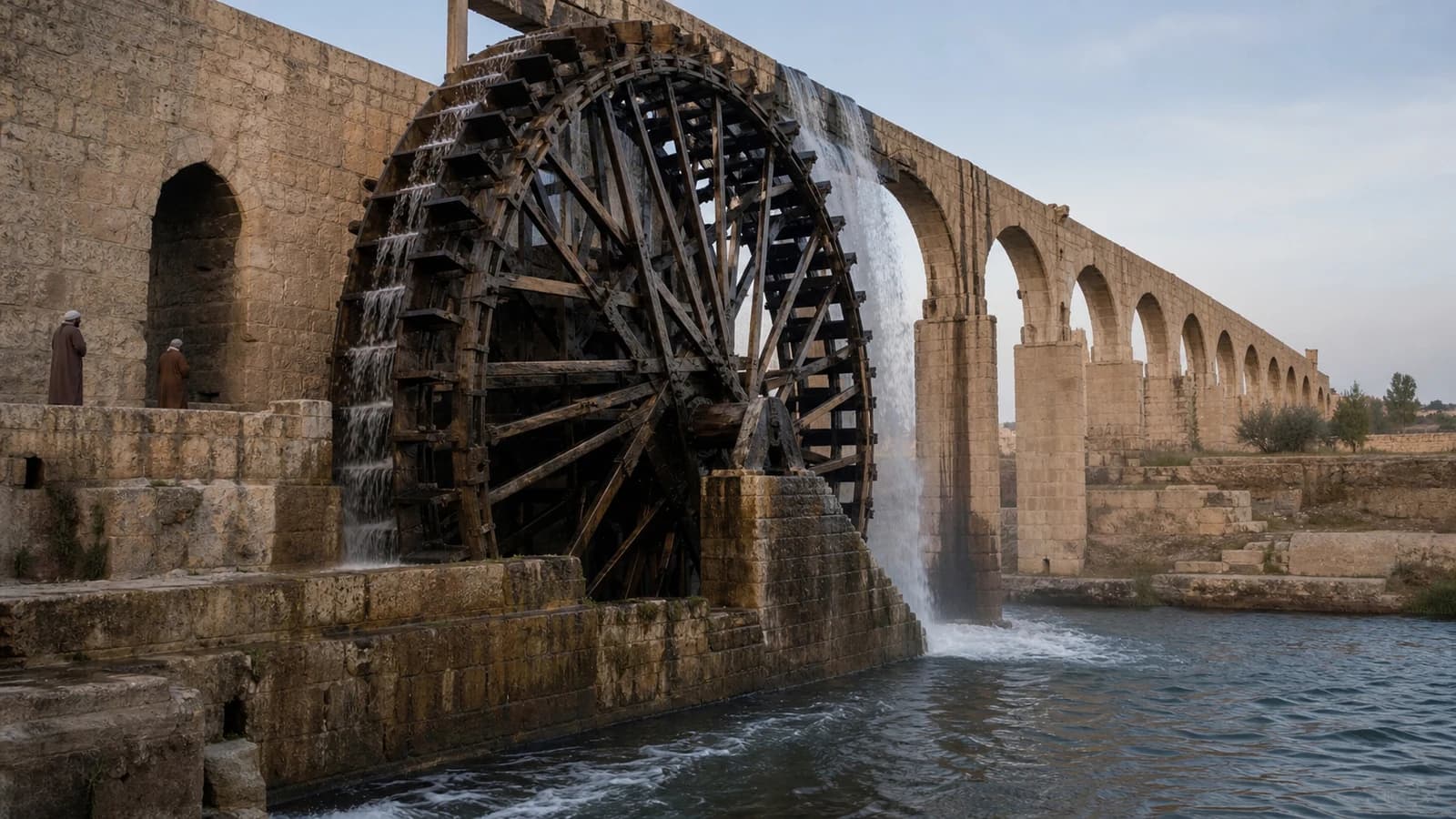
Hama Norias: How Waterwheels Lifted the Orontes
How Hama’s giant wooden norias lifted Orontes water into aqueducts, what the surviving wheels can prove, and why preservation requires continual craft.
The monumental norias of Hama are large, current-driven water-lifting wheels that historically moved water from the Orontes River to elevated masonry aqueducts. These structures do not mill grain or drive machinery; instead, they rely on the river’s flow to turn a wooden rim equipped with compartments or pots. As the wheel rotates, these containers lift water from the current and release it into troughs that feed into the city’s distribution network. Hama preserves an exceptional ensemble of these devices, yet their operation remains a cycle of maintenance and reconstruction rather than uninterrupted preservation.
Hydraulic Mechanics and System Integration
The noria functions as a connected hydraulic system where each component plays a specific role in lifting water. The axle supports the central structure, while paddles or blades catch the river’s current to generate rotational force. The rim holds boxes or pots that fill as they dip into the flow. Once lifted above the waterline, gravity causes the contents to empty into a wooden trough attached to the wheel’s outer edge. This trough channels the water into elevated masonry aqueducts that carry it toward urban users and gardens.
It is crucial to distinguish this mechanism from mill wheels. Norias do not convert kinetic energy into mechanical work for grinding or forging. They simply transfer potential energy by raising water to a higher elevation. The river provides the motive power, making the wheel’s speed dependent on seasonal flow rates rather than human adjustment.
Maintenance and Material Reality
Surviving norias are not static monuments but dynamic structures requiring constant care. Wet timber is susceptible to rot, and the Orontes River experiences significant seasonal fluctuations and occasional floods. These conditions demand that individual wheels be repeatedly repaired or rebuilt over time.
The wood used in construction was traditionally sourced locally or regionally, but material choices were driven by availability and resistance to water damage rather than universal standards. Modern reconstructions may use treated timber or contemporary fasteners, yet the fundamental geometry remains consistent with historical precedents. Treating these wheels as museum pieces ignores their functional nature; they are engineering solutions that have evolved through continuous intervention.
Origins and Historical Interpretation
Proposed dates for the invention of the noria often extend into the medieval period or earlier. However, surviving fabric does not automatically indicate the date of invention. Archaeological evidence is fragmentary, and later copies may obscure original designs. Scholars must carefully separate prescriptive texts that describe how norias should work from the physical objects that remain.
The ensemble in Hama represents a peak in this engineering tradition, particularly during the Ayyubid and Mamluk periods. Yet, attributing specific wheels to particular centuries without stratigraphic evidence is speculative. The current appearance of the norias is a palimpsest of repairs, replacements, and modern aesthetic choices rather than a pristine record of medieval technology.
Heritage Performance vs. Operational Reality
Today, the Hama norias serve as a heritage performance for visitors, but they also continue to irrigate surrounding agricultural lands. This dual role creates tension between conservation goals and functional needs. Restoring a wheel to its perceived original state may compromise its ability to withstand modern flood regimes.
Understanding these structures requires acknowledging their vulnerability. They are not immutable icons but adaptive technologies that have survived because they were maintained, not because they were preserved in isolation. Their value lies in the continuous human engagement required to keep them turning.
- Distinguish norias from mill wheels by checking for power transmission mechanisms
- Identify seasonal flow impacts on wheel rotation speed and water volume
- Separate surviving timber from original construction through dendrochronology if possible
- Note the difference between masonry aqueducts and wooden troughs in water transport
The cover image is an original AI-assisted historical reconstruction, not a photograph or measured record of a surviving Hama noria.
Sources
- UNESCO World Heritage Centre: Norias of Hama — heritage description and hydraulic setting.
- UNESCO: Emergency Maintenance of the Norias of Hama — maintenance, condition and safeguarding.
- British Museum: Water-hoist Collection Scope Note — comparative definition of water-lifting devices.


