Saqiya Waterwheel: How a Chain of Pots Raises Water
How animal-powered gearing turns a vertical chain of pots, why the saqiya differs from river-driven norias and shadufs, and where evidence survives.
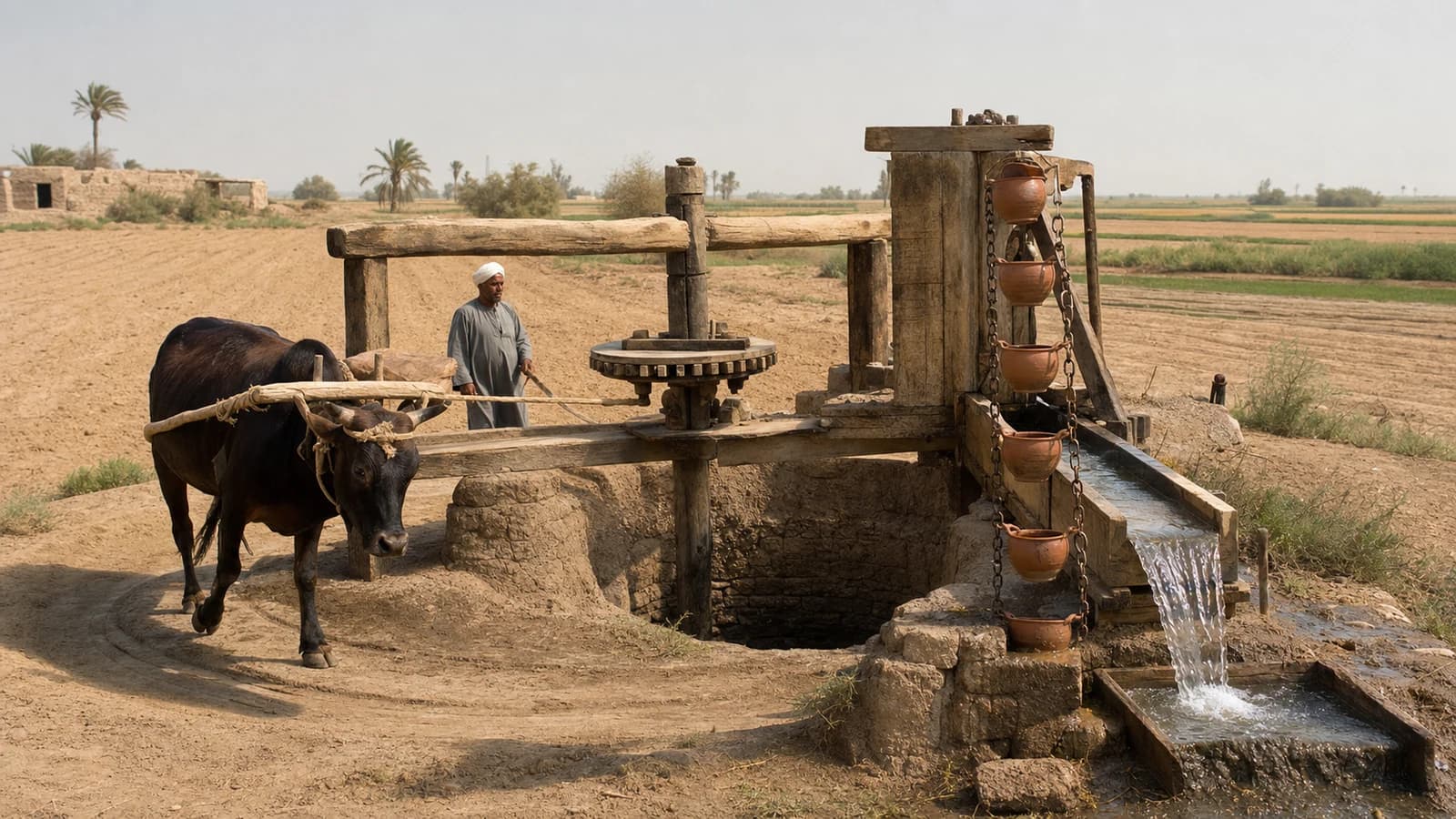
A saqiya functions as a water-lifting installation, typically powered by an animal walking in a circle. This mechanical arrangement allows the device to raise groundwater to the surface where direct river access is unavailable. The system adapts to local hydrological conditions, demonstrating regional versatility rather than adhering to a single standardized design.
Mechanical Transmission
The core of the system involves transferring rotational force from the animal path to the lifting mechanism. A wooden beam connects the animal to a horizontal axle, though specific constructions vary by region and period. Gears convert this horizontal motion into vertical rotation, driving a shaft that supports a chain or wheel equipped with vessels. Bearings reduce friction at critical joints, but wear necessitates frequent adjustment, indicating that operational efficiency depended on meticulous local maintenance rather than universal engineering constants.
Vessels and Discharge
The lifting elements consist of pots, often made of ceramic or wood, attached to the rotating component. As the chain turns, these vessels dip into the well water below. Gravity assists in pulling the filled pots upward until they reach the discharge point at the top. The angle of the vessel allows it to tip, emptying water into a collection trough positioned above. This continuous loop maintains output, though the height achieved is strictly limited by the structural integrity of the perishable materials and the specific gear ratio employed.
Terminology and Distinctions
Confusion frequently arises between the geared saqiya, the river-driven noria, and the lever-based shaduf. The noria relies on current flow rather than animal power, while the shaduf uses counterweights and levers. Clear terminology distinguishes these technologies. Arabic sources use varied terms across different regions, reflecting local adaptations. Consequently, one must avoid assigning a universal origin or layout to any single diagram, as surviving evidence points to significant regional variation in both function and form.
Archaeological Evidence
Archaeological remains often preserve masonry pits, bearing stones, and animal paths better than the perishable machinery itself. Wood, rope, and ceramic pots decay quickly, leaving gaps in our understanding of the exact mechanical links. Modern reconstructions must therefore remain tentative, distinguishing between surviving structural foundations and later written prescriptions. We should view the saqiya not as a fixed artifact but as a flexible technological adaptation to local water needs.
- Distinguish saqiya from noria and shaduf based on power source
- Acknowledge regional variation in terminology and mechanical layout
- Recognize that masonry survives better than wooden or rope components
- Treat modern diagrams as interpretations, not universal standards
The cover image is an original AI-assisted reconstruction of a generic saqiya, not a photograph or measured reconstruction of one excavated device.
Sources
- British Museum: Water-hoist Collection Scope Note — classification of water-lifting machinery.
- British Museum: Model of a Shaduf — comparative evidence for a different lifting mechanism.
- The Met: Art of the Islamic World, Unit 4 — science, technology and mechanical context.
Related reading
- How Hama’s river-driven norias work
- How qanat tunnels move water without lifting it


