Fatimid Rock Crystal Ewers: Carving Light from Quartz
How Fatimid artisans hollowed quartz into thin-walled ewers, carved animals and vines in relief, and why many vessels later entered European church treasuries.
Rock crystal is transparent quartz, harder than glass and unforgiving to carve. Under the Fatimids, especially in the tenth and eleventh centuries, artisans produced ewers and smaller vessels whose thin walls, handles and relief decoration required exceptional control. Only a small number survive.
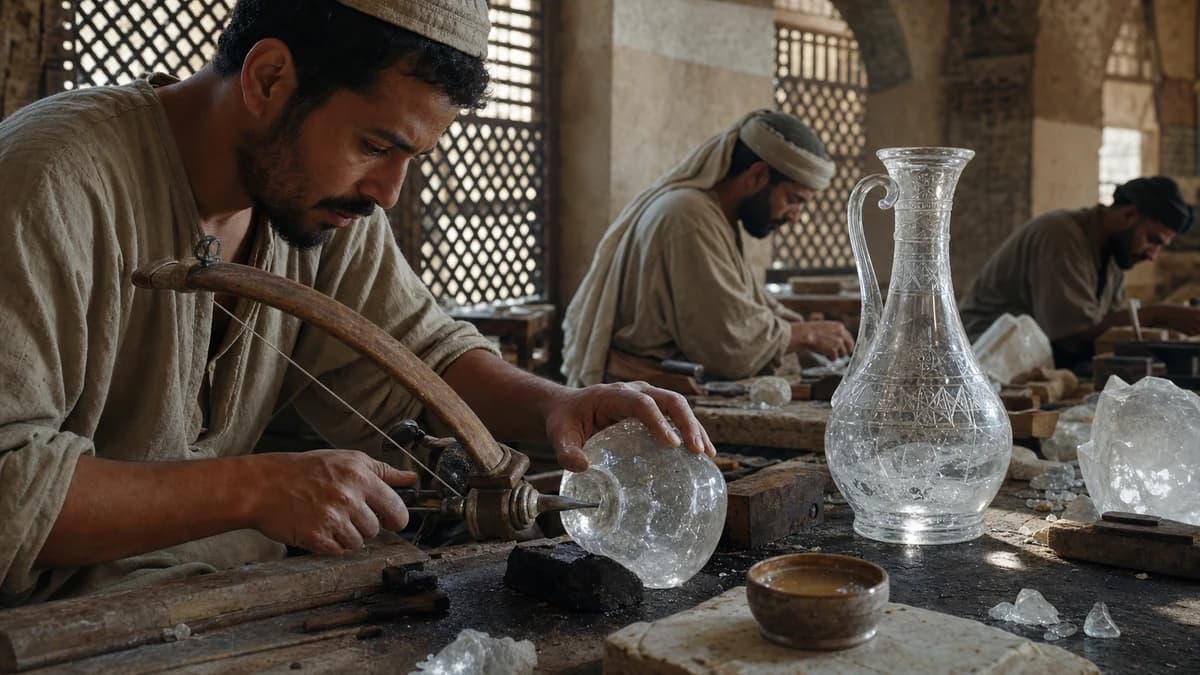
The cover image is an original AI-assisted lapidary workshop reconstruction, not a photograph of a surviving Fatimid ewer.
A vessel had to be hollowed from solid stone
The craft began with a suitable crystal mass. Abrasive powders and rotating tools gradually opened the interior and shaped the exterior. Because quartz does not soften like glass, a mistake could fracture months of work. Handles and narrow necks made the operation still more hazardous.
Carvers left selected areas in relief and cut away the ground around animals, birds, vines and palmettes. Polishing restored transparency after abrasion. Tool marks and wall thickness help distinguish the sequence, although later mounts can obscure original edges.
Transparency carried material and political value
Fatimid court culture in Cairo supported luxury arts in carved crystal, ivory, textile, ceramic and metal. A clear vessel turned water, light and movement into part of its appearance. Its material may also have evoked purity and wonder, but specific symbolic claims need textual evidence.
Animals such as lions or birds belong to a wider courtly vocabulary. They should not automatically be read as portraits of a ruler or as single fixed emblems.
European mounts reveal a second life
After leaving the Islamic Mediterranean, some rock crystal vessels entered European church treasuries. Gold, enamel or jeweled mounts converted them into liturgical containers or reliquaries. These settings helped preserve fragile objects while changing how they were handled and understood.
A vessel’s current name may describe this later Christian use rather than its original Fatimid function. Provenance should therefore be written as a sequence, not a leap from Cairo to a modern museum.
How to study a rock crystal vessel
- Identify which parts are carved quartz and which are later mounts.
- Look for wall thickness, drilling and polishing evidence.
- Distinguish original function from later treasury use.
- Treat a Fatimid attribution as the result of technical and stylistic comparison, not transparency alone.
These ewers are remarkable because they make extreme labor appear effortless. The finished vessel seems almost immaterial, even though it began as a heavy block of stone.
Sources
- The Met: The Art of the Fatimid Period — court culture and luxury arts.
- The Met: Carved Rock Crystal Flask — material and technical context.
- Victoria and Albert Museum: Islamic Middle East Collection — comparative Fatimid and Mediterranean objects.


