Dar al-Ilm: Books and Learning in Fatimid Cairo
What sources say about al-Hakim's Dar al-Ilm, its library and teaching, and why it should not be flattened into a modern university or public library.
The Dar al-Ilm, established in Cairo by the Fatimid caliph al-Hakim in the early eleventh century, served as a prominent court-supported center for books, copying, teaching, and Ismaili intellectual activity.
Foundation and Caliphal Patronage
Founded in the early eleventh century under the direct patronage of the Fatimid caliph al-Hakim, the Dar al-Ilm was designed to support the intellectual and religious goals of the ruling dynasty. The institution received significant court support, which helped fund the acquisition of manuscripts, the maintenance of the facility, and the daily operations of scholars and attendants. This patronage allowed the Fatimid court to foster a dedicated environment for Ismaili intellectual activity and state-aligned scholarship.
While the institution was closely tied to the dissemination of Ismaili doctrine, historical sources indicate that the activities within its walls extended beyond theology. Scholars and students engaged with a variety of subjects, reflecting a broad intellectual curiosity. The caliph's support of this institution helped project the cultural and intellectual authority of the Fatimid court throughout the region, establishing Cairo as a major center of learning.
The Library, Access, and Materials
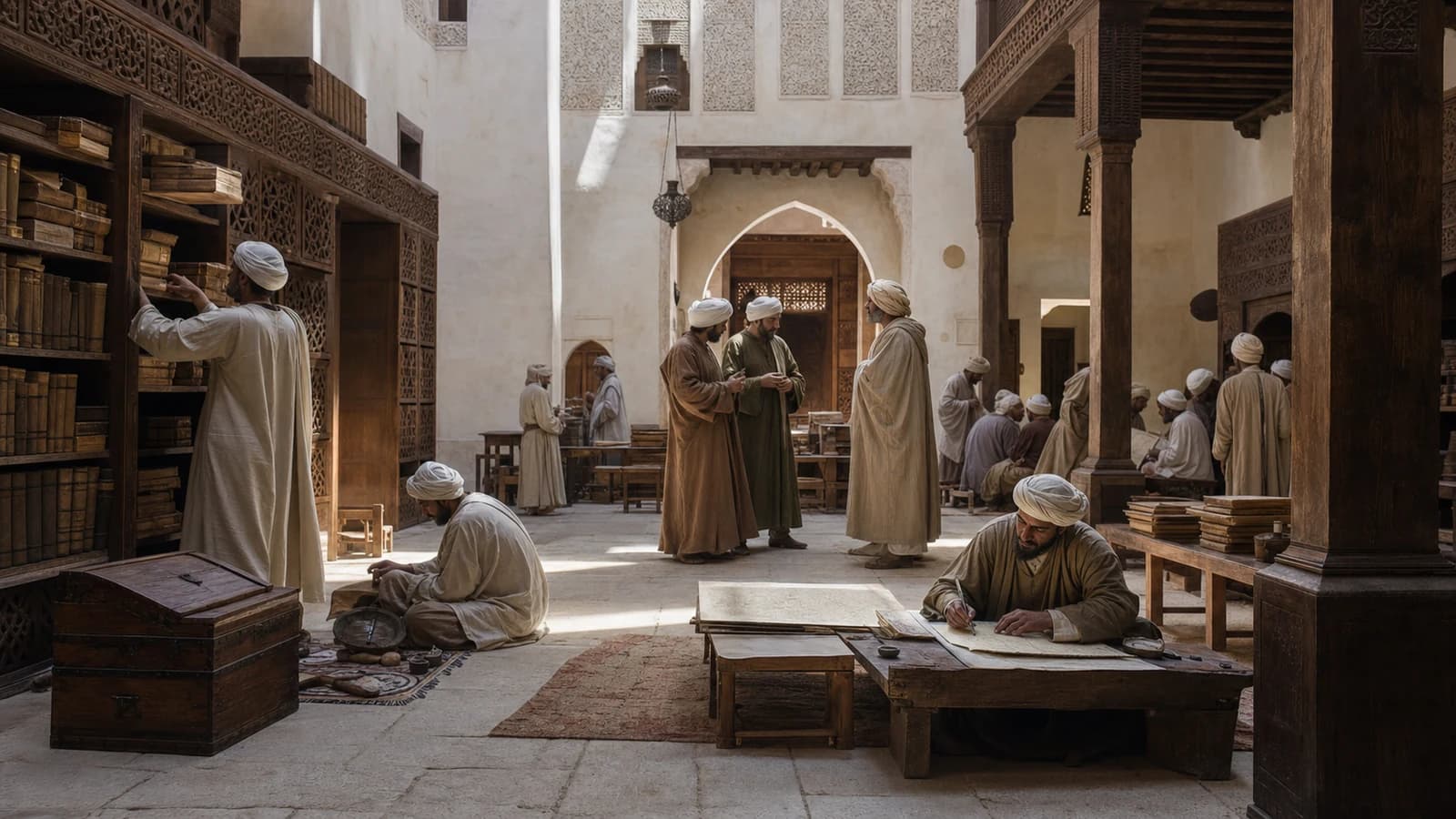
At the core of the Dar al-Ilm was a system that connected books, paper, copyists, and teaching. The institution provided writing materials, including paper, ink, and pens, to facilitate the copying of manuscripts and the preservation of knowledge. This integrated system allowed scholars and copyists to work efficiently, ensuring that texts were preserved, studied, and transmitted to students within the institution.
Although some historical accounts describe the Dar al-Ilm as being open to the public, modern historians qualify this terminology carefully. In the eleventh century, a public institution did not mean a modern tax-funded public library with universal membership. Access was highly dependent on social status, literacy, and court connections, meaning that the library primarily served an elite group of scholars, state officials, and religious students rather than the general population.
Reconstructing the Physical Space
The original physical structure of the Dar al-Ilm is not securely preserved in Cairo today. Because no archaeological remains or secure architectural structures survive, modern researchers cannot directly analyze the physical layout of the institution. Consequently, the arrangement of daily rooms, book storage, and teaching spaces must be reconstructed using historical chronicles and institutional texts.
These written accounts provide valuable clues about how the space was organized, describing rooms equipped with furnishings to accommodate readers and protect manuscripts. However, because these descriptions come from medieval texts that may contain rhetorical embellishments, historians must approach them with caution. The lack of physical evidence requires a careful reading of the surviving texts to separate institutional ideals from daily realities.
Institutional Distinctions
To maintain historical accuracy, it is essential to separate the Fatimid Dar al-Ilm from other institutions with similar names. It must be distinguished from the earlier Bayt al-Hikma in Baghdad, which operated under different administrative and intellectual frameworks. Additionally, the Cairo institution must not be conflated with later buildings and libraries that adopted similar names under subsequent dynasties.
The history of the Dar al-Ilm was also marked by periods of instability, reflecting the political fortunes of the Fatimid caliphate. Over the decades, the library collections faced dispersal and disruption during times of economic and political crisis. Despite these challenges, the institution remains a key subject of study for understanding the complex relationship between state patronage, sectarian scholarship, and the preservation of written knowledge in the medieval Islamic world.
Evidence-Reading Checklist
- Identify references to the early eleventh-century foundation by the Fatimid caliph al-Hakim in Cairo.
- Distinguish the Fatimid Dar al-Ilm from the Abbasid Bayt al-Hikma in Baghdad.
- Analyze how the term public is qualified in relation to medieval library access.
- Examine the reliance on chronicles and institutional texts due to the lack of a preserved physical structure.
- Trace the connection between books, paper, copyists, and teaching in the historical descriptions.
Through a careful reading of surviving chronicles, modern historians continue to reconstruct the intellectual and administrative systems that defined this important Cairo institution.
The cover image is an original AI-assisted reconstruction of a Fatimid book institution, not a photograph, floor plan or documented view of Dar al-Ilm.
Sources
- Institute of Ismaili Studies: The Fatimids and Their Traditions of Learning — institutional and intellectual context.
- Institute of Ismaili Studies: Intellectual Life in Fatimid Times — Dar al-Ilm, teaching and book culture.
- UCL Digital Egypt: Museum and Library Traditions — comparative history of collections and learning.
Related reading
- How Baghdad's translation movement worked
- How the kitabkhana organized book production


