Ebru Marbling: How Color Floats Before It Becomes Paper
A clear guide to ebru: thickened water, prepared pigments, combed patterns and the single controlled contact that transfers a floating design onto paper.
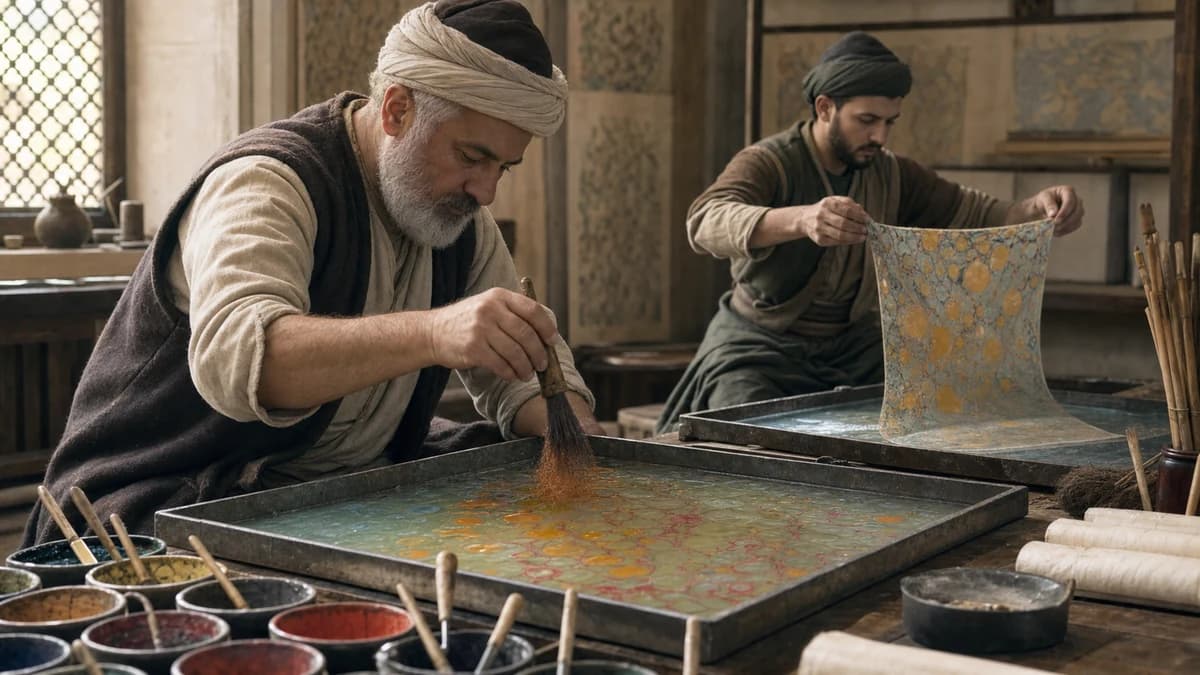
The cover image is an original AI-assisted workshop reconstruction, not a photograph of a historical sheet or living artist’s work.
The bath slows and supports the color
Traditional makers thicken water with a plant gum, commonly gum tragacanth. Pigments are finely ground and mixed with a dispersing agent such as ox gall so droplets spread without dissolving into one another. Recipes change with climate, water and material, so successful marbling depends on adjustment rather than a fixed formula.
Colors are sprinkled from brushes. A stylus draws curls; combs pull repeated waves; later floral ebru uses controlled drops and drawn stems. Too much disturbance muddies the bath, while dust or poorly prepared pigment can break the surface.
Transfer happens in one contact
A sheet is lowered evenly onto the floating pattern. When lifted, it carries the color while leaving most of the bath behind. The maker cannot repaint the same floating arrangement after transfer, although related patterns can be produced through repeated gestures.
Drying and burnishing prepare the paper for use. Marbled sheets became endpapers, margins, writing grounds and independent works. Calligraphers could write over carefully selected patterns, joining two crafts without making one merely decorative background.
A transregional technique gained local identities
Paper marbling traveled across Iran, the Ottoman world, South Asia and Europe. Terms, tools and patterns changed along the route. Calling every marbled sheet “Turkish ebru” erases these related histories; refusing the Ottoman tradition its distinct vocabulary does the opposite.
Dating loose sheets is difficult because paper could be stored and reused. Album context, pigments, watermarks, inscriptions and binding history are often more reliable than pattern alone.
How to examine marbled paper
- Identify whether the pattern is truly marbled or imitated by direct painting or print.
- Look for comb paths and the order in which colors overlap.
- Separate the date of the sheet from the date of the album or binding.
- Acknowledge later ownership marks and conservation.
Ebru turns fluid behavior into design. Its apparent spontaneity rests on material preparation precise enough to make chance usable.
Sources
- The Met: Album of Calligraphy with Marbled Paper — documented Ottoman marbling in book arts.
- The Met: The Art of the Ottomans before 1600 — court and manuscript context.
- The Met: Modern Artists and the Ottoman Past — continuity and reinterpretation of Ottoman techniques.


