Islamic Bookbinding: From Sewn Quires to Tooled Leather Covers
How binders folded and sewed quires, attached boards, covered books in leather and used tooling, doublures and envelope flaps to protect manuscripts.
A manuscript becomes a usable book only when its leaves can be opened, read and protected as a coherent object. Across Islamic lands, binders developed varied structures for Qur’ans, literature, science and administration. A familiar binding might combine sewn paper quires, pasteboard covers, a leather spine and boards, decorated doublures and a flap that wraps from the back. Yet materials and construction changed by region, date, budget and later repair.
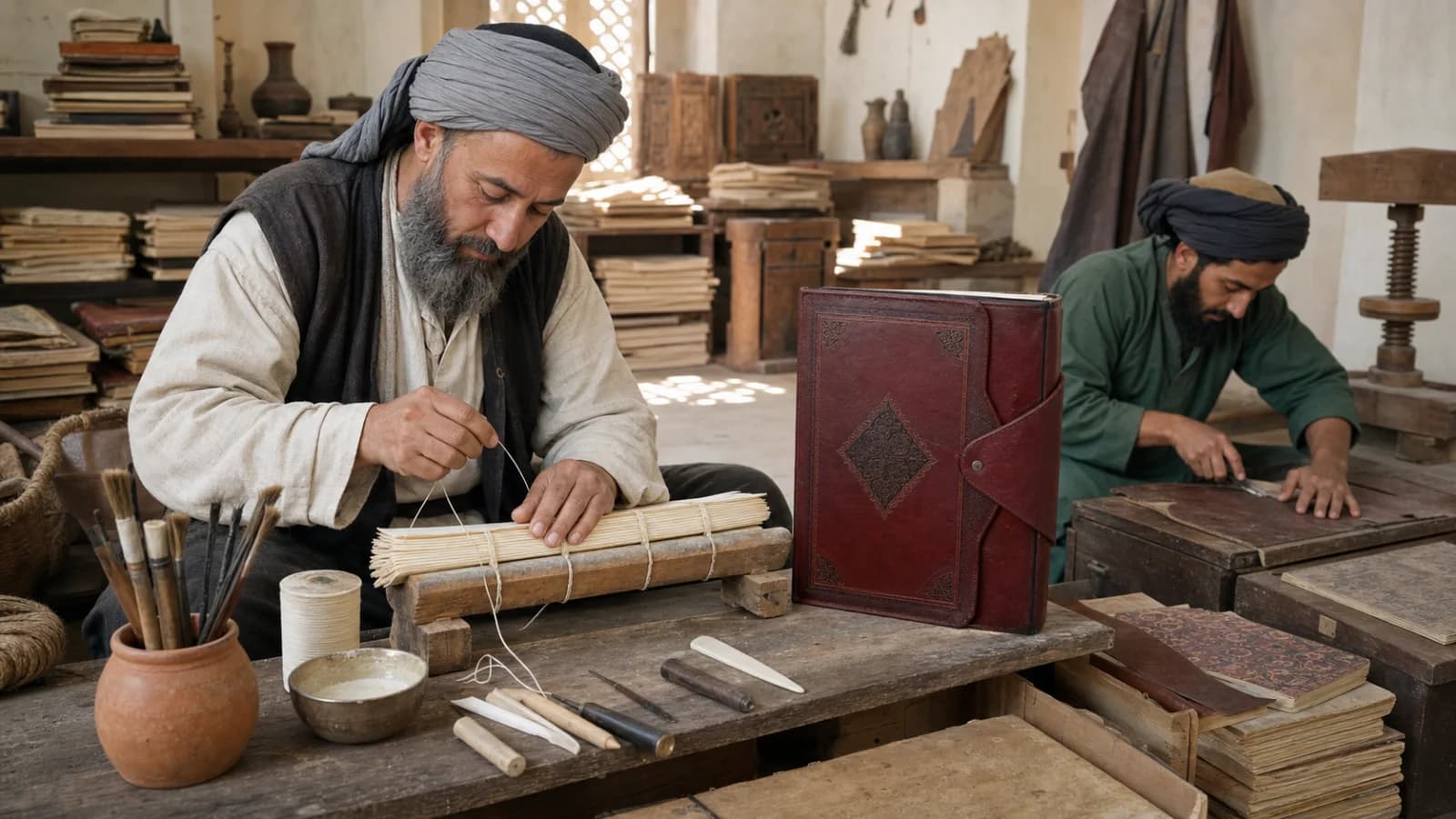
This article uses an original AI-assisted visual reconstruction for educational context. It is not a photograph of a specific historical bindery or surviving manuscript.
Building the book block
Scribes normally wrote on sheets that were folded and gathered into quires. The binder checked their order, then sewed the gatherings through their folds so the leaves would turn as a sequence. Endpapers and linings helped connect this book block to its covers. Boards could be made from laminated paper or other materials; leather was pared thin enough to fold around edges and joints without creating bulky ridges.
The result had to balance strength with movement. Sewing that was too tight could restrict opening, while a weak joint could detach the cover. A flat spine, characteristic of many Islamic bindings, behaves differently from a heavily rounded European spine. Repairs often replaced sewing, endleaves or covers, so the decoration visible today may be younger than the text it protects.
Tooling, stamping and envelope flaps
Leather covers could be blind-tooled, gilded, painted, cut or stamped. Craftspeople built designs from borders, corner pieces and central medallions, sometimes using blocks that repeated complex patterns efficiently. Inner covers, or doublures, offered another field for cut leather, filigree, textiles or painted paper. Decoration was planned around the closed book but also revealed in stages as a reader opened it.
The envelope flap is distinctive but not universal. Attached to the back cover by an extension, it folded across the fore edge and tucked beneath the front cover, offering additional protection to the pages. Its survival can reveal how a volume was stored and handled, but an isolated flap in a museum no longer shows the complete binding structure. Nor should every triangular flap be assumed original: components were traded, reused and reattached.
How to examine a binding
Begin at the center of a quire and look for sewing stations. Follow the thread, then study how the first and last leaves meet the boards. Compare wear at the spine, fore edge and flap. Repeated impressions can identify tools shared across several books, while differences in leather, thread or pastedowns may reveal later restoration. Catalogues often describe text, binding and repair history separately for this reason.
“Islamic binding” names a broad family, not a single timeless model. Ottoman, Mamluk, Persian, Maghribi, South Asian and other workshops made different choices and influenced one another. The strongest history keeps structure and ornament together: a cover is an artwork, but it is also a moving mechanism engineered to make reading possible.


