Allahu Akbar Meaning, Arabic Words and Everyday Worship
Allahu Akbar means God is greater or God is greatest. Learn its Arabic spelling, why translations differ and how the takbir is used in prayer, adhan and Eid.
Allahu Akbar, written الله أكبر in Arabic, is an affirmation of God's greatness. It is commonly translated as “God is greatest” or “God is greater.” Saying it is called takbir. Muslims use the phrase in daily prayer, the call to prayer and other acts of remembrance; its meaning is best understood alongside the occasion in which it is spoken.
Someone hearing the phrase for the first time may want a translation. Someone learning to pray needs to know what it does within worship. Those are connected questions, but they are not identical. This guide explains the words, shows several documented settings and distinguishes the phrase from other familiar Islamic expressions.
What do the Arabic words mean?
The phrase has two words: Allah and akbar. Allah is the name used for God in this expression; akbar conveys greatness in a comparative or superlative form. The short English rendering supplies “is” to make a natural English sentence. It is not a third word that has to be found in the Arabic spelling.
| Form | What it helps a reader understand |
|---|---|
| الله أكبر | The Arabic phrase without full vowel marks |
| اللَّهُ أَكْبَر | A vocalized form useful to a learner |
| Allāhu akbar | Transliteration that marks the long vowel in Allāh |
| Allahu Akbar | Common English spelling without scholarly diacritics |
| Takbir or takbīr | The act of declaring God's greatness, associated with saying the phrase |
The spelling Allahuakbar joins the transliterated words together, but the Arabic expression still contains two words. Allāhu and Allahu are different ways of representing the same phrase for readers with different levels of Arabic knowledge. Capitalization in an English heading does not add a separate religious meaning.
Turkey's Diyanet educational material explains the expression through the affirmation that nothing is greater than Allah. That is a theological explanation of the phrase's use. It helps prevent a literal English comparison from sounding as if an unstated rival has to be identified before the sentence makes sense.
Why do translations say both greater and greatest?
Arabic and English do not arrange every comparison in the same way. Akbar belongs to the Arabic elative pattern, which can express comparison or the highest degree in context. A 2025 linguistic study of Bisha Colloquial Arabic illustrates akbar in both comparative and superlative examples. That study concerns a particular dialect; it is linguistic background, rather than a religious ruling about the takbir.
“God is greater” brings out the comparative shape. “God is greatest” expresses the affirmation in familiar devotional English. “God is great” is also encountered as a brief translation, though it leaves less of the comparative emphasis visible. A learner does not need to treat every difference between these translations as a disagreement about which God is meant.
The question to ask is what a translation is trying to show. A word-by-word gloss may keep the form “greater.” A prayer guide may choose “greatest” to communicate the intended affirmation naturally. An explanation can give both and then identify its context. That is more useful than silently moving between translations as though their wording were identical.
For comparison, our Shahada guide explains a different statement about belief. The takbir is not a shortened transcription of the Shahada. Recognizing the two expressions separately makes a transcript of prayer or a beginner's lesson much easier to follow.
How is Allahu Akbar pronounced?
A practical written guide is al-LAA-hu AK-bar. The doubled l in Allah and the long aa sound deserve attention; the initial vowel of akbar begins the second word. This is an English learning aid, not a phonetic transcription of every accent or a test of a person's religious status.
Read the phrase as two connected words rather than as a sequence of English letter names. Listen to a qualified teacher or a clear Arabic recitation when learning it for worship. A written syllable guide cannot demonstrate vowel length, rhythm and articulation as well as an actual voice.
When reading English material, expect small transliteration differences. A macron in Allāh marks vowel length; its absence in an ordinary article does not create a different Arabic word. Some teaching materials use an extra a to signal a long vowel. Choose a consistent system in your own notes, and keep the Arabic alongside it where possible.
For learners, pronunciation and meaning can be practiced together: identify the two words, hear the phrase, repeat it and recall the affirmation. For rules about an individual pronunciation difficulty during prayer, ask a knowledgeable teacher who can hear the person. A generic article cannot decide a specific case from an English spelling alone.
What does the takbir do in salah?
The takbir marks the beginning of ritual prayer and appears within its movements. In Sahih al-Bukhari 757, a report about teaching someone to pray begins with takbir and emphasizes calmness in the subsequent postures. The report places the utterance within a sequence of worship, rather than presenting it as a detached slogan.
For a newcomer, this explains why the same words may be heard more than once during a congregational prayer. Repetition serves the liturgical sequence; the phrase is not being given a new dictionary meaning at each movement. The imam's audible voice can help those following recognize the transition, while detailed practice belongs to the prayer tradition being taught.
Diyanet's explanation of salah connects beginning prayer with Allahu Akbar to awareness of God's greatness and worship. That is the devotional setting in which to understand the words. It should not be reduced to a command aimed at everyone within hearing distance.
Someone visiting a mosque can observe respectfully without assuming that every audible phrase requires a response from them. Someone learning salah should follow their teacher's complete instruction, including the recitations and movements around the takbir. Our Five Pillars of Islam guide places salah within the wider framework of Muslim worship.
Why is it heard in the adhan and iqama?
The adhan announces prayer, while the iqama signals that congregational prayer is about to begin. Both include the takbir. Sunan Abi Dawud 499 preserves a report of the call's wording, with the affirmation of God's greatness alongside the testimony of faith and invitations to prayer.
Hearing Allahu Akbar from a mosque therefore often means that the listener is hearing a familiar component of a larger call. Translating only those two words cannot explain the entire sequence. The surrounding words identify the call's religious purpose.
For the full distinction, read our adhan and iqama explanation. A useful transcript should make clear whether it is showing the complete call, a particular tradition's wording or one repeated phrase. It should not present a fragment as a complete universal script.
Egypt's Dar al-Ifta discusses repeating the adhan after the muezzin, including responses to the takbir and different responses to the invitations to prayer. This is a good example of why “always reply with the same words” is too broad. The occasion and the line being heard matter.
How is takbir used around Eid?
Takbir is also associated with Eid observance. It can occur as part of a longer formula that includes praise of God and the affirmation that there is no deity but God. The brief phrase Allahu Akbar and a longer Eid recitation are related, but they are not interchangeable as complete written texts.
In its ruling on takbirs before the two Eid prayers, Dar al-Ifta discusses the practice and accepts an expanded formula. This is the position explained by that institution. Different teaching traditions can give different instructions about wording, timing and congregational practice.
A beginner attending Eid prayer should use the local community's practical guidance rather than trying to infer the whole service from a translation of one phrase. It helps to ask a simple question in advance: “Which parts will the congregation say together, and what should a newcomer follow?” That question concerns participation, not the basic meaning of akbar.
For families planning a future Eid, a calendar estimate is another separate issue. Our Hajj and Eid al-Adha 2027 planning guide distinguishes dates from official travel and community announcements. Understanding the takbir does not itself establish the date of an observance.
Is the phrase only used in public worship?
No. A documented personal devotional setting is bedtime remembrance. Sahih al-Bukhari 5362 reports a sequence involving Subhan Allah, Alhamdulillah and takbir before sleep. The report shows that the phrase belongs in private devotion as well as in audible congregational worship.
The phrases in that sequence do different work. Subhan Allah expresses glorification; Alhamdulillah expresses praise; Allahu Akbar affirms greatness. They can appear together without becoming synonyms. A reader should preserve the distinction when translating a longer recitation.
In a conversation, the speaker's occasion also helps the listener understand the utterance. An expression of religious affirmation can accompany an emotional response, but the words alone do not identify the event or explain the speaker's intentions in full. Ask about the setting before attaching a detailed story to a short recording or isolated quotation.
Is Allahu Akbar a Quran verse, a greeting or the Shahada?
It is useful to distinguish a familiar formula from a verse reference. Quran 17:111 instructs the magnification of God, and Quran 2:185 relates magnifying God to guidance in its Ramadan passage. Those are scriptural contexts for the act. Quoting the familiar two-word formula does not, by itself, identify a complete verse number.
Nor is the takbir the usual peace greeting, and it is not the full testimony of faith. A vocabulary list should give each expression its own meaning and context. Collapsing them into “Muslim words for God” makes it harder to understand what someone is actually saying.
For a listener, three details are usually enough to begin: the phrase affirms God's greatness, saying it is called takbir, and its role depends on the surrounding act of worship or conversation. For a learner participating in prayer, add instruction from a teacher who can explain the entire sequence. Meaning is the starting point; context makes the words intelligible in use.
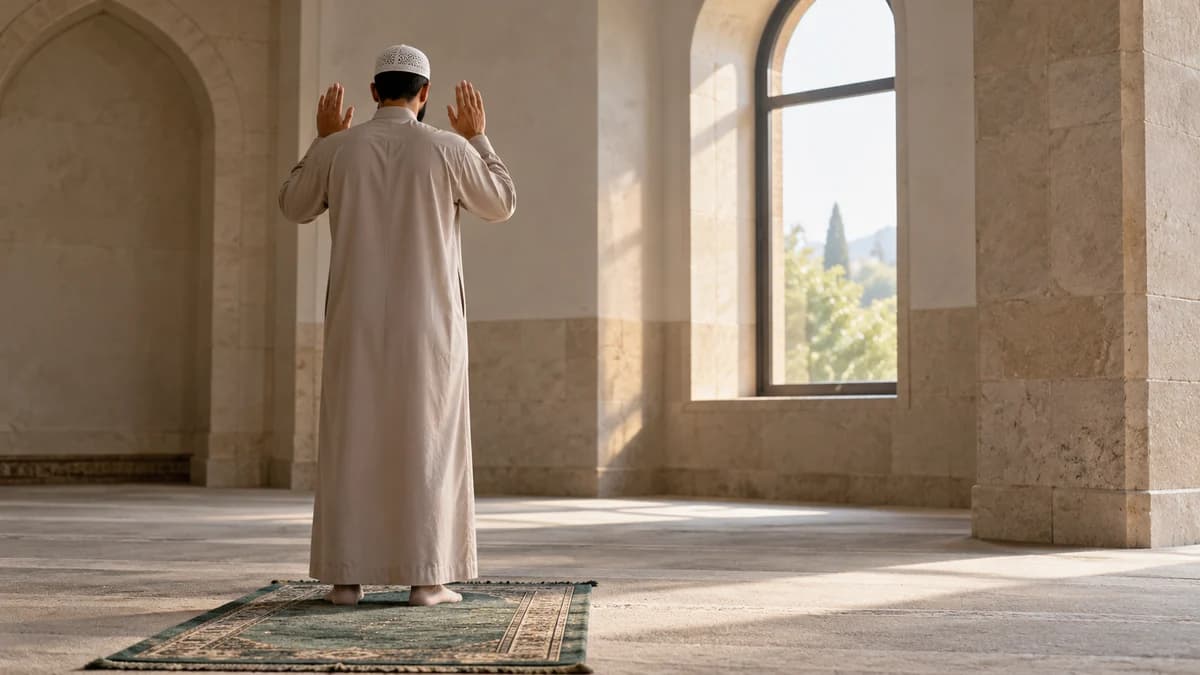
Cover image: AI-generated editorial illustration of an ordinary act of prayer. It does not document an identified person, mosque or event.
Sources
- Diyanet, What kind of monotheism? — religious explanation of God's greatness in the phrase.
- Fatema Alharthy, Comparative constructions in Bisha Colloquial Arabic — 2025 primary linguistic study; dialect examples inform the comparison, not a liturgical ruling.
- Sahih al-Bukhari 757 — prayer instruction beginning with takbir.
- Diyanet, Prayer (salah) — devotional account of opening prayer.
- Sunan Abi Dawud 499 — transmitted wording of adhan and iqama; the source displays its grading.
- Dar al-Ifta, Repeating the adhan after the muezzin — that institution's guidance on responses within the call.
- Dar al-Ifta, Takbirs before both Eid prayers — explains an accepted Eid practice without establishing a universal single formula.
- Sahih al-Bukhari 5362 — bedtime remembrance involving takbir.
- Quran 17:111 and Quran 2:185 — scriptural contexts for magnifying God, distinct from quoting a complete verse.