Alhambra Vases: Nasrid Lustreware at Architectural Scale
How the monumental Alhambra vases were built, glazed and fired, what the Gazelle Vase depicts, and why their original display remains an open question.
The so-called Alhambra vases are monumental ceramic vessels produced under the Nasrids in the thirteenth to fifteenth centuries. Their narrow bases, swollen bodies, wing-like handles and long necks turn pottery into an architectural presence. The celebrated Gazelle Vase remains in the Alhambra Museum.
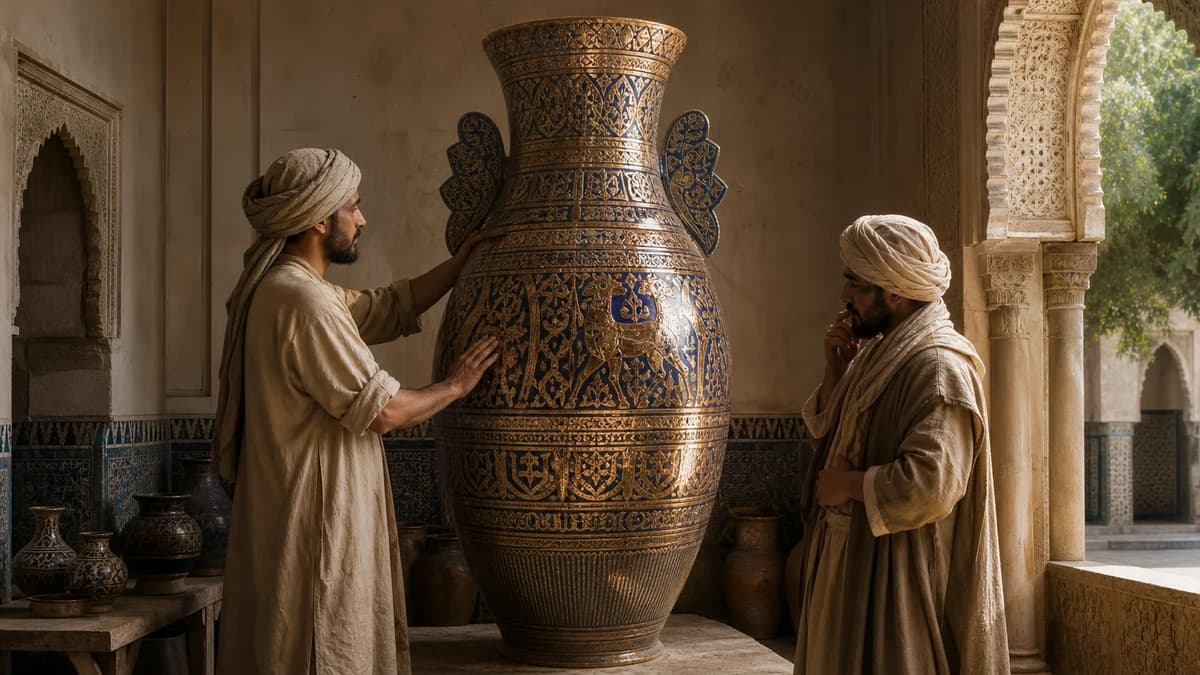
The cover image is an original AI-assisted palace reconstruction, not a photograph or replica of the Gazelle Vase.
Large size multiplied the risks of production
A potter had to build a tall, balanced body from prepared clay, join handles securely, dry it without cracking and fire it evenly. Decoration then combined cobalt blue with metallic lustre, which required a separate low-oxygen firing to leave a thin reflective film on the glaze.
Not every surviving area retains its original intensity. Wear, old repairs and burial or display conditions affect color. Photographs taken under different light can make the same lustre appear brown, gold or nearly invisible.
The Gazelle Vase joins geometry, script and animals
Its name comes from two facing animals in a central band, commonly called gazelles. Around them are arabesques, geometric divisions and Arabic inscriptions. Some inscriptions repeat Nasrid dynastic formulas, making courtly language part of the vessel’s surface.
The animal identification and every line of text deserve close reading. Familiar labels can become fixed even when zoological or epigraphic details are uncertain.
What were the vases for?
Their scale and tiny bases make everyday liquid storage unlikely. Scholars have proposed ceremonial or architectural display, perhaps in niches, but the original position of each vessel is not securely documented. Images showing them filled with flowers are modern imagination unless supported by specific evidence.
Pieces now dispersed among collections may have left the palace at different dates. The group is linked by form and technique, yet individual histories vary.
How to look at an Alhambra vase
- Trace the vessel’s structural zones from base to neck.
- Separate blue painting from metallic lustre.
- Read inscriptions as text rather than generic ornament.
- State proposed function as a hypothesis, not a settled fact.
Alhambra vases occupy a productive boundary between object and building. Their bodies are ceramic, but their scale, surface divisions and likely display ask to be understood architecturally.
Sources
- Patronato de la Alhambra: The Gazelle Vase — official object history and description.
- Cuadernos de la Alhambra: Research on the Alhambra Vases — specialist study of the group.
- Victoria and Albert Museum: Researching the Alhambra — material and architectural research context.


