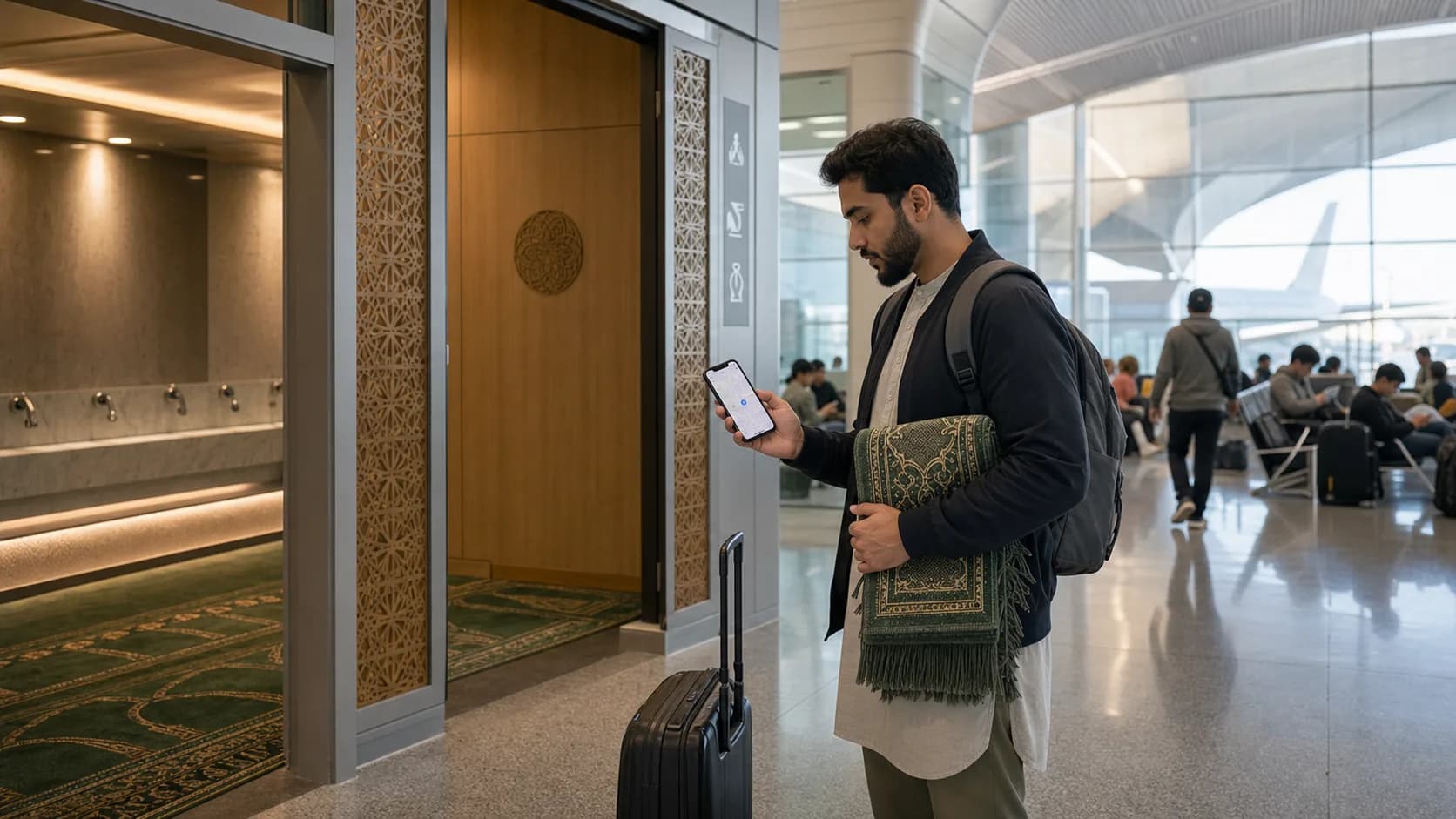
Airport Prayer Room Layover Guide for Muslim Travelers
A practical airport prayer-room guide for Muslim travelers covering layovers, wudu, qibla direction, terminal transfers, prayer-room checks and halal meal backups.
A useful airport prayer room guide should start before the traveler reaches security. Many airports publish prayer rooms, multi-faith rooms, mosques or quiet rooms, but the details vary sharply by terminal, access side, security zone, opening pattern and walking distance. A Muslim traveler who assumes every large airport works the same way can lose the whole prayer window between passport control, terminal trains, gate changes and boarding calls.
Before travel, check prayer times for the departure city, transit city and arrival city, then keep the qibla finder ready for gates, lounges, family rooms and quiet corners. The point is not to make worship mechanical. It is to protect calm. A two-hour layover can be enough when the prayer room is near the gate; it can be too short when a traveler must change terminals and clear security again.
Official airport pages are the first source to check. Heathrow publishes multi-faith prayer-room information. Changi publishes prayer-room facility information. Hamad International Airport publishes prayer-room information. Dubai Airports lists prayer rooms among airport facilities, and Hong Kong International Airport has a prayer-room page. These pages do not all look alike, which is exactly the lesson: a Muslim layover plan should be airport-specific, not copied from a different trip.
Treat the names as planning signals. A “multi-faith prayer room” at Heathrow may have different expectations from an airport mosque at Hamad International Airport, and a prayer room page at Changi or Hong Kong International Airport may be organized by terminal rather than by airline. Dubai Airports places prayer rooms inside a broader facilities context. The traveler should record the exact airport, terminal, security side and nearest gate area before the trip, because the same airline can use different terminals on different dates.
The four checks before booking a tight layover
- Which prayer will fall during the airport window: Dhuhr, Asr, Maghrib, Isha or Fajr?
- Is the prayer room or mosque before security, after security, or in a different terminal?
- Will the traveler need wudu, luggage storage, family time or accessible facilities before prayer?
- Is there a realistic halal meal, vegetarian backup or packed snack if the layover becomes delayed?
The terminal question matters most. If the prayer room is landside and the traveler is airside, the published facility may not help during a short connection. If the airport has several terminals, the nearest room may still be too far for a boarding window. If the traveler is with children, elders or a stroller, a ten-minute walk on the map may become twenty minutes with elevators and security queues.
For a connection under ninety minutes, be conservative. The traveler may need deplaning time, bathroom time, a gate change and boarding time before any prayer-room search begins. For a connection of two to four hours, the plan can be more deliberate: identify the prayer room, choose whether to pray before or after food, and set a hard return-to-gate alarm. For a long layover, the airport mosque or prayer-room area can become the day’s anchor, but the traveler should still watch terminal trains and passport-control rules.
Plan wudu and cleanliness without improvising late
Not every airport prayer room has dedicated washing facilities. Some travelers can use nearby restrooms; others may need more time, privacy or accessible fixtures. Pack a small travel towel, unscented wipes where appropriate, socks or footwear that are easy to manage, and a lightweight prayer mat if you prefer not to rely on the room’s materials. Keep these in carry-on, not checked luggage.
For families, split the task. One adult checks gate and boarding time while the other handles children, wudu and bags. Solo travelers should set an alarm for boarding and keep documents in the same pocket every time. Airport prayer should not become a panic search for passport, phone, shoes and gate number after salah.
Also plan for the case where the official prayer room is full, closed for cleaning or too far away. A quiet gate corner, family room or lounge may be the backup, but only if the traveler can maintain dignity, cleanliness and direction. This is where a small prayer mat and qibla tool matter. The backup is not a downgrade; it is the reason a delayed flight does not erase worship from the travel day.
Use halal meal backups as part of the prayer plan
Food can break a layover as easily as a terminal transfer. A Muslim traveler who needs halal-certified food should not wait until the family is hungry to search. Check the airport map, airline meal policy and nearby restaurants before departure. If certainty is not available, carry simple permissible snacks that pass security rules and fit the traveler’s health needs. This is especially important for children, elders, diabetics and long overnight connections.
A strong layover plan has a prayer-room target, a backup quiet place, a wudu strategy, a meal backup and a hard return-to-gate time. That may sound too practical for a spiritual act, but airports are practical places. The more the traveler handles logistics early, the more worship can stay quiet and focused.
Write the plan in one note: airport code, terminal, prayer-room page, next prayer, walking buffer, meal backup and boarding time. Share it with the family or travel group. The value is not the note itself. The value is that every person knows when the airport plan changes from “we have time” to “we must go back to the gate now.”


