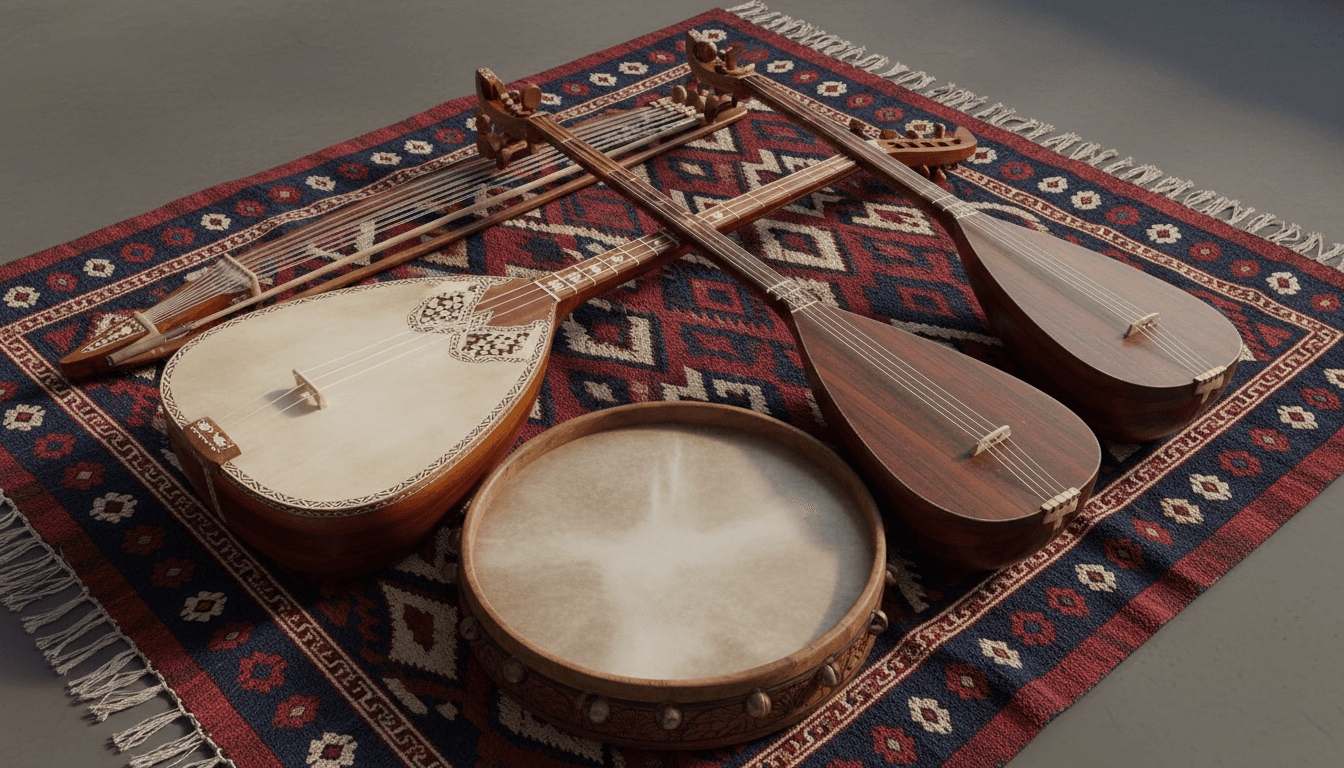
Uyghur Musical Instruments: Rawap, Dutar, Dap and Satar
A practical source guide to Uyghur plucked, bowed, wind and percussion instruments, with identification clues, regional use, ensemble roles and archive methods.
Rawap, dutar, dap and satar are often presented as a fixed national instrument set. In practice, instrument names cover variants, construction changes across workshops and regions, and ensemble roles differ among Muqam, Sanam, Meshrep, ballad, stage and teaching contexts. A photograph can reveal body shape, neck, strings, bow and playing position, but it cannot by itself establish tuning, local name or repertoire. This guide combines catalog metadata, performer credits, heritage documentation and careful visual description so that readers can identify an instrument without converting resemblance into certainty.
Key points
- Rawap names several long-necked plucked-lute forms; body, skin, strings, frets and repertoire help distinguish variants.
- Dutar generally refers to a long-necked two-string tradition, but material, tuning, technique and community use must be documented for a specific instrument.
- Dap is a frame drum whose size, rings, skin and playing context vary; it can mark complex Muqam cycles or accompany social dance.
- Satar is bowed and should not be identified only from a long neck; bow use, sympathetic strings, body and performer testimony matter.
Names identify families before they identify objects
Instrument names travel across Turkic and Persianate musical worlds. The same spelling may refer to related but non-identical objects, while one Uyghur instrument may receive several Latin spellings. Begin with the performer's name for it, original script, place and genre. Then record measurable construction rather than forcing the object into the nearest museum label.
A rawap record should note bowl or body shape, skin or wooden soundboard, neck length, frets, peg arrangement, strings and decorative features. These traits help compare Kashgar-associated, Dolan or other forms, but regional labels still require provenance. An unlabeled tourist object cannot establish where it was played.
Dutar as instrument, teaching tool and narrative companion
Dutar literally points to two strings in a broad regional naming tradition, yet actual instruments and techniques are historically specific. UNESCO's classroom resource connects a Uyghur dutar with a named ballad and a Kazakhstan education setting. It is evidence of teaching design and community transmission, not a universal manual for every Uyghur dutar style.
Ballad accompaniment can prioritize voice and narrative pacing, while an ensemble part may use a different rhythmic or melodic role. Credit the named performer and arrangement. If tuning is reported, record its source and pitch reference rather than copying a tuning from another instrument with a similar name.
Dap, rhythm and social movement
The Smithsonian glossary describes a smaller dap as important in Twelve Muqam rhythm and a larger frame drum in folk dance, Meshrep and healing contexts. This distinction is a useful lead, but size alone does not identify function. Photograph diameter, frame depth, rings, membrane, grip and performer position, then pair the image with event information.
Rhythmic cycles are learned practices, not decorative background. A transcription should name the recording and performer, explain the counting system and mark uncertainty. Short video edits can shift audio or remove the cycle's beginning, so use a complete performance when analyzing rhythm.
Bowed satar and the limits of visual matching
A satar is played with a bow and may have sympathetic strings that contribute resonance. In a low-resolution image, a bow can fall outside the frame and the instrument may be confused with a plucked lute. Seek multiple angles, program credits and performer testimony before assigning a label.
Workshop repair can replace pegs, bridges, strings or skin without erasing the instrument's history. A catalog should record modifications and dates where known. The desire for an original object can obscure the fact that maintained musical tools often survive precisely because makers and players altered them.
Ensemble evidence and regional repertoire
UNESCO's Muqam description emphasizes regional systems and varied bowed, plucked and wind instruments. A Twelve Muqam ensemble should not be used as the template for Dolan, Turpan, Hami, wedding or diaspora ensembles. Identify the repertoire first and explain the role heard in that recording.
Smithsonian performer credits provide a model: named artists, voice, dutar, tanbur, recording place and release metadata. Catalogs should retain such credits when clips are reused. A platform's generic background-music label strips the evidence that allows later researchers to distinguish player, instrument and community.
Building a trustworthy instrument record
Record local and translated names, maker, owner, place, date, dimensions, materials, strings, tuning claim, playing technique, repertoire, repairs, case, image rights and audio links. Preserve uncertainty with phrases such as probably or identified by the performer instead of hiding doubt in a confident title.
Connect the record to Muqam, Meshrep, dance and manuscript pages through direct same-language links. Sources should include at least one item-level recording or object record, one institutionally described heritage context and comparative scholarship. This gives readers an evidence path rather than a decorative list of instruments.
How to read the evidence
Separate primary records, academic research, organizational reports and official statements. Record the source's date, place, method and scope. Evidence about one object, performance, interview or country does not by itself establish a permanent characteristic of an entire community.
Related reading
- Uyghur Twelve Muqam: Music, Poetry, Performance and UNESCO Heritage
- Meshrep Explained: Uyghur Community Gathering, Music and Social Practice
- Uyghur Dance: Sanam, Sama, Muqam and Performance Context
- How to Research Uyghur Manuscripts: Catalogs, Scripts and Provenance
Sources
These sources have different evidentiary roles. Their inclusion makes claims checkable and does not imply acceptance of every interpretation in a source.
- Smithsonian Folkways — Music of Central Asia, Volume 10 — Album scholarship and illustrated glossary for Uyghur instruments, performers, genres and regional musical relationships.
- UNESCO ICH — Dutar: The Ballad of Abdugopur Kutlukov — UNESCO educational resource connecting the Uyghur dutar, a named ballad and heritage-language teaching in Kazakhstan.
- UNESCO Intangible Cultural Heritage — Uyghur Muqam of Xinjiang — Primary UNESCO description of regional Muqam practices, performance forms and transmission concerns.
- Smithsonian Folkways — Sanam — Catalogued Uyghur performance from the Ili tradition with performer, instrument, place and recording metadata.
- British Library — Uighur musicians at Chini Bagh, Kashgar — Item-level archive record with photographer, location, collection hierarchy, shelfmark and digitized-image link.


