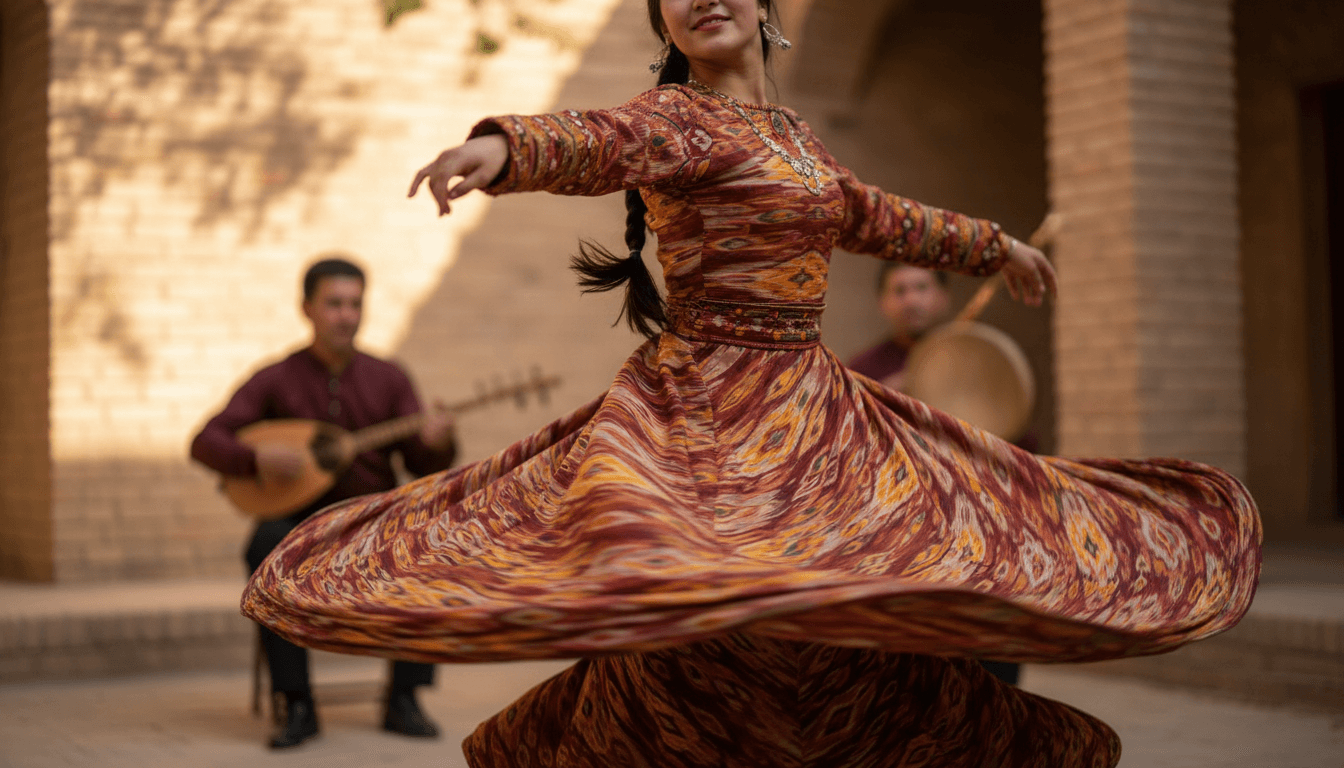
Uyghur Dance: Sanam, Sama, Muqam and Performance Context
A documented guide to Uyghur Sanam and Sama dance, their relationships to Muqam, Meshrep and weddings, and how to identify a performance without flattening regional traditions.
Search results often label any Uyghur dance as Sanam, Sama or Muqam. Those words do not name interchangeable steps. Sanam can describe a regional suite of song and dance pieces that accelerates, while Sama is associated in particular accounts with collective circular movement and specific festive or religious histories. Muqam joins music, poetry and dance in several regional systems, and Meshrep names social gatherings in which performance may occur. This guide shows how to identify a recorded performance through place, ensemble, rhythm, sequence, occasion and the performers' own description instead of relying on costume or a recycled caption.
Key points
- Sanam has regional suites and a characteristic progression; one Ili recording cannot define every oasis version.
- Sama, Sanam, Meshrep and Muqam overlap in performance settings but are not synonyms for one generic Uyghur dance.
- A stage arrangement may preserve repertoire while changing duration, spacing, gender grouping, accompaniment and audience participation.
- Reliable media captions identify the original uploader, performers, location, date, occasion and complete sequence.
Sanam as a regional song-and-dance suite
The Smithsonian Folkways Sanam recording is unusually useful because it names performers, instruments, release history, cultural group and the Ili Valley tradition. Its note describes a continuous suite whose dance pieces grow faster. That evidence supports an account of one documented performance form; it should not be rewritten as an exact tempo map for every city.
Regional naming matters. A community may recognize a local melody, lyric, rhythmic turn or movement pattern even when an outsider hears only a broad shared style. Document the locality claimed by performers and preserve their title in Uyghur script where available. Translation can add a gloss without replacing the original genre name.
Sama and the importance of occasion
Accounts of Sama connect it to collective movement, public space and particular festive histories, including contexts influenced by Islamic ritual and local custom. A video of dancers moving in a circle is not enough to establish that label. The uploader's knowledge, music, event, place and sequence should be checked together.
Religious association also should not turn the dance into a formal act of worship in every context. Practices can move between shrine festival, Eid gathering, neighborhood celebration, stage and diaspora cultural event. State the context actually documented and avoid claiming one theological interpretation for all participants.
Muqam and Meshrep are related settings, not labels for everything
UNESCO describes Uyghur Muqam as combining song, dance, folk and classical music across Twelve Muqam, Dolan, Turpan and Hami traditions. Dance belongs within that broad performance world, but a short independent dance number is not automatically a complete Muqam segment. Name the suite and section when the source does.
Meshrep may include dance, music, food, games, storytelling and social learning. Calling the gathering a dance omits most of its structure; calling every dance a Meshrep confuses event with performance. Internal links between the subjects can explain their relationship without collapsing them into one page.
From participatory floor to proscenium stage
Community performance can allow dancers to enter and leave, respond to musicians and alter duration. A staged work needs fixed entrances, lighting, spatial symmetry and a predictable ending. These changes may make teaching and touring possible, but the recording should say that it is an arrangement rather than an untouched village scene.
Costume can be standardized for visibility, and large ensembles can magnify movements that work differently at close range. Compare rehearsal notes, program credits and longer recordings. A thirty-second clip selected for social media often deletes the tempo build or audience exchange that identifies the form.
Reading heritage claims
UNESCO listings document an element, nomination process, safeguarding concern and state reporting framework. They do not certify every performance advertised with the UNESCO name. Official protection reports can show institutions and festivals, while advocacy research may question whether display is separated from community control. Both need specific evidence.
A balanced page records what was performed, by whom and under which institution, then distinguishes that observation from claims about cultural vitality. The number of shows is not the same as the number of community practitioners, and a ban or cancellation at one place is not proof about every region without a defined dataset.
A verification workflow for dance media
Save the original URL, upload date, claimed recording date, creator, full caption, frame landmarks, musicians, instruments and event signage. Reverse-search representative frames and compare the audio with longer versions. Do not repost images of vulnerable people with a new political caption when consent and location are uncertain.
Finally, describe movement without inventing meaning: direction, formation, hand position, footwork, tempo and interaction are observable; symbolism requires a source. Linking the media record to Sanam, Muqam, Meshrep, clothing and wedding guides creates a useful structure while keeping each concept distinct.
How to read the evidence
Separate primary records, academic research, organizational reports and official statements. Record the source's date, place, method and scope. Evidence about one object, performance, interview or country does not by itself establish a permanent characteristic of an entire community.
Related reading
- Meshrep Explained: Uyghur Community Gathering, Music and Social Practice
- Uyghur Twelve Muqam: Music, Poetry, Performance and UNESCO Heritage
- Uyghur Wedding Traditions: Nikah, Family Customs and Regional Change
- Uyghur Clothing: Doppa, Atlas Silk, Embroidery and Evidence
Sources
These sources have different evidentiary roles. Their inclusion makes claims checkable and does not imply acceptance of every interpretation in a source.
- Smithsonian Folkways — Sanam — Catalogued Uyghur performance from the Ili tradition with performer, instrument, place and recording metadata.
- UNESCO Intangible Cultural Heritage — Uyghur Muqam of Xinjiang — Primary UNESCO description of regional Muqam practices, performance forms and transmission concerns.
- UNESCO Intangible Cultural Heritage — Meshrep — Primary UNESCO listing for the element, its social functions, transmission and urgent-safeguarding status.
- UHRP — Extracting Cultural Resources: Intangible Heritage in Uyghur Regions — Advocacy research on official heritage programs, clothing, performance and the distinction between community practice and staged representation.
- British Library — Uighur musicians at Chini Bagh, Kashgar — Item-level archive record with photographer, location, collection hierarchy, shelfmark and digitized-image link.


