Uyghur Clothing: Doppa, Atlas Silk, Embroidery and Evidence
A source-based guide to Uyghur doppa caps, atlas silk, embroidery, regional dress and the difference between living clothing practice, museum objects and staged heritage.
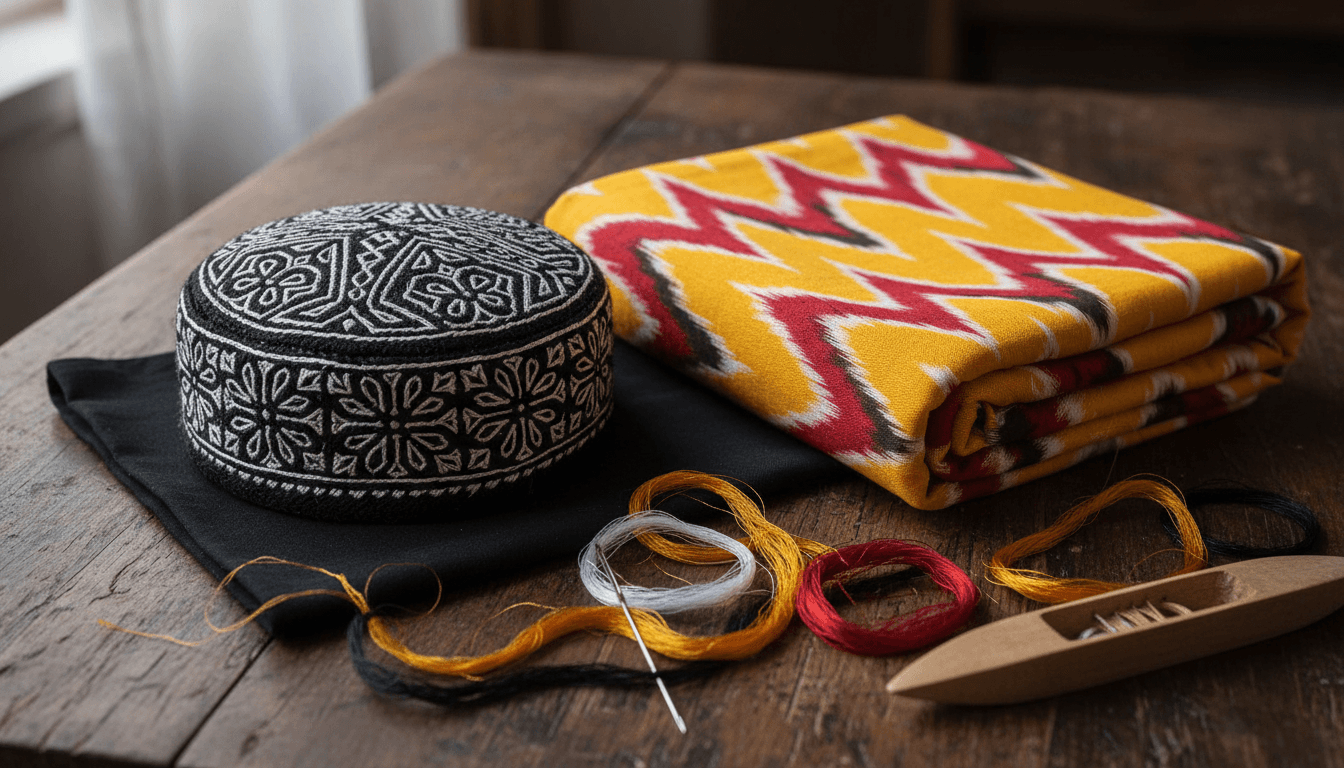
Uyghur clothing is often reduced online to one embroidered cap and a brightly patterned dress. The visual shorthand is recognizable, but it hides differences of place, period, gender, age, occupation and occasion. A doppa can be everyday clothing, a gift, a marker of regional taste or a costume element. Atlas silk can refer to a textile technique, a garment made from that cloth or a modern heritage symbol. This guide treats clothing as material history: who made an item, who wore it, when, with which fibers and stitches, and how its meaning changed in markets, family photographs, museums, stage performance and diaspora life.
Key points
- Doppa is a broad cap category rather than one fixed design; shape, ground cloth, embroidery, motif and use vary across communities and periods.
- Atlas silk and other ikat-patterned textiles should be identified by material and technique, not by color alone or by a retailer's unverified product label.
- Museum catalogues, family photographs and current festival images document different contexts and should not be blended into a timeless national costume.
- Heritage policy can fund craft transmission while also standardizing selected designs; both preservation and selection should be visible in the evidence.
Doppa is a family of caps, not a single uniform
The word doppa is used across parts of Central Asia for a fitted cap, but a useful Uyghur record goes beyond the category name. It describes the number and form of panels, the height and contour of the crown, the base fabric, lining, edge, stitch, motif, colors, maker, owner, place and approximate date. A Kashgar market cap and an Ili family heirloom may share a name without sharing a design history.
Motifs are frequently assigned universal meanings in souvenir descriptions. Some interpretations may come from makers or families, while others are recent marketing language. Record who supplied an explanation and when. A repeated floral form can be a workshop convention, a personal preference, a regional fashion or a later heritage emblem; the object alone cannot decide among them.
Atlas silk, ikat and the problem of material labels
Atlas commonly refers to lustrous woven cloth associated with resist-dyed warp patterns, but garments sold or photographed under that name may use silk, cotton, rayon or mixed fibers. A catalog should separate fiber identification from weave and pattern. Visual resemblance is not laboratory proof, and modern production can reproduce an older design with different yarn and machinery.
Clothing combines textiles with cutting, lining, fasteners, braid and embroidery. A dress made from atlas-patterned cloth is not evidence that every component was locally produced. Ask whether a source documents a household loom, workshop, state factory, imported cloth or contemporary designer. Trade and adaptation are part of the history rather than defects in authenticity.
Everyday wear, ritual use and staged performance
Family albums can show when a cap or coat was worn at school, work, a wedding, Eid or a portrait studio. Stage photographs answer a different question: what an ensemble selected for visibility and movement. A performer may wear a coordinated costume that no neighborhood used as daily dress. Captions should identify the event and avoid turning one troupe's wardrobe into a population-wide rule.
Wedding clothing also changes with income, law, fashion, religious preference and migration. Civil registration, nikah, banquet and family visiting may involve different garments. The same person may choose contemporary global fashion for one moment and regional textile references for another. That sequence is more informative than labeling one outfit traditional and the other modern.
How archives can date a garment
An archive photograph needs its collection hierarchy, shelfmark, photographer, location and date range. The British Library record for musicians at Chini Bagh is valuable because it preserves such metadata; the clothes visible in the image remain evidence for those photographed people at that event, not a complete survey of Kashgar. Compare multiple dated images before claiming continuity or disappearance.
Written sources may name fabrics, gifts, prices or occupations without an image. Manuscripts and contracts can therefore complement photographs and surviving garments. Transcription and translation must preserve uncertain textile terms instead of silently replacing them with a familiar English category. Where provenance has a gap, state it.
Heritage programs and community transmission
Official cultural-protection publications describe protected crafts, exhibitions, training and performance institutions. These records can establish that a program or designation exists. They do not automatically show how many independent makers remain, whether learners continue after a course or how a standardized design relates to family practice. Those questions require workshop records and interviews.
Rights organizations argue that state-led heritage can extract selected visual forms while religious, linguistic or community contexts face restriction. That claim should be attributed and compared with specific official programs and dated evidence. The analytical task is not to declare every program preservation or erasure, but to show what was funded, selected, changed and left outside the display.
A responsible object record
For each garment or cap, record consent, owner, maker if known, local name in original script, confirmed romanization, materials, construction, dimensions, condition, repairs, place, date, occasion and image rights. Do not publish a family's names, migration history or location merely to make provenance appear complete. A restricted record can still preserve knowledge.
Use side-by-side source roles: an object and family account for lived use, a museum or archive for catalog metadata, scholarship for comparison, and official or advocacy reports for contemporary heritage policy. This structure keeps a beautiful item connected to people without forcing it into a single political or commercial story.
How to read the evidence
Separate primary records, academic research, organizational reports and official statements. Record the source's date, place, method and scope. Evidence about one object, performance, interview or country does not by itself establish a permanent characteristic of an entire community.
Related reading
- Uyghur Food Guide: Halal Practice, Polo, Laghman, Nan and Hospitality
- Uyghur Wedding Traditions: Nikah, Family Customs and Regional Change
- How to Research Uyghur Manuscripts: Catalogs, Scripts and Provenance
- Uyghur Names and Spelling: Arabic Script, Latin and Chinese Forms
Sources
These sources have different evidentiary roles. Their inclusion makes claims checkable and does not imply acceptance of every interpretation in a source.
- UHRP — Extracting Cultural Resources: Intangible Heritage in Uyghur Regions — Advocacy research on official heritage programs, clothing, performance and the distinction between community practice and staged representation.
- State Council Information Office — Cultural Protection and Development in Xinjiang — Chinese government account of cultural-heritage policy, protected sites, publications and performance institutions.
- British Library — Uighur musicians at Chini Bagh, Kashgar — Item-level archive record with photographer, location, collection hierarchy, shelfmark and digitized-image link.
- Lund University Library — The Jarring Collection — Collection guide to Eastern Turki/Uyghur, Arabic and Persian manuscripts, documents, medical manuals and literature.
- UNESCO Intangible Cultural Heritage — Uyghur Muqam of Xinjiang — Primary UNESCO description of regional Muqam practices, performance forms and transmission concerns.


