Sabil-Kuttab: Why Cairo Put a School Above a Fountain
How a sabil dispensed drinking water, how a kuttab taught children above it, and why corner placement made charity visible in Mamluk and Ottoman Cairo.
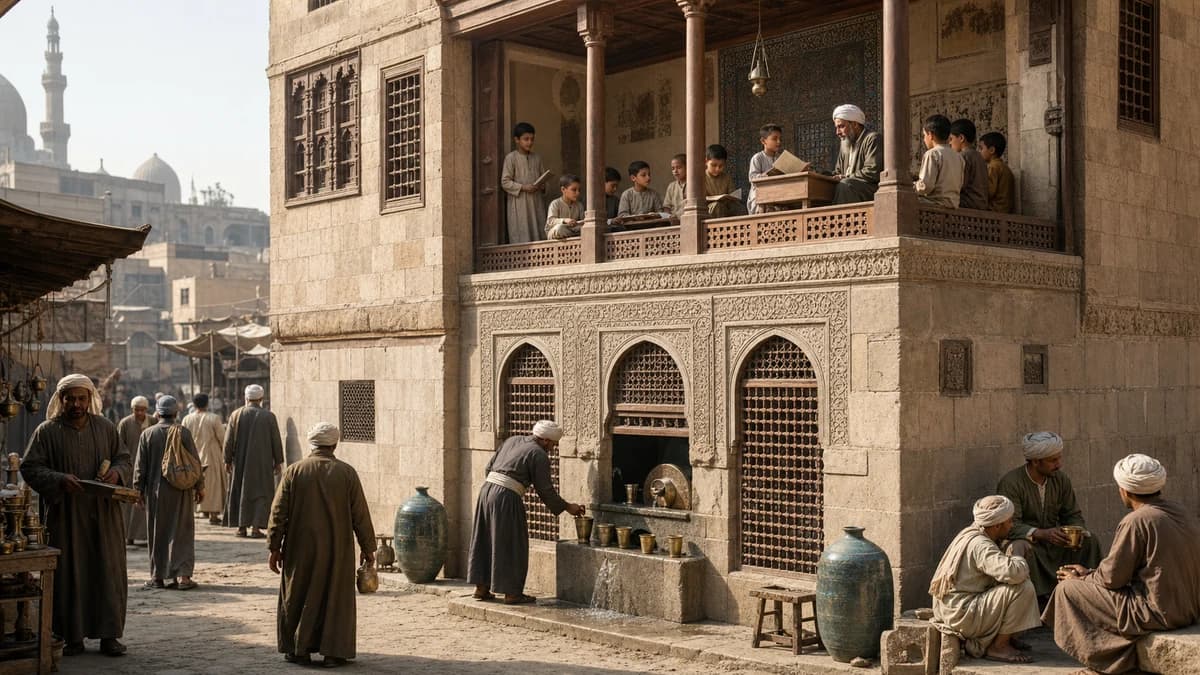
A sabil-kuttab combines two charitable functions in one compact building: a ground-floor public water dispensary and an upper-floor elementary school. The type became a distinctive feature of Cairo, where a prominent street corner could make both the distribution of water and the patron’s endowment highly visible.
The cover image is an original AI-assisted historical reconstruction, not a photograph of the Qaytbay or Katkhuda sabil-kuttab.
The sabil supplied controlled access to water
Water was stored in a cistern and brought to attendants who dispensed it through screened openings. The grille allowed air circulation and communication while controlling cups and containers. Marble revetment, carved stone and inscriptions turned a practical service into an architectural statement.
The system required filling, cleaning and paid labor. Cairo did not have a pressurized municipal network in the modern sense, so the building’s charitable value depended on the logistics that delivered Nile water and maintained the cistern.
The kuttab used light and air above the street
The upper school often opened through arches or screens, giving children ventilation and daylight above the dense market level. Instruction could include Qur’an reading, writing and basic learning. The number, age and curriculum of pupils depended on the foundation rather than a universal standard.
At the eighteenth-century Sabil-Kuttab of Abd al-Rahman Katkhuda, a two-tiered arcaded pavilion crowns the fountain block. Its position where al-Mu‘izz Street divides makes the building a visual focus as well as a service point.
One façade, two forms of charity
Combining water and education saved urban space and created a vertical hierarchy: public distribution below, teaching above. The form also connected bodily need and religiously valued learning without making the two activities identical.
The type changed through Mamluk and Ottoman periods. Some sabil-kuttabs were attached to mosques or funerary complexes; others stood more independently. Restoration can replace wood screens, tile or stone, so the present appearance should be checked against documentation.
How to read a sabil-kuttab
- Find the cistern, filling access and screened distribution windows.
- Trace the stair and separate entrance to the upper school.
- Study how the corner or street position directs public attention.
- Read inscriptions and waqf documents for patron, staff and beneficiaries.
The sabil-kuttab is a small building with a large urban role. It turned a constrained street corner into an enduring system for water, learning and remembrance.
Sources
- Archnet: Sabil wa Kuttab al-Sultan Qaytbay — development and charitable functions of the type.
- Archnet: Sabil-Kuttab of Abd al-Rahman Katkhuda — plan, street setting and decoration.
- Smarthistory: Sultan Hasan Complex — waqf evidence for a sabil-kuttab and school places.


