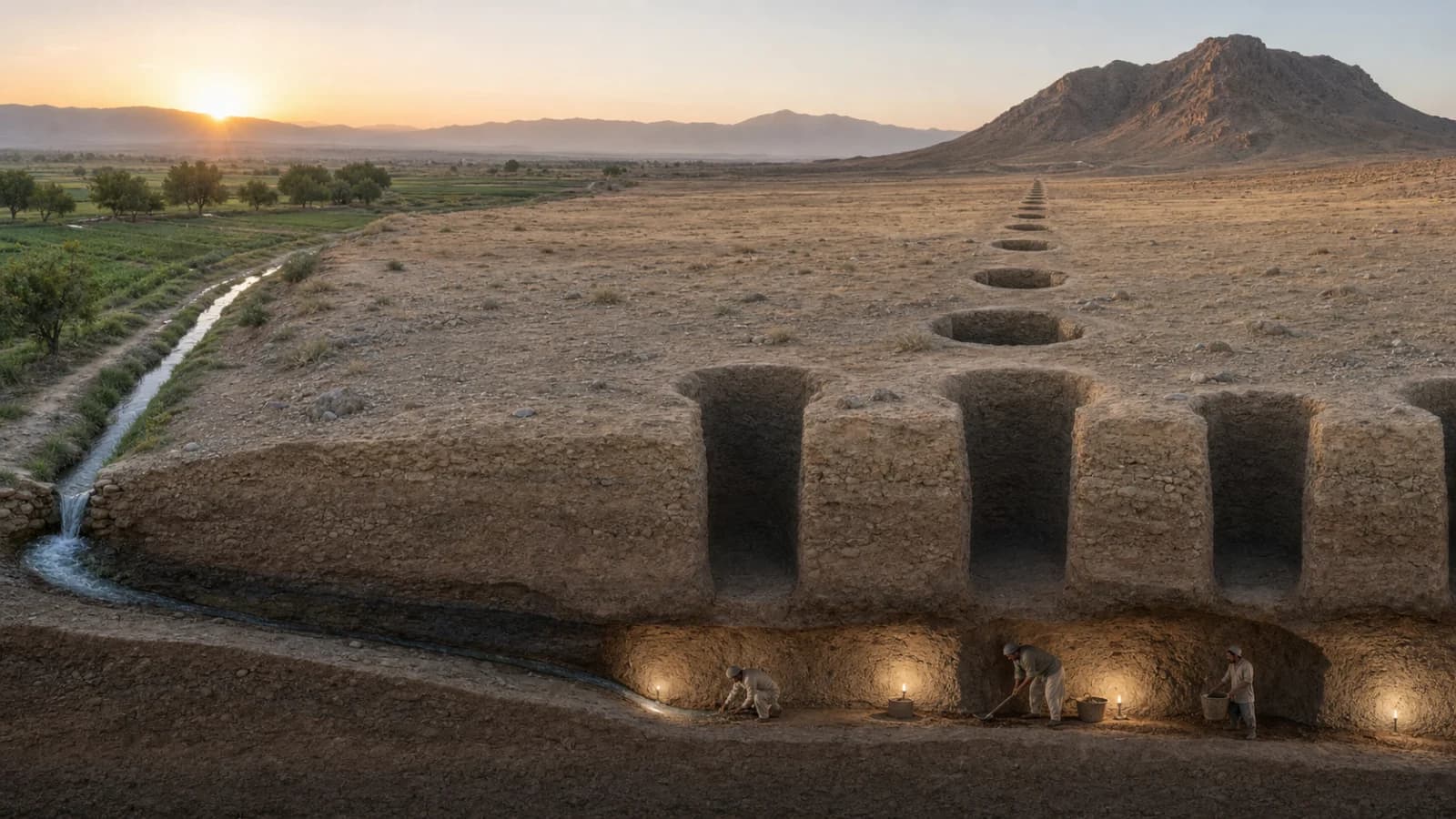
How a Qanat Works: Mother Well, Tunnel, Shafts and Gravity
A step-by-step guide to qanat engineering: tapping an aquifer, setting a gentle gradient, removing spoil, maintaining shafts and sharing the flow.
A qanat is a gravity-fed water system that taps groundwater at a higher elevation and carries it through a gently sloping underground tunnel to a lower outlet. Known by regional names including karez and kariz, the technology sustained settlements, fields and gardens across many arid regions. It moves water; it does not create a new supply.
The cover image is an original AI-assisted technical reconstruction, not a photograph or survey of a specific qanat.
From aquifer to outlet
Construction begins by locating a reliable aquifer, often in an alluvial fan near the head of a valley. A deep “mother well” reaches the water-bearing layer. From the lower settlement side, workers excavate a near-horizontal tunnel toward that source with a gradient just steep enough for flow.
If the tunnel is too flat, water stagnates and sediment accumulates; if too steep, erosion can damage the channel. Surveying the level over kilometres with traditional instruments and experience was therefore a central skill.
Why the line of holes is visible from above
Vertical shafts are sunk at intervals along the tunnel. They provide access and ventilation, and allow excavated soil to be raised in baskets. Spoil piled around each opening forms the chain of crater-like rings visible across an arid plain. The shafts are not normally a row of independent water wells for drawing water from the surface.
At the outlet, or mazhar, the underground flow reaches daylight and enters open channels, reservoirs, mills, fields or gardens. Distribution then becomes a social and legal task as well as a hydraulic one.
Maintenance and sharing are part of the system
Collapse, silt, roots and changes in the water table can reduce flow. Specialized workers must descend, clear and repair the tunnel under dangerous conditions. Open shafts also require protection. A qanat abandoned above ground may still contain unstable voids below.
UNESCO highlights communal management and equitable water distribution in the Persian qanat tradition. Time shares, channels, ownership and maintenance obligations can determine who receives water and when. “Sustainable” should not mean limitless: over-pumping nearby aquifers, drought and land-use change can still damage the source.
How to read a qanat landscape
- Follow the shaft line from higher alluvial ground toward settlement and fields.
- Distinguish the mother well, access shafts, tunnel and outlet.
- Check the gradient and destination of the water.
- Look for reservoirs, mills, channels and gardens connected to the flow.
- Study management and maintenance records, not engineering alone.
The qanat’s apparent simplicity conceals precision. Its long life depends on hydrogeological knowledge, patient excavation, routine repair and agreed rules for sharing a finite flow.
Sources
- UNESCO World Heritage Centre: The Persian Qanat — aquifers, mother wells, shafts, gradient and communal management.
- ICOMOS evaluation: The Persian Qanat — infrastructure, conservation and technical significance.
- UNESCO: Jerusalem water system, Qanat es-Sabeel — a documented regional adaptation.
Related reading
- Passive cooling and water in architecture
- Water on the Darb Zubaydah


