Qajar Lithography: Printing Persian Books by Stone
Why lithography suited flowing Persian calligraphy, how scribes and illustrators adapted to print and why the new books continued manuscript visual habits.
Qajar lithography refers to the expansion of chemical stone-printing technology in nineteenth-century Iran, which allowed for the reproduction of Persian books containing both calligraphic text and illustrations.
The Technology and Aesthetics of Stone Printing
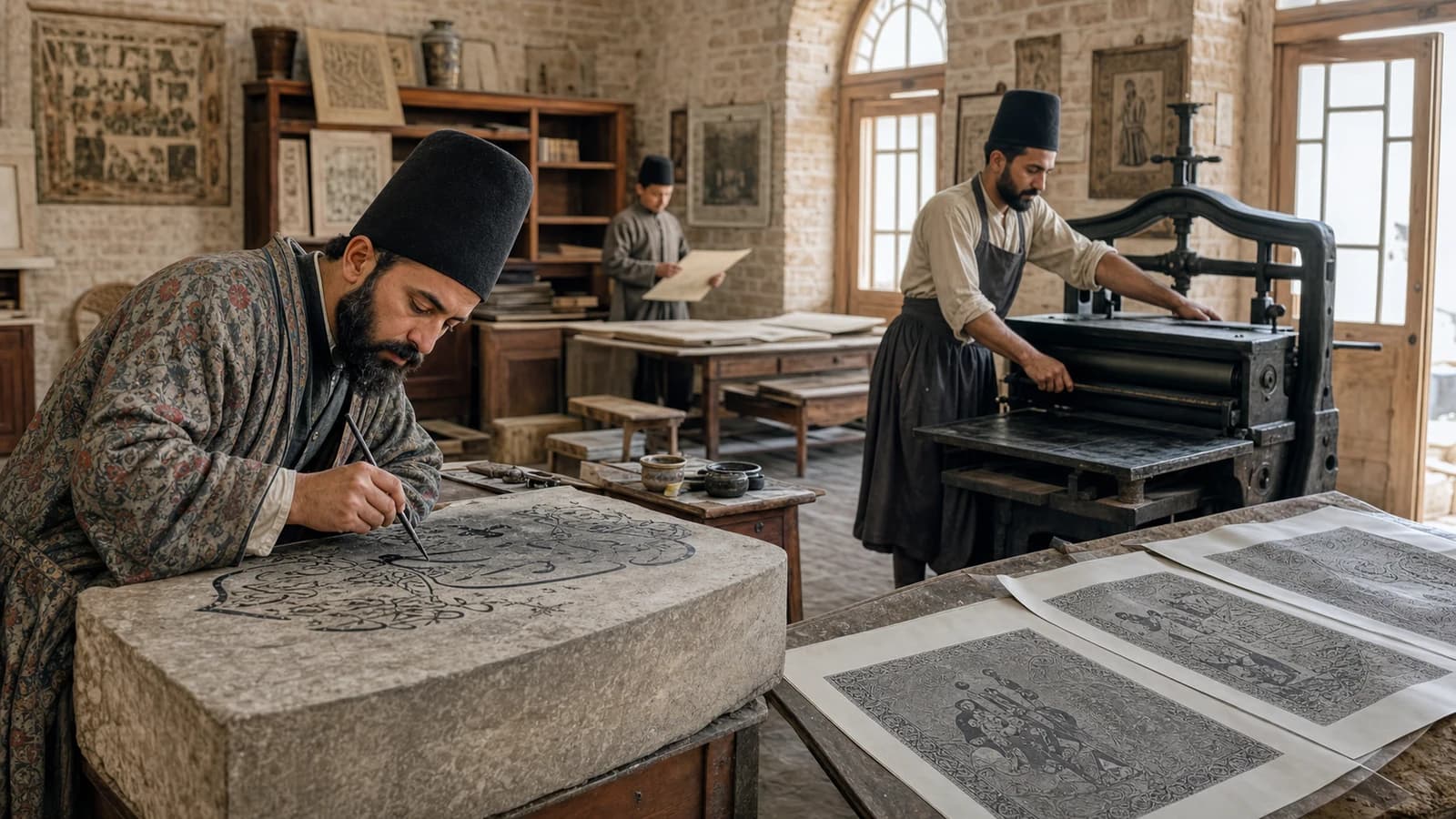
The expansion of lithographic book production in nineteenth-century Qajar Iran offered a unique method for reproducing the written word. In lithography, writing or drawing in greasy material is transferred through a prepared stone surface. This chemical process allowed calligraphic forms to be reproduced more naturally than many early movable-type fonts, which often struggled to capture the flowing qualities of traditional scripts.
Because the greasy ink could be applied with a pen or brush, the printed page preserved the aesthetic qualities of handwriting. This compatibility made lithographic books highly acceptable to a public accustomed to manuscripts, as the technology did not force the text into rigid, disconnected blocks.
The Collaborative Network of Production
The production of a lithographic book in the nineteenth century was a collaborative effort. This network involved calligraphers, illustrators, printers, and patrons who worked together to bring a text to completion. The calligrapher prepared the text, while illustrators drew the images that would accompany the writing. Patrons funded these projects, and printers managed the physical execution of the printing process.
Because of the flexibility of the medium, printers frequently reused images across different editions. This practice of reusing illustrations was common in the production of popular religious, literary, historical, and educational works, creating a shared visual style across various nineteenth-century publications.
The Coexistence of Print and Manuscript
Historians of the book emphasize that print and manuscript should not be treated as opposing worlds. Printed books could deliberately imitate manuscript frames, headings, and images. This close stylistic relationship meant that the transition between hand-copied texts and printed volumes was fluid, with many design elements carrying over directly from the manuscript tradition.
Furthermore, it is inaccurate to assume that lithography made every book cheap or mass-produced. In reality, print runs, paper, distribution, and readership varied significantly from one project to another. While some popular titles achieved wider distribution, other editions remained limited in their reach. Modern researchers must use catalogue evidence to identify the specific edition, place, and date of these diverse publications.
Analyzing Lithographic Books
- Examine the layout to see how the printed book imitates manuscript frames and headings.
- Identify the specific edition, place, and date of publication using library catalogue evidence.
- Check the text for the involvement of calligraphers, illustrators, printers, and patrons.
- Observe the reuse of images across different editions of religious, literary, historical, or educational works.
In conclusion, the expansion of lithography in nineteenth-century Qajar Iran represents a sophisticated adaptation of printing technology. By preserving calligraphic forms and imitating manuscript structures, this collaborative medium allowed for a diverse range of books to be produced without creating a sharp divide between print and manuscript cultures.
The cover image is an original AI-assisted reconstruction of a Qajar lithographic workshop, not a photograph of a named printer or documented edition.
Sources
- Library of Congress: Persian-Language Rare Materials — Qajar print holdings and bibliographic evidence.
- Library of Congress: A Thousand Years of the Persian Book — book production and historical transitions.
- The Met: Nineteenth-Century Iran and Modernity — Qajar visual culture and new technologies.
Related reading
- How Bulaq transformed Arabic print
- How the kitabkhana organized manuscript production


