Bulaq Press and the Transformation of Arabic Print
How Egypt's Bulaq Press organized type, translation and state publishing, and why Arabic print history began before this influential nineteenth-century press.
The Bulaq Press, established near Cairo in the early nineteenth century under the governorship of Muhammad Ali, was a state-sponsored printing house that transformed the production of Arabic texts.
State Projects and Textual Production
The primary impetus behind the establishment of the Bulaq Press was its integration into various state projects. The administration required a reliable method to produce materials for administration, military training, education, translation, and the dissemination of technical knowledge. By providing printed manuals and textbooks, the press supported the state's expanding educational and administrative initiatives.
Alongside these official publications, the Bulaq Press also printed editions of Arabic literary and scholarly works. Rather than focusing solely on administrative utility, the press issued a variety of cultural and intellectual texts. This dual output meant that Bulaq served both the immediate practical needs of state projects and the broader interests of the reading public.
The Materiality of Arabic Movable Type
Printing in Arabic presented unique technical and aesthetic challenges. Unlike Latin scripts, Arabic is a cursive script where letters change shape depending on their position within a word and connect to adjacent letters. Early printers had to design and cast numerous individual pieces of movable type to account for these joining forms and essential diacritical marks.
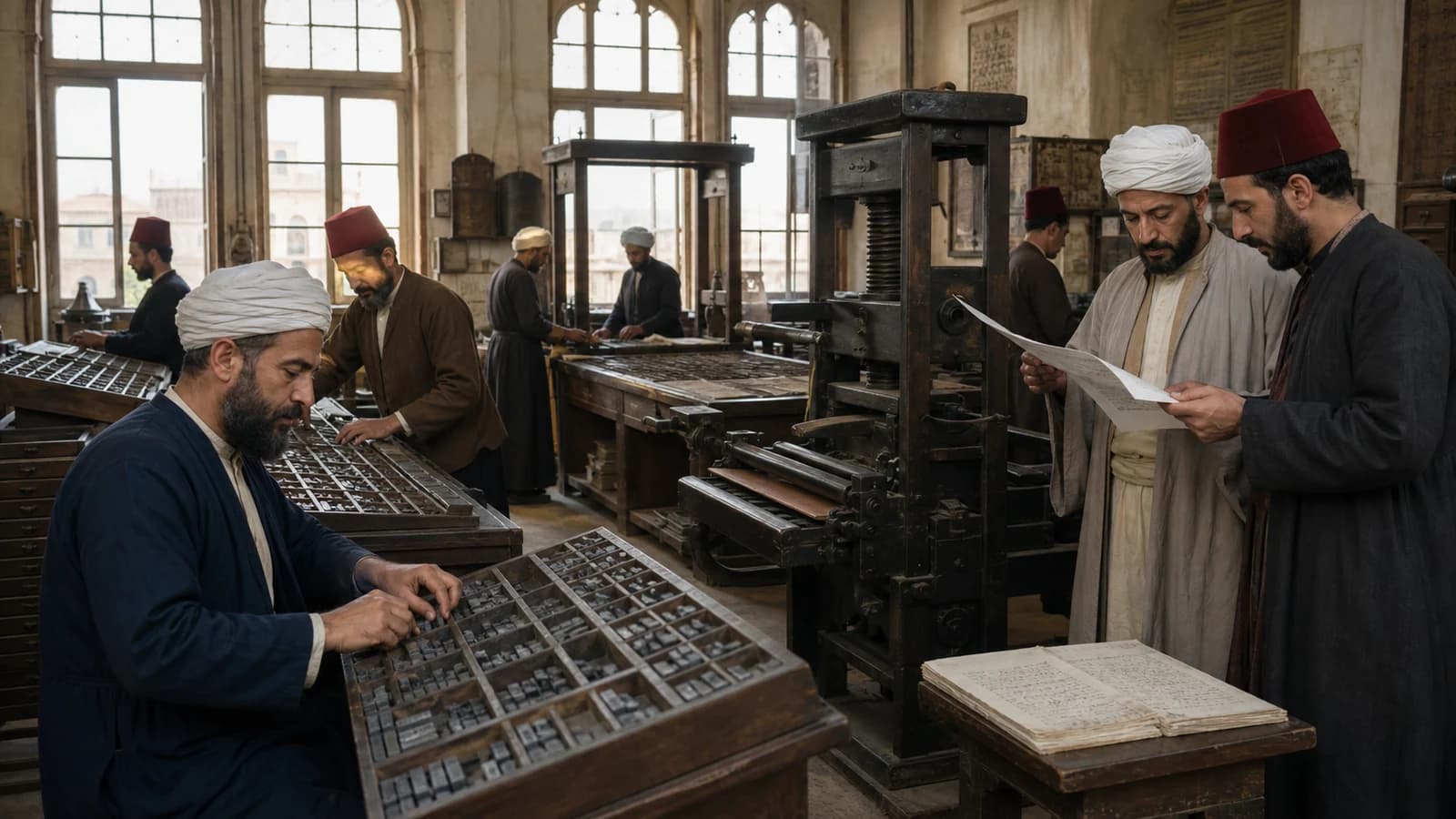
The production process at Bulaq relied on skilled compositors who assembled the metal type by hand, and proofreaders who checked the printed text. Despite the efficiency of the press, print did not instantly replace the manuscript tradition. For decades, printed books coexisted with hand-copied manuscripts, and early printed books often imitated the layout and calligraphic styles of traditional manuscripts to gain acceptance among readers.
Placing Bulaq in Printing History
While the Bulaq Press was highly influential, it was not the first place where Arabic was printed. Arabic printing had a long prior history, including early European presses, Ottoman presses, and regional printing traditions. Bulaq's significance lies in its scale, its state backing, and its sustained output, rather than absolute chronological priority.
Historians studying Bulaq publications must carefully distinguish between true first editions and later Bulaq reprints. Title pages, colophons, and catalog records provide crucial evidence for dating and verifying the authenticity of specific print runs. These elements reveal the names of the editors, proofreaders, and patrons involved in each project, exposing the collaborative network behind the press.
Methods for Reading Bulaq Imprints
- Examine the colophon at the end of the book to identify the exact date of printing and the names of the technical staff.
- Compare the typeface of early Bulaq editions with contemporary manuscript hands to identify stylistic influences.
- Analyze the title pages and catalog records to distinguish first editions from later Bulaq reprints.
- Cross-reference the titles listed in Bulaq catalogs with state projects in education and translation to assess the press's alignment with government policy.
In conclusion, the Bulaq Press was a cornerstone of nineteenth-century Egyptian modernization, bridging the gap between state utility and literary production. By examining its technical achievements and institutional context, historians can trace the gradual transition from manuscript culture to the age of print in the Arabic-speaking world.
The cover image is an original AI-assisted reconstruction of the Bulaq Press workshop, not a photograph of a documented room or specific edition.
Sources
- Library of Congress: Arabic-Language Rare Materials — Arabic print history and Bulaq holdings.
- Library of Congress: Bulaq Printed Book — object-level evidence for a Bulaq edition.
- Library of Congress: Related Arabic Print Resources — catalogues and research pathways.
Related reading
- How Arabic movable type was designed
- How lithography changed Persian books


