Omar Khayyam and the Jalali Calendar: Measuring the Solar Year
How a team including Omar Khayyam reformed the calendar for Sultan Malik-Shah, tied months to the Sun and confronted the fraction hidden inside every year.
Omar Khayyam is famous internationally for poetry, but he was also a major mathematician and astronomer. In the 1070s, he worked with other scholars on a calendar reform sponsored by the Seljuk sultan Malik-Shah. The resulting Jalali calendar began its era in 1079.
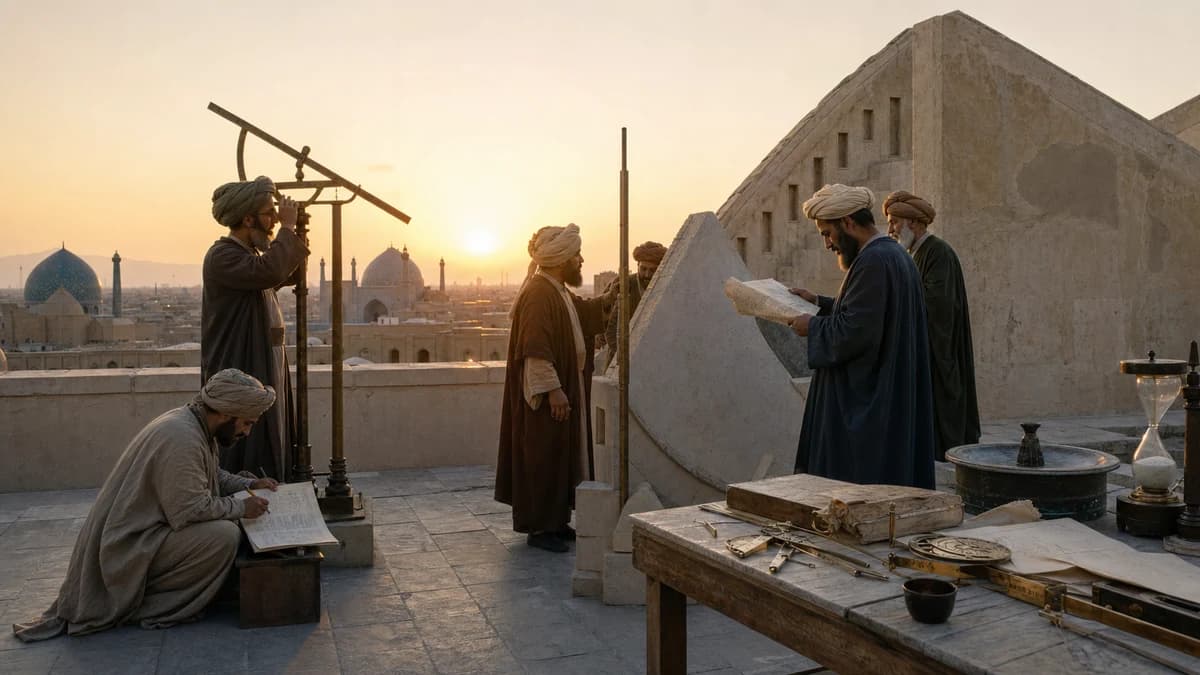
The cover image is an original AI-assisted observatory reconstruction, not a portrait of Khayyam or a photograph of a surviving Seljuk instrument.
A solar calendar must manage a fractional day
The tropical year is not an integer number of days. A calendar of 365-day years drifts against the seasons unless it periodically inserts leap days. The challenge is to match civil dates to the Sun closely while using a rule or observation that administrators can maintain.
The Jalali system tied the new year to the vernal equinox. Historical descriptions emphasize astronomical observation; later arithmetical leap-cycle schemes should not automatically be projected backward as Khayyam’s exact rule.
The work was institutional, not solitary
Malik-Shah and his vizier Nizam al-Mulk supported an observatory and assembled a team. Khayyam’s name is prominent, but calendar reform required repeated observations, calculation, instruments, tables and state adoption. Describing it as one poet suddenly inventing a perfect calendar erases that collaboration.
The reform operated within a political history. Patronage made sustained observation possible, while the sultan’s death and later instability affected the observatory’s continuity.
Accuracy claims need careful definitions
Popular comparisons often say the Jalali calendar is “more accurate than the Gregorian calendar.” Such statements depend on which historical Jalali rule is modeled, how leap years are assigned and whether accuracy means average year length or keeping Nowruz at the observed equinox.
The safest conclusion is that the reform represented sophisticated solar astronomy and achieved close seasonal alignment. A precise error quoted to many decimal places can suggest certainty that the historical procedure does not supply.
How to compare calendars
- State whether the calendar uses observation, arithmetic or both.
- Define the solar year and date range used for comparison.
- Separate the original Jalali reform from later Iranian calendar rules.
- Credit the scholarly team and its patronage.
The Jalali calendar turns an astronomical measurement into public time. Its history joins the motion of the Sun to mathematics, bureaucracy and the fragile life of an observatory.
Sources
- MacTutor: Omar Khayyam — biography, mathematics and calendar work.
- MacTutor: A Brief History of Astronomy — astronomical context and calendar measurement.
- British Society for the History of Mathematics: Khayyam — historical study of his mathematical and astronomical work.


