Mustansiriya Madrasa: Four Law Schools in Baghdad
How the thirteenth-century Mustansiriya brought four Sunni legal schools into one endowed complex with teaching, lodging, food and medical services.
The Mustansiriya Madrasa, founded by the Abbasid caliph al-Mustansir in thirteenth-century Baghdad, is a landmark educational complex designed to accommodate the four Sunni legal schools within a single institution.
The Caliphal Foundation and Institutional Design
Commissioned by the penultimate Abbasid caliph al-Mustansir and completed in 1233, the Mustansiriya Madrasa represented a highly organized effort by the caliphate to centralize and regulate Islamic legal education. The most notable feature of its institutional design was the equal provision of space and resources for the four major Sunni schools of law: the Hanafi, Shafi'i, Maliki, and Hanbali madhhabs. This was a departure from earlier madrasas, which typically served only one or two legal schools.
Historical sources indicate that the caliph endowed the madrasa with vast agricultural estates and commercial properties. The income from these endowments funded generous stipends for teachers and students, free meals, clothing, oil for lamps, and medical care. While the institution offered a wide range of studies, including medicine, mathematics, and literature alongside law, it should not be equated directly with a modern comprehensive university, as its curriculum and administration remained rooted in traditional Islamic legal scholarship.
Architectural Layout and Spatial Organization
The surviving building, situated on the banks of the Tigris River, features a large central courtyard surrounded by two-story arcades. The spatial organization is dominated by four large, vaulted halls, or iwans, facing the courtyard. While historical sources describe these iwans as assigned to the four Sunni legal schools for lectures, modern visitors must note that the current physical state of these halls is heavily compromised by extensive twentieth-century restoration, making it difficult to verify the original thirteenth-century structural details.
Surrounding the courtyard are dozens of small vaulted rooms that served as student lodgings. The complex also included a large kitchen, a bathhouse, a pharmacy, and a hospital room where a physician taught medicine and treated students. A dedicated library housed thousands of manuscripts, which were maintained by a salaried librarian. The architectural design thus integrated residential, educational, and administrative functions into a highly secure and self-contained complex.
Damage, Reuse, and Restoration
The Mustansiriya Madrasa suffered significant damage during the Mongol sack of Baghdad in 1258, which resulted in the destruction of much of the city's infrastructure and the loss of many library books. Despite this catastrophe, the building survived and was repaired, continuing to function as a school intermittently under various regional rulers. In later centuries, particularly during the Ottoman period, the building was reused as a caravanserai, a military barrack, and a customs warehouse.
These centuries of reuse and neglect led to the collapse of several sections of the original structure. In the twentieth century, extensive restoration campaigns rebuilt large portions of the brickwork, the courtyard arcades, and the decorative inscriptions. Consequently, visitors must distinguish between the original thirteenth-century Abbasid brickwork and the modern concrete-backed restorations that now define much of the building's appearance.
Evaluating the Historical Evidence
When analyzing the Mustansiriya Madrasa, historians must carefully weigh the descriptions found in medieval Arabic chronicles against the physical evidence of the surviving, heavily restored building. The written sources provide detailed accounts of the daily routines, the specific food rations, and the elaborate opening ceremonies. However, the physical ruins do not always preserve direct evidence of these activities, such as the exact locations of the kitchens or the library shelves.
Furthermore, claims regarding the Mustansiriya's status as the oldest university depend entirely on modern definitions of higher education. Rather than applying modern academic categories retroactively, researchers focus on how the madrasa functioned as an instrument of Abbasid statecraft, designed to foster Sunni unity and project caliphal authority during a period of political fragmentation.
Evidence-Reading Checklist
- Identify the physical boundaries between the original thirteenth-century brickwork and modern restorations.
- Locate the four central iwans and assess their symmetrical placement around the courtyard.
- Examine the surviving decorative brick inscriptions for historical references to caliph al-Mustansir.
- Compare the layout of the student residential cells with the descriptions of student life in medieval texts.
In conclusion, the Mustansiriya Madrasa stands as a monumental testament to late Abbasid patronage, illustrating a highly organized system of legal education that integrated diverse intellectual traditions within a single architectural frame.
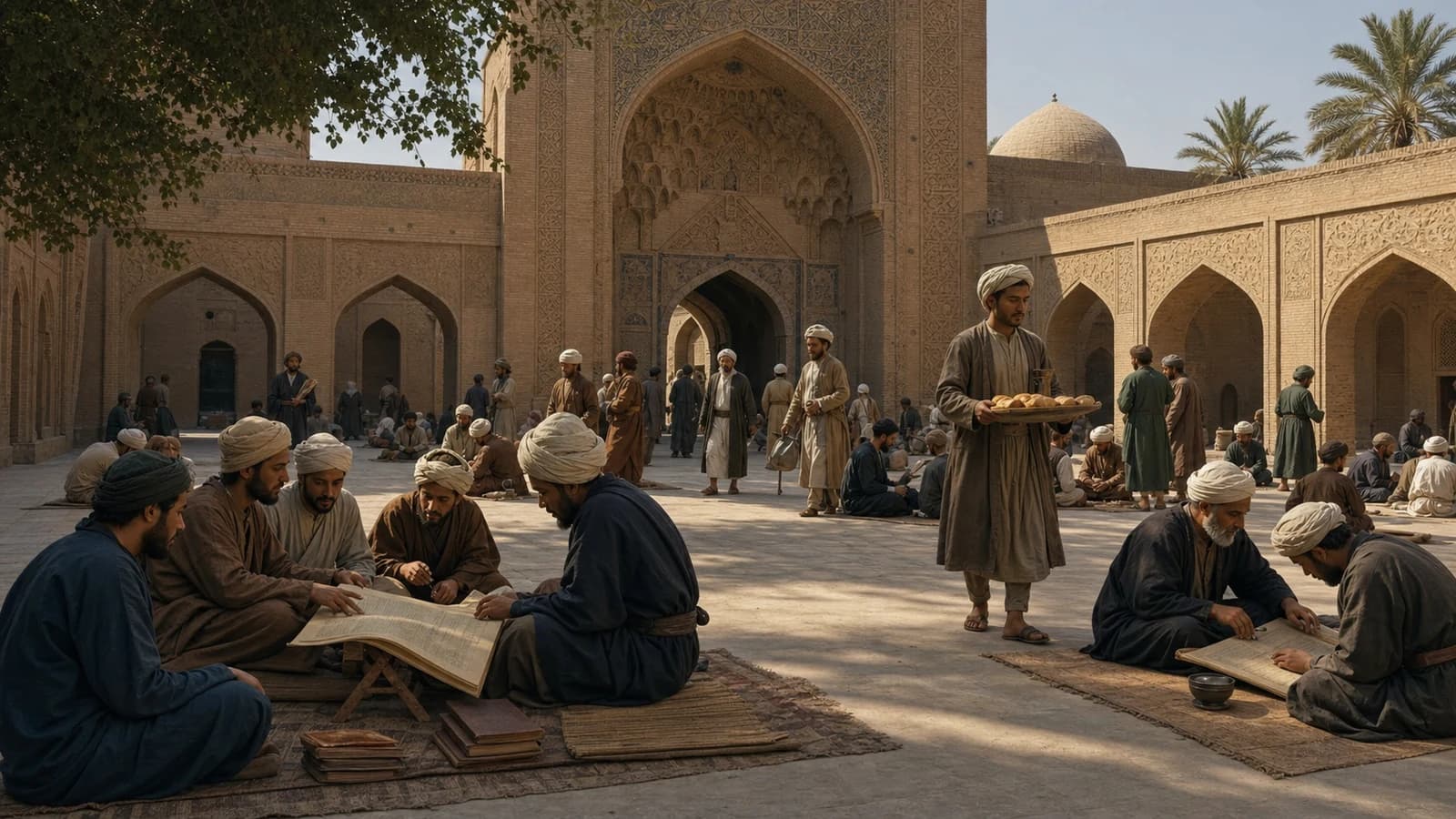
The cover image is an original AI-assisted reconstruction of the Mustansiriya in use, not a photograph or exact record of its thirteenth-century interior.
Sources
- ICESCO Heritage Portal: Mustansiriya Madrassah — architecture, curriculum and institutional role.
- Mustansiriyah University: Historical Background — foundation history and later reception.
- UNESCO World Heritage Centre: Historical Features of the Tigris — Baghdad's riverfront heritage context.
Related reading
- How waqf deeds financed institutions
- How medieval madrasas actually worked


