The Mughal Family Tree Explained: From Babur to Bahadur Shah II
A source-based guide to the Mughal imperial line, major father-son links, contested successions and why the family tree is not a simple eldest-son list.
The Mughal dynasty is often memorized as a line of six famous emperors: Babur, Humayun, Akbar, Jahangir, Shah Jahan and Aurangzeb. That sequence is useful, but it hides the central fact of Mughal succession: the throne did not pass automatically to the eldest son.
Princes built households, commands and alliances, and imperial deaths could produce civil war. A family tree therefore shows biological relationships; it does not by itself explain why one prince ruled and his brothers did not.
The main imperial line
Babur founded Mughal rule in northern India after the First Battle of Panipat in 1526. His son Humayun inherited the throne, lost it to the Sur dynasty and recovered Delhi shortly before his death. Humayun's son Akbar then expanded and reorganized the empire over a long reign.
Akbar was succeeded by his son Salim, who ruled as Jahangir. Jahangir's son Khurram became Shah Jahan after a contested succession. Shah Jahan's son Aurangzeb defeated his brothers in another war of succession and confined his father.
Why “eldest son” is the wrong rule
Mughal political culture treated several male princes as potential sovereigns. Seniority mattered, but military position, court alliances, provincial resources and timing mattered too. The result could be rebellion during a father's reign or open conflict after illness or death.
This helps explain why a chart must include Dara Shikoh, Shah Shuja, Murad Bakhsh and Aurangzeb even though only Aurangzeb became emperor. The unsuccessful branches shaped the outcome.
After Aurangzeb
Aurangzeb's death in 1707 was followed by another struggle won by his son Mu'azzam, Bahadur Shah I. The eighteenth century then saw short reigns, court factions, regional powers and repeated outside interventions while the Mughal title retained symbolic importance beyond the emperor's shrinking direct power.
Bahadur Shah II, also known as Bahadur Shah Zafar, was a descendant of this later line and the last Mughal emperor. After the uprising of 1857, the British deposed and exiled him, ending the dynasty's formal rule.
- Babur → Humayun → Akbar → Jahangir → Shah Jahan → Aurangzeb is the central early line.
- Succession was contested, not fixed by automatic primogeniture.
- Brothers and collateral branches are essential to understanding each transition.
- The dynasty continued symbolically until Bahadur Shah II was deposed after 1857.
How to read portraits and family charts
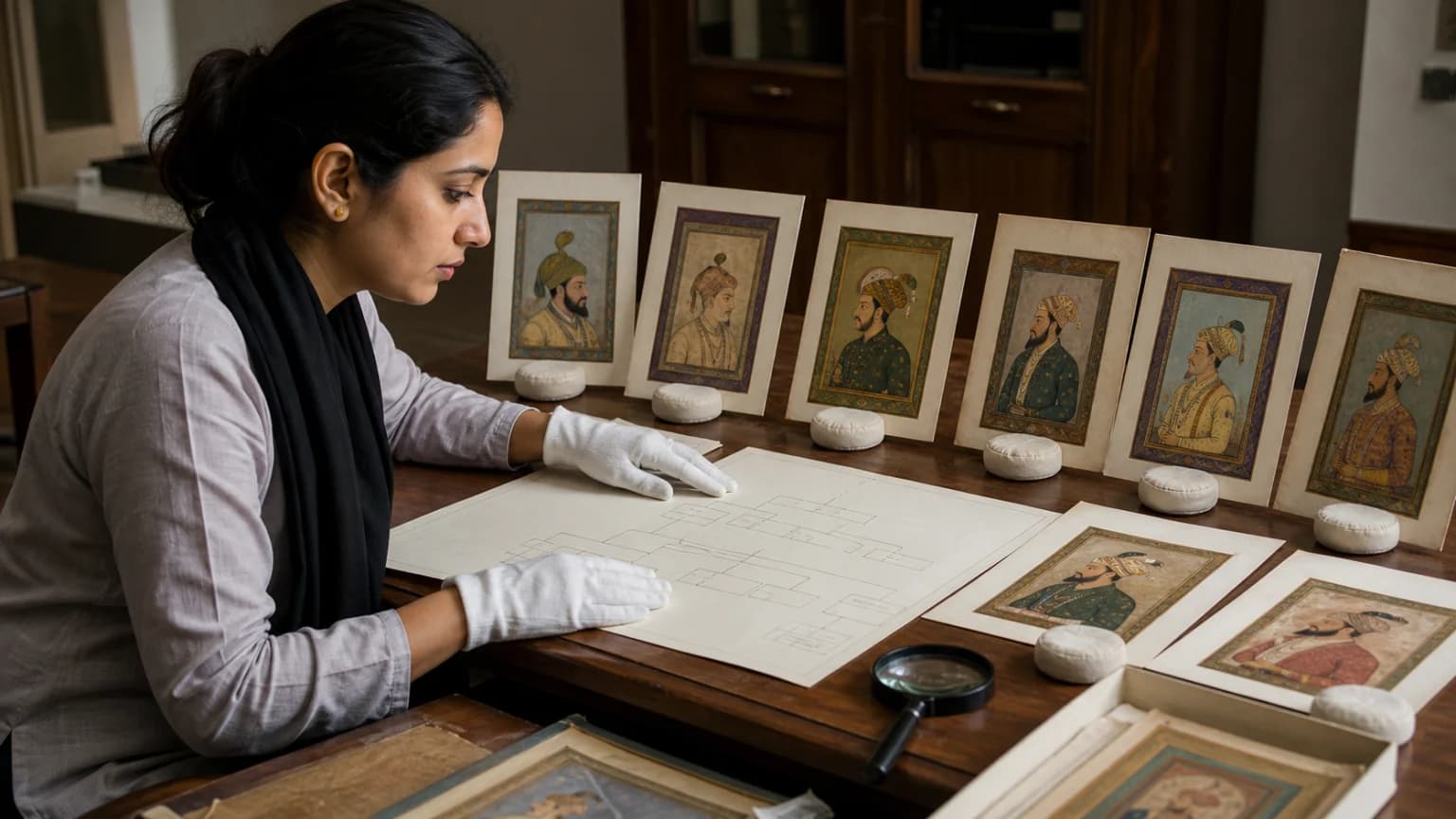
Mughal portraits are historical objects with their own dates, inscriptions, copies and later album histories. Do not assume every likeness was painted from life. Use museum catalog records alongside genealogies, chronicles and modern scholarship.
Sources
- Smithsonian National Museum of Asian Art: Mughal Dynastic Chart — Provides a museum-based visual chronology of Mughal rulers and relationships.
- Smithsonian: Writing My Truth — The Mughal Emperor Babur — Provides source context for Babur and the dynasty's foundation.
- The Metropolitan Museum of Art: The Art of the Mughals after 1600 — Provides chronology and cultural context for Jahangir, Shah Jahan, Aurangzeb and later Mughal art.
- Victoria and Albert Museum: The Arts of the Mughal Empire — Provides museum context for Mughal rulers, workshops and imperial chronology.
- Cambridge University Press: Safavid, Mughal and Ottoman Empires — Provides comparative academic context for dynasty, succession and imperial structure.


