Mashrabiya and Jali: Screens for Light, Air and Privacy
Mashrabiya and jali both filter light and views, but their materials, construction and regional histories differ. Here is how to tell them apart.
Mashrabiya and jali are perforated architectural screens that can soften sunlight, move air, frame views and give occupants visual privacy. They are often grouped together in discussions of climate-responsive design. That comparison is useful only if their different materials, construction systems and regional histories remain visible.
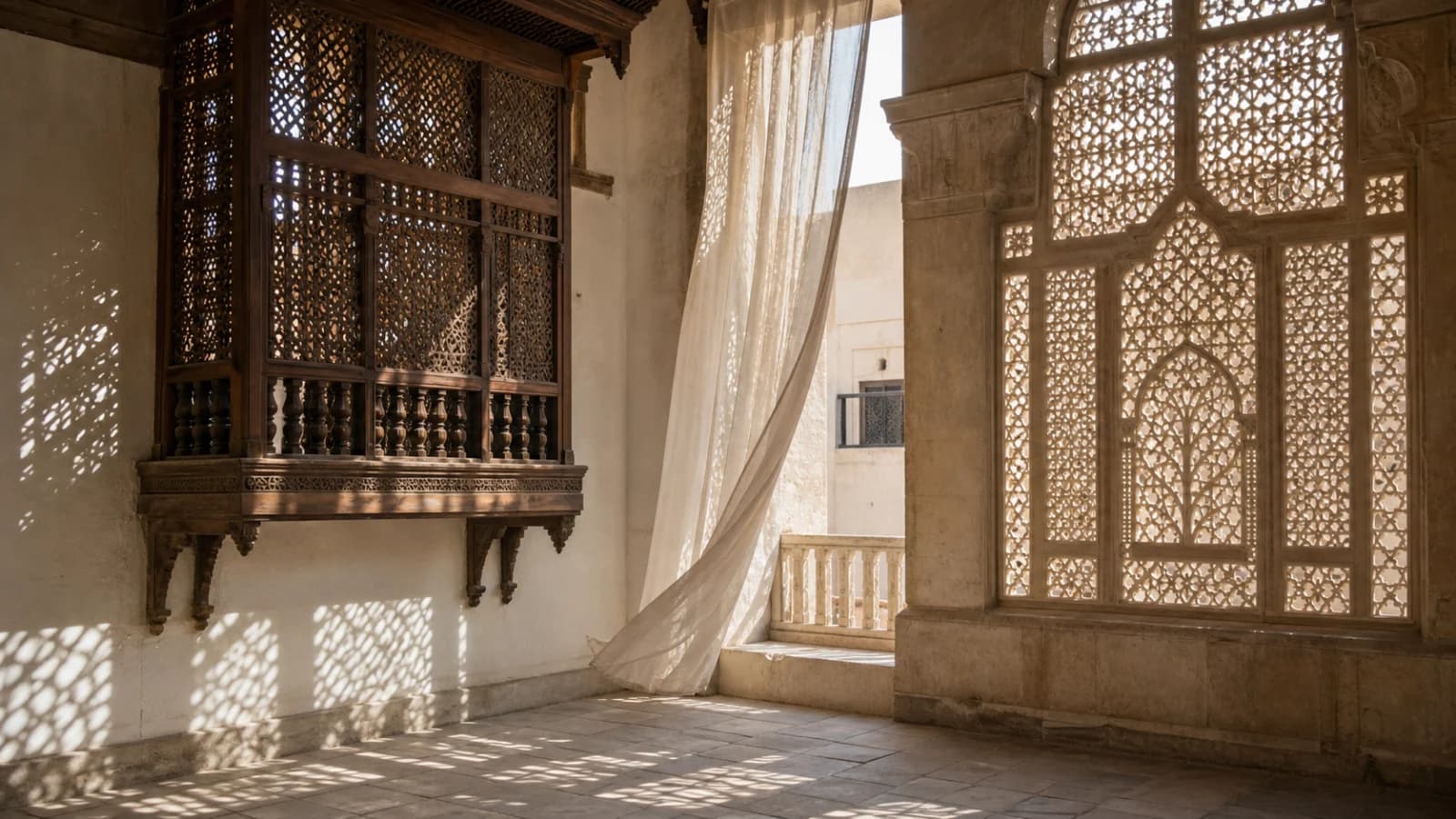
The cover image is an original AI-assisted comparative visualization, not a photograph of a specific historic interior.
Mashrabiya: assembled turned wood
In the urban architecture of Cairo and other parts of the Arab world, a mashrabiya is typically a lattice assembled from many short turned-wood elements fitted into polygonal joints. It can fill a flat window, form an interior partition or enclose a projecting upper-storey bay. The Met notes that such screens filtered bright light and provided ventilation while maintaining privacy.
The density is not always uniform. Tight lattice can shield eye level, while more open zones admit stronger light or a broader view. A projecting bay gains exposure to moving air and allows someone inside to look along the street. Yet performance depends on orientation, opening size, shutters, room depth and weather; the screen alone is not a complete cooling system.
Jali: openings carved through a solid panel
Jali is widely used for perforated screens in South Asian architecture. Mughal examples may be carved from sandstone or marble, although wood and other materials also occur. Instead of assembling turned pieces, a stone jali begins as a slab whose openings are carved through, leaving a continuous web of material.
Patterns can be geometric, vegetal or combined. The V&A’s conservation account of a white marble jali from about 1640 shows both the delicacy of the carving and the structural vulnerability of a screen with many old breaks and repairs. Stone may appear permanent, but narrow bridges and projecting details require careful design and conservation.
What the screens actually do
Both types reduce glare by breaking a large bright opening into smaller ones. Their patterned shadows change as the sun moves. From a darker interior, an occupant may see outward more easily than a passer-by can see in, but this privacy effect reverses at night when the interior is lit.
Airflow through perforations is real, yet slogans that claim a screen automatically “air-conditions” a room are misleading. Pressure differences, cross-ventilation, thermal mass, evaporative water, vegetation and occupant behavior all contribute. Historical screens should be studied as part of a building, not isolated as a decorative device or universal technology.
How to tell them apart
- Look at the material: many mashrabiyas are turned wood; many monumental jalis are pierced stone.
- Inspect the construction: assembled spindles and joints differ from openings carved through a slab.
- Check whether the screen projects beyond the façade or sits within an opening.
- Study the pattern density at eye, floor and upper levels.
- Use regional and historical evidence rather than naming every lattice “mashrabiya.”
The most productive comparison is not which tradition “invented” filtered light. It is how craftspeople working with wood or stone transformed a boundary into a finely tuned surface—one that is simultaneously wall, window, ornament and social interface.
Sources
- The Metropolitan Museum of Art: Mashrabiyya Screen — material, joinery and architectural use.
- V&A: Conservation of a Mughal marble jali — carving, date and conservation evidence.
- V&A: India teachers’ resource — jali materials, pattern and light.
Related reading
- Islamic geometric patterns
- Traditional passive cooling in Islamic architecture


