Khettara and Foggara: Underground Water for Oases
How North African gallery systems tap groundwater by gravity, why maintenance shafts matter, and how communities manage fragile oasis water today.
Khettara and foggara represent regional variants of the qanat system, a network of gently sloping underground galleries engineered to transport groundwater from aquifers to arid oases in Morocco and the broader Sahara. These subterranean infrastructures allow settlements to thrive in hyper-arid environments by intercepting hidden water tables and delivering flow via gravity alone. The terminology reflects distinct geographical traditions: khettara denotes systems in parts of Morocco, while foggara is the prevalent term across Algerian, Tunisian, Libyan, and other Saharan regions. Understanding these structures requires looking past surface landscapes to the hydraulic engineering that sustains them.
Subterranean Architecture and Hydrology
The core mechanism begins with a mother well or recharge zone dug into a foothill or alluvial fan where groundwater is accessible. From this point, a tunnel—often less than a meter wide—is excavated at a precise, gentle gradient that allows water to move toward the settlement without eroding the channel walls. The total length of these tunnels can extend several kilometers, maintaining a consistent downward slope that ensures steady flow.
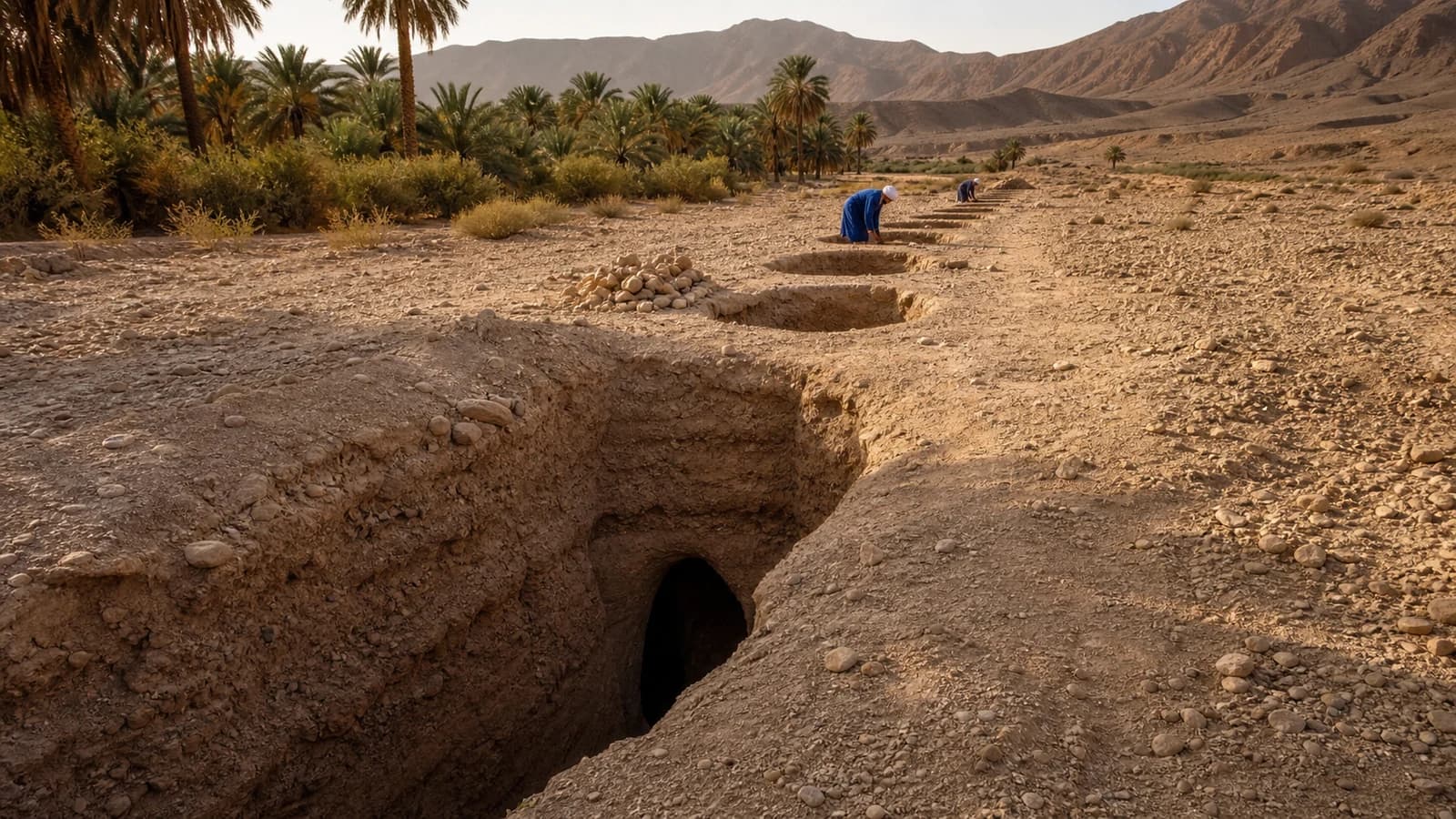
Vertical shafts punctuate the tunnel at regular intervals. These are not ordinary draw wells for accessing water but serve critical engineering functions. They provide ventilation to workers during construction and maintenance, allow for the removal of excavated soil (spoil), and offer access points for cleaning silt from the gallery floor. The convergence of surface irrigation channels with these subterranean outputs creates a complex hydraulic network that manages both quantity and distribution.
Collective Labor and Social Organization
Construction and upkeep demand coordinated communal effort. Communities organize labor through customary laws that define water shares, ensuring equitable distribution among landowners and users. These shares are often tied to specific time intervals or volumetric measurements, regulated by local authorities or elders who enforce the schedule. The social fabric of oasis life is inextricably linked to the maintenance of these galleries.
Skilled technicians, often passed down through familial lines, oversee the delicate work of repairing tunnel collapses or clearing blockages. Their knowledge includes reading subtle signs of water level changes and maintaining the precise gradient required for gravity flow. This expertise constitutes a form of embodied technical knowledge that is difficult to replicate without direct apprenticeship.
Contemporary Pressures and Threats
Modern khettara and foggara systems face multiple overlapping threats. Climate variability, including prolonged droughts and falling water tables, reduces the recharge capacity of the parent aquifers. Simultaneously, the introduction of motor pumps by individual landowners often bypasses the gravity-fed system, depleting shared groundwater reserves faster than natural recharge can replenish them.
The abandonment of traditional maintenance practices further accelerates decline. As younger generations migrate to urban centers for economic opportunities, the collective labor required to keep galleries open diminishes. Many systems fall into disuse not because the water is gone, but because the social and technical infrastructure necessary to manage it has fractured. UNESCO’s framing of these systems as living heritage highlights their cultural value, yet this designation does not guarantee their survival against hydrological and economic pressures.
Evidence-Based Assessment
Historical accuracy requires distinguishing between surviving physical structures, prescriptive texts that describe ideal operations, and later reconstructions that may idealize past efficiency. Not all systems share the same age or origin story; many were modified or abandoned over centuries. Evaluating their current state demands careful observation of remaining shafts and tunnels rather than reliance on generalized narratives about Islamic hydraulic ingenuity.
- Verify if the site is classified as khettara in Morocco or foggara elsewhere to determine regional design norms.
- Check for surviving vertical shafts that indicate the original tunnel’s path and maintenance access points.
- Assess whether water shares are still enforced by local customary law or have been replaced by private pumping rights.
- Distinguish between active galleries maintained by communal labor and abandoned sections reclaimed by sedimentation.
The cover image is an original AI-assisted desert landscape reconstruction, not a survey of one named khettara or foggara.
Sources
- UNESCO Virtual Museum: Voices of Water — Morocco — khettara knowledge and contemporary voices.
- UNESCO Intangible Heritage Assistance: Khettaras — safeguarding needs and community practice.
- UNESCO and IPACC: Indigenous Peoples and Water in Africa — regional water knowledge and environmental context.
Related reading
- How qanat underground channels work
- How Oman’s aflaj differ


