How Akbar's Hamzanama became a 1,400-painting manuscript
What Akbar's Hamzanama depicted, how its unusually large paintings were made, why museum dates and surviving-folio counts differ, and what individual leaves can prove.
Akbar's Hamzanama was an illustrated Persian adventure cycle made for the Mughal emperor's court in the second half of the sixteenth century. Museum records commonly reconstruct an undertaking of 1,400 paintings, often described as fourteen volumes of one hundred pictures. The painted leaves were unusually large and combined opaque colors, ink and gold with cotton and paper. They tell fantastic stories about Amir Hamza, a legendary hero associated with the Prophet Muhammad's uncle; they do not provide a documented biography of the historical man. The surviving leaves are now scattered among collections, so dates, artists and the total number still known must be tied to particular records.
The Metropolitan Museum of Art's catalog of a battle scene dates one leaf to about 1564–69 and lists dimensions of approximately 68.6 by 54 centimeters. The Victoria and Albert Museum's account of Akbar's workshop treats the whole project as a long collaborative production, roughly in the period 1562–77. Those statements concern different scales: one object and an evolving imperial commission.
Was the Hamzanama a biography of Hamza?
The historical Hamza ibn Abd al-Muttalib was the Prophet Muhammad's uncle. The Hamzanama takes a figure associated with him and turns him into the hero of an immense romance. The Victoria and Albert Museum describes tales of unbelievers, witches, demons and magical forces that had long been performed orally before Akbar had a version prepared for courtly books. The MAK collection record in Vienna likewise separates the historical person from the invented episodes that accumulated in the narrative tradition.
This distinction changes how a picture should be read. A scene of an archer, giant, spy or impossible escape can illustrate a romance without documenting a sixteenth-century battle, or a seventh-century event in Hamza's life. Even a named character does not make the depicted action historical. The Met's leaf showing Mihrdukht aiming through a ring is identified as a story in which a princess's skill sets a challenge for Hamza's son. Its catalog is evidence for the pictured episode, the object's date and material, and the museum's interpretation of style. It is not evidence that such an archery contest took place.
The manuscript can also be called a dastan, a storytelling tradition rather than a chronicle. Its appeal at court lay in suspense, heroes and episodes suited to performance and illustration. That explains why many scenes contain multiple actions and crowds rather than a single quiet portrait. The label “Islamic manuscript” describes the cultural and literary setting; it does not mean every painted monster is a religious doctrine or that the romance should be used as a source for the Prophet's biography.
Why do museums repeat the number 1,400?
The Cleveland Museum of Art describes an original design of fourteen volumes with one hundred illustrations each. The Met also summarizes the enterprise as 1,400 illustrations, while the V&A notes that early accounts differ between twelve and fourteen bound volumes, each understood to contain around one hundred paintings. These are reconstructions of a dispersed work, not a surviving modern inventory of fourteen intact books. The arithmetic behind 1,400 is clear; the original binding structure is less secure.
The figure also says nothing exact about how many painters held a brush on a given day. The Met object record says nearly one hundred artists worked over about fifteen years. The V&A discusses a large royal workshop guided by Iranian-trained masters with many artists from the subcontinent. Both descriptions convey the scale of labor, but a rounded project total must not become a census of named workers or a claim that every leaf had one separate author.
To put the project in its reign, the Mughal history timeline follows Akbar between Babur and later rulers. It is chronological context, while the numbers of volumes and paintings here come from museum research on the manuscript itself.
When did the project begin and end?
The Met says Akbar commissioned the work in 1562 and dates its pictured battle leaf to about 1564–69. The V&A describes the production as approximately 1562–77, while the MAK catalog gives a broader 1557–77 range for the court project. These ranges should be reported as catalog judgments rather than collapsed into a day on which all volumes were commissioned, painted and bound. A folio dated circa 1570 may fit a long enterprise without fixing its opening year.
The V&A explains that the stories were adapted into Persian prose and copied for the imperial volumes. Preparing a text, planning sequences, painting and mounting large sheets could overlap. The V&A further notes that the original volumes no longer survive as complete bindings, which makes a precise production schedule hard to reconstruct. One institutional label may date patronage, another the visible paint, and another the likely period in which the workshop operated. Readers should check what each date actually describes.
This work belonged to Akbar's early artistic patronage, long before the later imperial histories and translated epics often associated with his court. His religious policy and court debates are a separate subject. A painting of a legendary Muslim hero cannot by itself prove what the emperor believed during the Ibadat Khana debates of the late 1570s.
How large were the paintings and what held them together?
The Met's battle leaf has cataloged dimensions of 68.6 by 54 centimeters and is described as ink, opaque watercolor and gold on cloth mounted on paper. The Cleveland leaf from volume eleven specifies a page measurement of 83.7 by 67 centimeters and a medium of gum tempera, ink and gold on cotton and paper. These are two different objects; the Met entry does not identify its dimensions as those of the painted surface alone. The object number and the stated basis of measurement are essential to any comparison.
The V&A describes a layered construction: a paper sheet carrying the Persian text and a painted cotton cloth associated with it were joined into large folios. These leaves are therefore more than pictures reproduced from an ordinary small paper book. Text, fabric, pigment, backing and sometimes later mounting are separate physical elements. On a museum page the front image may be easy to see while the text on the reverse, the weave of the cloth or the join between layers is harder to inspect.
The material choice mattered artistically. The broad surface allowed figures, buildings, animals, rocky terrain and many simultaneous actions to be arranged on a scale that could be followed beyond a small reading desk. It also meant that damage, trimming and remounting could affect a surviving leaf differently from a compact bound manuscript. A photograph can show composition and color, but cannot establish the exact fiber, original adhesive or all conservation treatments without the object's technical record.
How did a workshop make so many different scenes?
The V&A account describes Iranian-trained masters directing artists of different backgrounds in Akbar's book workshop. Painters, calligraphers, bookbinders and illuminators contributed different skills. The result was not a mechanical copy of one Persian model: Indian artists and Iranian court traditions interacted across many commissions. The Hamzanama was one of the workshop's first major undertakings, while later projects developed different degrees of detail and narrative control.
Attribution needs restraint. The Met battle leaf is attributed to Shravana, Dasavanta and Tara, rather than signed by a single uncontested maker. This is a curatorial assessment about a specific object; it does not let us assign every surviving leaf to the same three people. The V&A explains that in later illustrated Akbarnama manuscripts an inscription can distinguish a designer from the artist who carried out the coloring. That later documented practice makes collaboration plausible as a workshop method, but is not a signature on each Hamzanama sheet.
The MAK record lists several named illustrators associated with the project. Lists of names, stylistic attribution and inscriptions on a particular object have different evidential force. The most cautious account is that a large, organized workshop produced the cycle under imperial patronage, with specific hands sometimes identifiable only provisionally. Our discussion of people and animals in Islamic art helps compare the figurative vocabulary with other museum objects, without assigning a disputed author to a Hamzanama leaf.
What do three surviving scenes actually show?
The Met's “Hamza's Heroes Fight” leaf presents Hamza's allies Qasim and Badi'uzzaman in combat beneath and around a pavilion, with other fighting groups crowding the space. The institution dates the object circa 1564–69 and records three attributions. The picture supports an observation about densely staged narrative action; it does not identify the precise order in which every worker drew, colored and finished the figures.
The Met's Mihrdukht leaf, dated around 1570, shows a princess shooting through a ring suspended from a golden bird. The catalog relates the challenge to a marriage story involving Hamza's son Hamid. Instead of calling all Hamzanama scenes “battles,” this episode shows how courtship, skill, garden imagery and a female character could drive an adventure. Its cataloged cotton support also allows a material comparison with the battle sheet; the two entries need not have identical dimensions or later histories.
The Cleveland folio portrays Alamshah breaking the chain of a dam while water threatens his father's camp. The museum identifies it as a leaf from volume eleven and notes that a title in its bottom margin continues text from the previous page. That detail matters: the image and nearby writing belong to a sequential narrative, not an independent poster. It also shows why a single detached image may need text from neighboring leaves to understand a scene completely. The three records provide different kinds of evidence: a battle composition, a named archery episode and a page whose text points beyond its present borders.
How many folios survive, and where?
Only a fraction of the reconstructed 1,400 illustrations remains. The V&A says fewer than 200 survive and describes Vienna's MAK group as sixty folios, with twenty-eight complete folios and two fragments in its own collection. The MAK's current collection entry, last updated in September 2026, states 200 surviving leaves worldwide and sixty in Vienna. Those counts differ slightly. They may use different dates, thresholds for fragments, or catalog scopes; the two pages do not establish one shared counting rule. It is safer to say that roughly one seventh or less of the original cycle survives than to present one museum's rounded total as a verified global census.
The folios' dispersal means that a visitor may see an object in New York, London, Vienna or Cleveland without seeing the neighboring episode. The British Museum's painting of the giant Zumurrud Shah is cataloged as cotton painting from the Hamzanama; its story includes an impossible feat and a fantastic creature. The museum's registration number identifies the specific object better than a generic caption such as “Akbar miniature.” The Cleveland accession similarly names a volume, while not recovering an intact book.
This dispersal creates a research task, not an excuse to invent a full sequence. Object records can supply dimensions, medium, inscriptions and provenance. They cannot always tell where the leaf sat within a lost binding or whether every apparent pair originally faced each other. Surviving leaves may have been trimmed, detached or remounted. Photographs are valuable for comparison, but claims about sequence and original display should be expressed as reconstructions when the relevant binding evidence is missing.
What did the project change in Mughal painting?
The Hamzanama gave Akbar's workshop an extended assignment involving many figures, repeated characters, landscapes, buildings and dramatic incidents. The V&A sees its surviving leaves as evidence of an emerging Mughal style, later refined in other manuscripts. The Met's overview of Mughal art before 1600 places the workshop within a broader court that employed Persian and Indian Muslim and Hindu artists. These are institutional art-historical syntheses; the surviving sheets demonstrate particular visual solutions, not a simple one-direction transfer from one culture to another.
The legacy can be understood through what can actually be inspected. A large cotton painting records a scene, materials and sometimes attributed hands; later manuscripts show different arrangements of text and image. Readers interested in repeated vegetation and patterned borders can use the guide to arabesque ornament as a visual comparison, while keeping the Hamzanama's narrative painting distinct from a purely decorative pattern. Akbar's commission is striking because its immense reconstructed scale meets a small, tangible set of surviving leaves that can still be compared one by one.
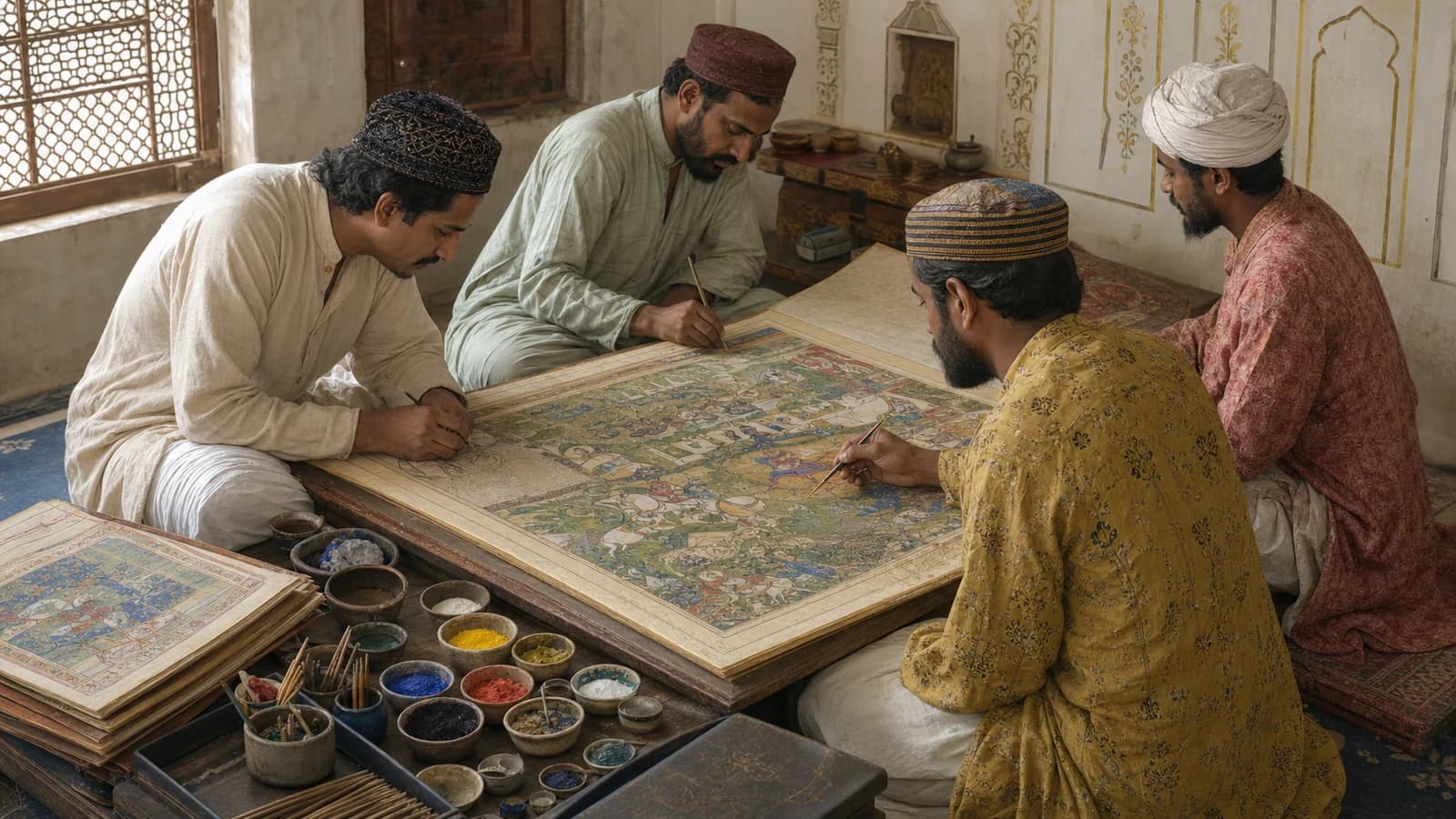
The cover image is an original AI-assisted historical reconstruction of a workshop, not a photograph of a surviving Hamzanama leaf, a specific room or a named painter.
Sources
- Metropolitan Museum of Art, battle folio 18.44.2 — Supports the 1,400-picture project summary, approximate fifteen-year workshop, circa 1564–69 object date, medium, dimensions and provisional artist attributions. Its dimensions are for this cataloged object.
- Victoria and Albert Museum, “The arts of the Mughal Empire” — Supports the romance and oral-story background, cotton and paper construction, workshop organization, broad 1562–77 dates and its stated survival and collection counts. Its account acknowledges disagreement on the original volume count.
- Cleveland Museum of Art, Hamza-nama leaf 1976.74 — Supports the fourteen-by-one-hundred reconstruction, volume-eleven identification, page dimensions, materials and the marginal continuation of text; it is evidence about one leaf.
- MAK Vienna, Hamzanama collection record — Supplies a broader project date range, the totals currently displayed on its page of 200 known leaves and sixty held at MAK, and its named-artist associations. Its count is not silently reconciled with the V&A's formulation.
- Metropolitan Museum of Art, Mihrdukht folio 2022.170 — Supports the archery episode, circa 1570 date, cotton medium and object dimensions; the pictured story is not a historical event claim.
- British Museum, painting 1925,0929,0.2 — Provides a cataloged example of a giant episode and cloth painting, illustrating the romance's fantastic content and the value of accession numbers.
- Metropolitan Museum of Art, “The Art of the Mughals before 1600” — Places Akbar's early manuscript workshop within broader artistic patronage and a mixed group of court artists; it is context rather than an inventory of surviving Hamzanama leaves.


