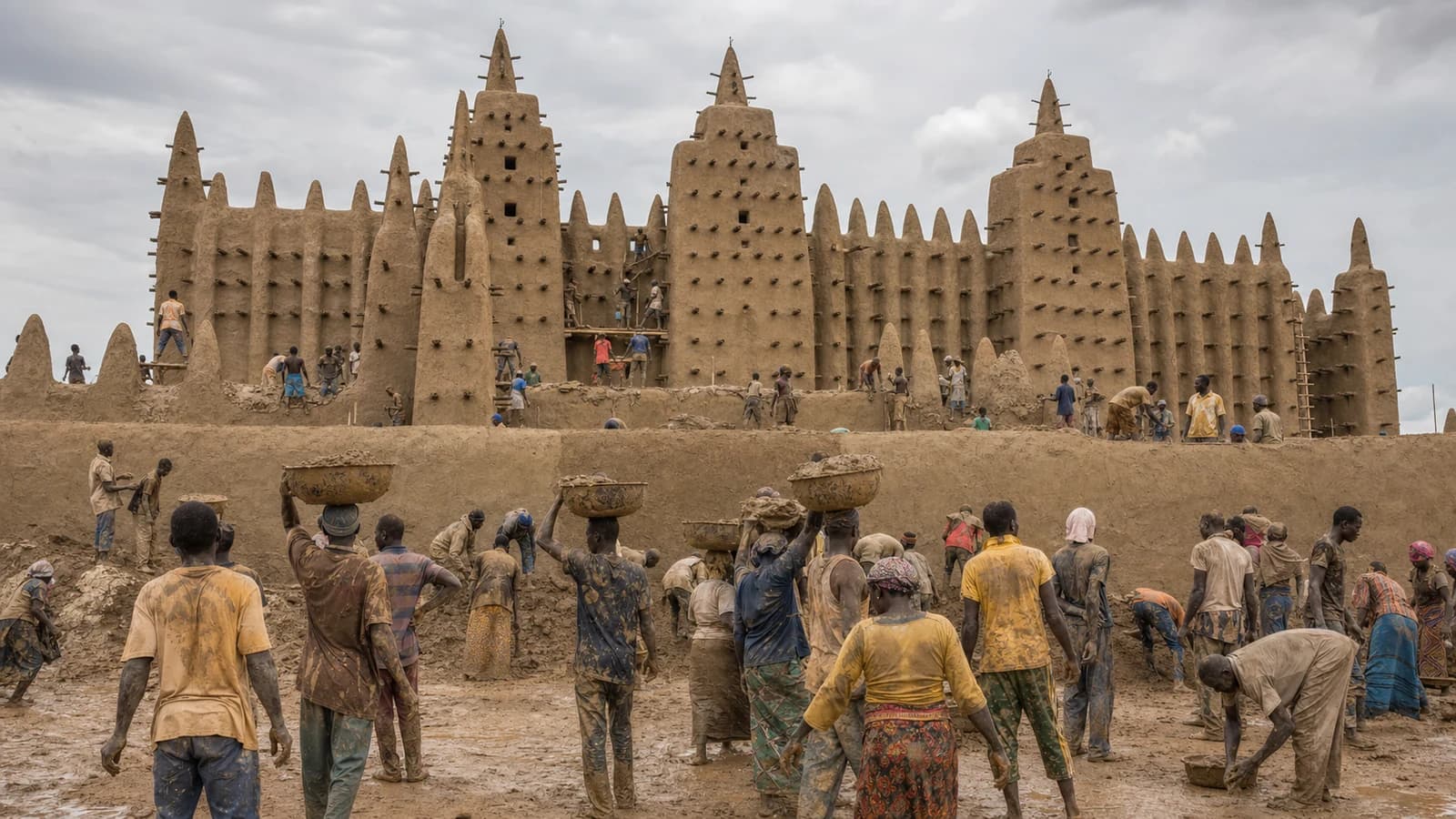
Why Djenné's Great Mosque Must Be Replastered
How earthen walls, projecting toron timbers and communal maintenance sustain Djenné's Great Mosque—and why renewal is part of the building, not its failure.
The Great Mosque of Djenné stands as a monumental earthen building within the UNESCO-listed old town. Constructed primarily of sun-dried earthen masonry, the structure relies on thick walls and heavy buttresses to maintain its stability and form. This massive building is a central feature of the local landscape, representing a highly specialized tradition of building with local soil and organic materials. The physical survival of such a large earthen monument requires constant vigilance and a deep understanding of structural engineering adapted to the local climate.
A defining feature of the mosque's exterior is the presence of projecting toron timbers. These bundles of wood pierce the walls, providing a distinctive facade rhythm that characterizes the building's appearance. Beyond their aesthetic contribution, the toron timbers serve a vital practical purpose by acting as permanent scaffolding. This built-in access system allows workers to climb the steep, high walls safely during maintenance, ensuring that even the highest points of the facade remain reachable without the need for temporary structures.
A Living Sacred Site and Its History
The present mosque largely dates to the early twentieth century, though it stands on an older sacred site. Because of this history, it is inaccurate to describe every visible wall as medieval. The physical fabric of the building has undergone significant changes over generations, and what visitors see today is the result of successive layers of construction, repair, and renewal. Acknowledging that the current structure dates to the early twentieth century helps clarify the distinction between the ancient spiritual history of the location and the physical age of the standing walls.
This distinction is crucial for understanding the nature of earthen architecture, which is inherently dynamic rather than static. The site has served a religious function for generations, and the building continues to be a living place of worship. Preserving the mosque is not merely about maintaining an archaeological relic for external observation, but about supporting an active religious and civic center that remains central to the daily lives of the local population.
The Necessity of Seasonal Replastering
The primary threat to the structural integrity of the Great Mosque is seasonal rain erosion. In this region, periodic heavy rains can quickly wash away the protective outer layers of the building, exposing the underlying sun-dried earthen masonry to severe damage. To prevent this deterioration, a new layer of earthen plaster must be applied to the exterior surfaces as a recurrent conservation act. Without this regular maintenance, the structural stability of the entire monument would be compromised within a few seasons.
This ongoing maintenance is organized through a community replastering festival, which mobilizes the population to renew the protective coating of the mosque. While external accounts sometimes portray this event as a picturesque spectacle, it is actually a highly organized labor system. The work requires immense physical effort, specialized skills, and complex social organization. The local community coordinates the gathering, preparation, and application of the plaster, ensuring that the collective labor is directed efficiently to protect the sacred building.
Evidence-Reading Checklist
- Verify that the present mosque structure largely dates to the early twentieth century rather than the medieval era.
- Identify how the projecting toron timbers provide permanent structural access to the high facade.
- Explain why seasonal rain erosion makes the application of new earthen plaster a recurrent necessity.
- Recognize the community replastering work as a structured system of labor, skills, and social organization.
- Distinguish the living religious function of the mosque from simplified tourist imagery.
In conclusion, the preservation of the Great Mosque of Djenné relies on a delicate balance of traditional materials, community dedication, and structural design. The building's thick walls, buttresses, and toron timbers are not merely decorative elements but functional components of a living architectural system. By understanding the continuous labor required to protect this earthen monument from seasonal erosion, we can better appreciate the social and technical skills that keep this historic sacred site standing today.
The cover image is an original AI-assisted reconstruction of communal replastering, not a photograph of a particular year's festival or measured conservation record.
Sources
- UNESCO World Heritage Centre: Old Towns of Djenné — heritage values, setting and conservation.
- UNESCO Urban Heritage Atlas: Djenné — urban form, materials and living heritage.
- UNESCO: Restoration of Djenné's Great Mosque — maintenance and conservation practice.
Related reading
- How Sudano-Sahelian mosque towers are built
- What Sankore manuscripts reveal about Timbuktu


