Siyer-i Nebi: An Ottoman Illustrated Life in Six Volumes
How Murad III's workshop turned a fourteenth-century Turkish prophetic biography into a vast illustrated manuscript—and how museums should frame its images.
To understand the Siyer-i Nebi, a clear distinction must be maintained between the fourteenth-century text and the late sixteenth-century illustrated manuscript. The original text was authored by Mustafa Darir, who completed a Turkish life of the Prophet. For over two centuries, this text circulated as a work of prose and poetry designed for study and recitation. The decision to transform this established text into a massive, multi-volume illustrated masterpiece came from the Ottoman court in Istanbul.
Sultan Murad III commissioned the project, mobilizing the resources of the royal manuscript workshop. The project was completed around 1595. This transition of patronage highlights how the Ottoman court utilized existing regional literary traditions to create highly specialized visual programs that reflected the authority and piety of the ruling dynasty. Rather than a contemporary eyewitness record, the work is a late sixteenth-century courtly commission based on a much earlier text.
Workshop Scale and Visual Sequencing
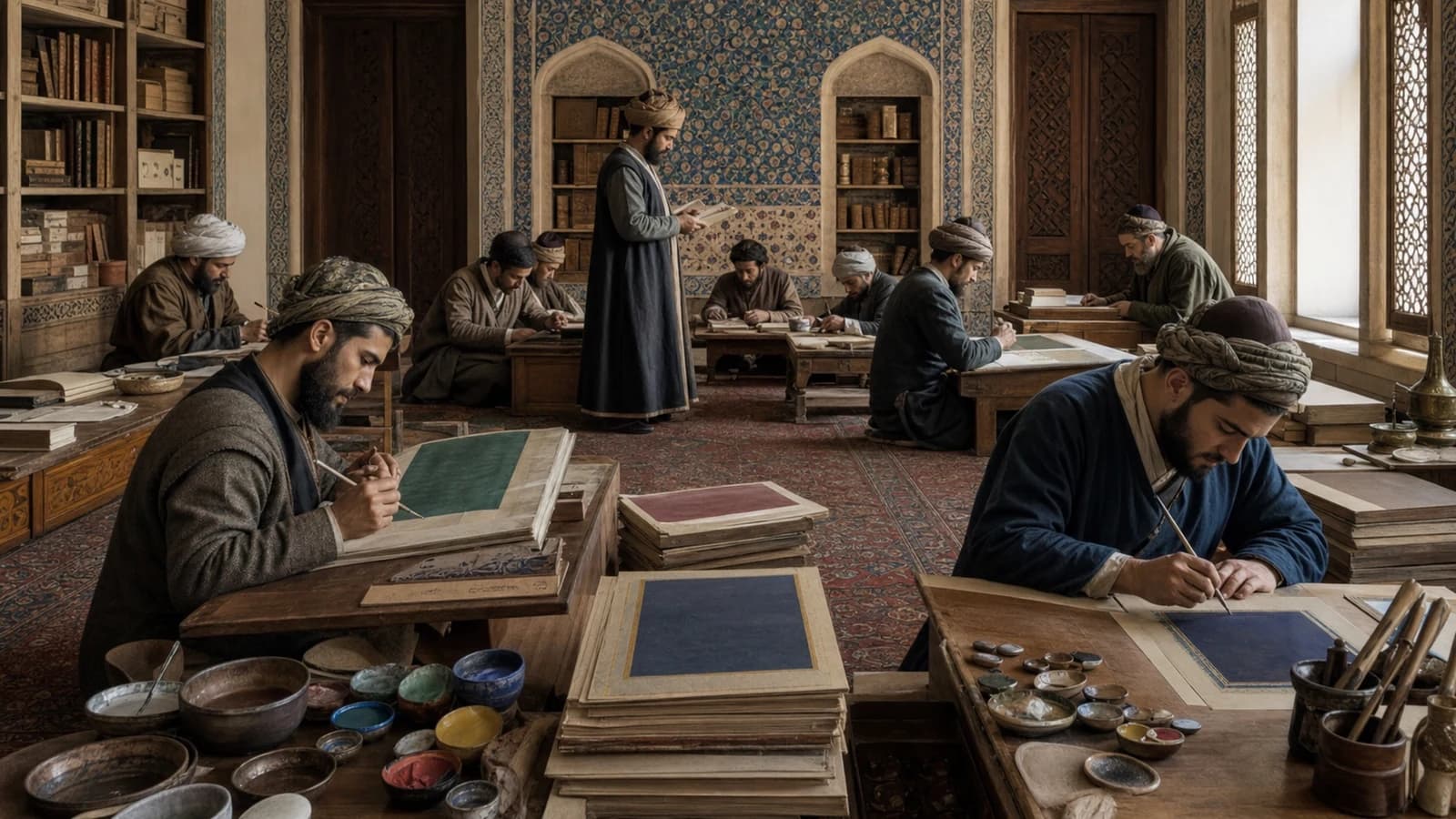
The production of the Siyer-i Nebi was an undertaking of unprecedented scale for the royal workshop, resulting in a six-volume illustrated copy. Such a vast quantity of illustrations required a highly organized division of labor. Multiple painters, calligraphers, and apprentices worked under the direction of court designers, leading to subtle variations in style, color palette, and composition across different sections of the work.
The narrative sequencing of the miniatures was designed to guide the viewer systematically through the life of the Prophet. Painters utilized bold pigments and structured frames to organize the complex historical scenes. Because the volumes were designed for sequential viewing, the relationship between the written Turkish text and the adjacent illustrations was carefully calculated to reinforce the narrative flow.
Iconography and the Convention of Veiling
A central feature of many Siyer-i Nebi illustrations is the specific iconographic convention used to depict the Prophet. In many scenes, his face is covered by a veil, and his body is enveloped by a stylized golden flame. This visual strategy served to denote spiritual status and maintain a respectful distance, preventing the literal representation of sacred features while still positioning the figure clearly at the center of the narrative action.
This convention was highly developed within the Ottoman court workshop of the late sixteenth century, but it does not represent a universal visual practice across all Muslim communities or historical periods. Other regions and eras produced different iconographic traditions. The Siyer-i Nebi must therefore be studied as a specific product of late sixteenth-century Ottoman court culture rather than as a generic representative of all Islamicate devotional art.
Dispersal, Fragmentation, and Museum Interpretation
Today, the Siyer-i Nebi no longer exists as a single, unified physical object. Over the centuries, the volumes became separated, and several were damaged or partially dismantled. Museum folios preserve only fragments of the original viewing sequence, and individual folios displayed in isolation present only a small part of the original, highly structured narrative.
This physical dispersal poses significant challenges for modern museum curators and historians. Museum object captions cannot reconstruct all volumes alone, making it difficult to fully re-establish the complex relationships between the text, the multiple artists involved, and the original multi-volume structure of the commission. Scholars must rely on the surviving physical evidence to piece together the history of this monumental work.
Evidence-Reading Checklist for the Siyer-i Nebi
- Verify the fourteenth-century date of the text by Mustafa Darir versus the late sixteenth-century completion date of the illustrated manuscript.
- Identify variations in painting style that indicate the involvement of multiple workshop artists rather than a single hand.
- Examine the placement of the veil and golden flame to analyze Ottoman courtly conventions of sacred representation.
- Acknowledge that museum folios preserve only fragments of the original viewing sequence and that object captions cannot reconstruct all volumes alone.
In conclusion, the Siyer-i Nebi remains one of the most ambitious illustrated manuscript projects ever executed by the Ottoman royal workshop. By separating the fourteenth-century text from its late sixteenth-century visual realization, historians can better appreciate the specific context of Murad III's court. The manuscript's current fragmented state serves as a reminder of the complex histories of preservation, dispersal, and interpretation that shape our understanding of courtly book arts.
The cover image is an original AI-assisted reconstruction of an Ottoman scriptorium, with no depiction of the Prophet and no copy of a Siyer-i Nebi image.
Sources
- The Met: Folio from a Siyer-i Nebi — commission, author, volume and date.
- The Met Bulletin: Recent Acquisitions 1993-1994 — object study and Ottoman manuscript context.
- The Met: Art of the Ottomans before 1600 — court atelier and artistic setting.
Related reading
- How Ottoman hilya calligraphy developed
- How the kitabkhana organized book production


