How Medieval Water Clocks Turned Flow into Time
How reservoirs, regulated outlets, floats, cords and counterweights made medieval water clocks display hours through moving figures, sounds and dials.
A water clock measures time by converting a gradual change in water level into a readable signal. The principle is ancient and was used in many societies, but engineers in medieval Muslim-ruled lands created exceptionally elaborate versions. Their clocks could move pointers, open doors, release metal balls, sound instruments and animate human or animal figures. Behind the display stood a demanding problem: untreated water does not automatically flow at a perfectly constant rate.
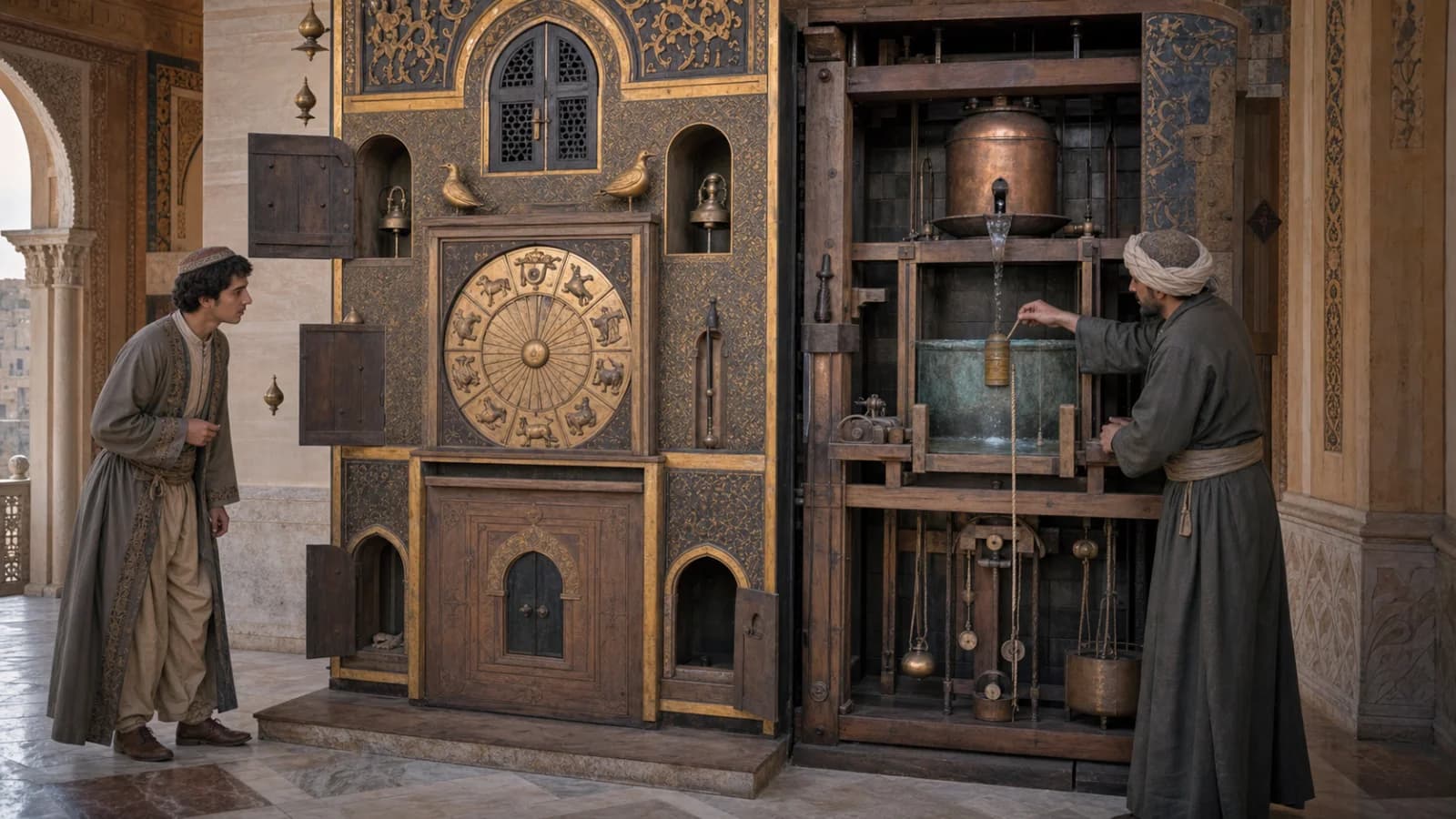
This article uses an original AI-assisted visual reconstruction for educational context. It is not a photograph of a particular historical clock or palace interior.
From changing water level to measured motion
Imagine a tank with a small outlet near its base. As the tank empties, pressure at the outlet falls and the flow can slow. Designers could reduce this variation by feeding a measuring vessel from a reservoir whose effective head was regulated, by shaping an outlet carefully, or by calibrating the display against the actual flow. A float in the receiving or emptying vessel rose or sank with the water. A cord attached to that float passed over pulleys and moved a pointer or another component.
The slow motion was then divided into events. At a chosen position, a linkage might release a ball. The ball rolled onto a cymbal, producing an audible hour, while a counterweight shifted a figure or opened a door. A siphon could empty a vessel rapidly after it filled gradually, creating a reset or triggering the next stage. The clock was therefore less like one modern clockwork and more like a carefully choreographed chain of hydraulic thresholds.
Time was not always divided the same way
Some historical systems used equal hours; others divided daylight and darkness into twelve seasonal hours, whose length changed through the year. A clock intended for unequal hours needed adjustment as days lengthened or shortened. Surviving descriptions show that calibration, dial layout and water regulation were part of the design, not afterthoughts. The public face might present zodiacal or courtly imagery, but the keeper still had to fill, set and maintain the mechanism.
Al-Jazari’s early-thirteenth-century treatise is a major source for clocks in this tradition, including the elephant, castle and peacock designs. Yet it should not stand in for every Islamic water clock. Earlier and later makers worked across a wide geography, and written descriptions, manuscript paintings and later reconstructions preserve different kinds of evidence. The often-repeated story that Caliph Harun al-Rashid sent Charlemagne a spectacular clock is also debated; the broader existence of complex water clocks is much better established than every anecdote attached to them.
Reading the façade and the machinery together
On a reconstruction, separate the clock into four layers: power, regulation, transmission and display. The water and descending weight provide power. The outlet and float determine the rate. Cords, pulleys and tipping containers transmit and divide movement. Doors, birds, musicians or dials make time perceptible to an audience. Confusing those layers can lead to reconstructions that look magnificent but cannot run.
A working water clock was not a perpetual machine. It consumed a height difference in water and had to be refilled and reset. Its accuracy depended on clean passages, stable vessels, low friction and skilled attendance. That dependence is not a flaw in the history. It reveals timekeeping as a collaboration between crafted apparatus and knowledgeable keeper—and explains why these clocks were as much demonstrations of ordered service as displays of mechanical ingenuity.


