Jami al-Tawarikh: Making a World History in Tabriz
How Rashid al-Din's team assembled sources about Mongols and distant peoples, translated the work and built an illustrated history for an Ilkhanid court.
The Jami al-Tawarikh, or Compendium of Chronicles, is a monumental historical work commissioned in the early fourteenth century by the Ilkhanid court in Persia and compiled under the direction of the vizier Rashid al-Din. Conceived initially as a history of the Mongols, the project was subsequently expanded into a vast, multi-volume world history that sought to document the dynasties, religions, and peoples of Eurasia. Produced in the specialized scriptorium of the Rab-i Rashidi complex in Tabriz, this work represents a highly collaborative effort to synthesize diverse historical traditions into a single, cohesive narrative.
Collaborative Production at the Rab-i Rashidi
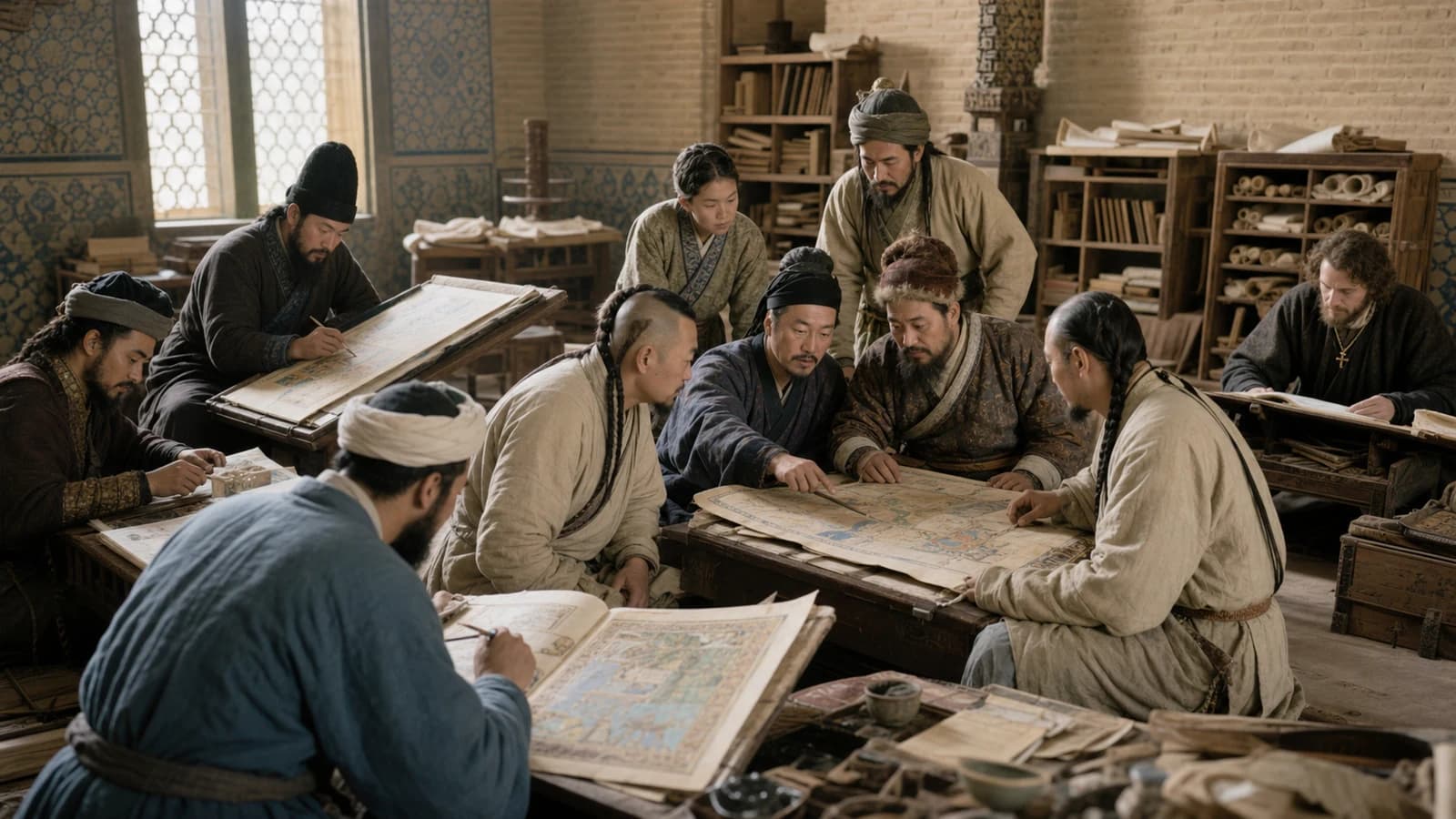
The creation of the Jami al-Tawarikh was made possible by the unique intellectual and administrative infrastructure of the Rab-i Rashidi, a major educational and charitable quarter established by Rashid al-Din in Tabriz. Here, a large workshop of scribes, translators, calligraphers, and illustrators worked in concert. To compile the history, Rashid al-Din consulted a diverse group of informants, including Mongol experts on nomadic genealogy, Chinese scholars, Kashmiri Buddhists, and Christian clerics, drawing on a wide array of written and oral sources.
While the endowment deeds of the Rab-i Rashidi provide detailed instructions for the annual copying and translation of Rashid al-Din's works into both Arabic and Persian, the exact division of labor within the workshop remains a subject of historical reconstruction. Scholars analyze the handwriting, ink consistency, and stylistic variations in the paintings to understand how different artists and scribes collaborated on a single volume, revealing a highly organized but flexible production system designed to meet demanding court deadlines.
The Visual Language of the 1314 Manuscript
A key witness to this ambitious project is the famous 1314 Arabic manuscript of the Jami al-Tawarikh, portions of which are preserved in the Edinburgh University Library and the Khalili Collections in London. The illustrations in this manuscript are celebrated for their eclectic visual vocabulary, which seamlessly integrates artistic conventions from different cultures. The paintings draw from Chinese, Persian, Arabic, and Byzantine visual sources, creating a unique synthesis that reflects the cosmopolitan nature of the Ilkhanid court.
These illustrations were not merely decorative; they served to legitimize the Ilkhanid rulers by visually linking them to the great imperial and religious lineages of the past, including the ancient Persian kings, the Prophet Muhammad, and the emperors of China. However, historians must avoid treating this political breadth as a form of modern, objective neutrality. The Jami al-Tawarikh was an imperial project designed to project the authority of the Ilkhanid court, and its portrayal of rival dynasties and historical events was carefully calibrated to serve the political interests of its patrons.
Materiality and Scriptorium Practices
The physical characteristics of the surviving 1314 folios offer invaluable insights into the material culture of the Ilkhanid scriptorium. The large format of the paper, the high quality of the ink, and the systematic layout of the text columns and image frames demonstrate the high level of patronage enjoyed by the workshop. The bilingual production in Arabic and Persian was intended to ensure the work's dissemination across the diverse linguistic landscapes of the Ilkhanid realm and the wider Islamic world.
When examining the historical and material evidence of the Jami al-Tawarikh, researchers should apply the following analytical checklist:
- Analyze the paper quality, watermarks, and sheet dimensions to confirm production within the fourteenth-century Tabriz workshops.
- Identify the stylistic sources of specific visual motifs, noting the integration of Chinese, Byzantine, Persian, and Arabic elements.
- Compare the Arabic and Persian versions of the text to identify translation discrepancies or shifts in political emphasis.
- Examine the colophons and marginal notes for evidence of later ownership, library stamps, or physical conservation history.
The Historical Significance of the Compendium
The Jami al-Tawarikh remains a crucial source for understanding the globalized nature of the Mongol period, reflecting an unprecedented level of cultural exchange across Eurasia. In museum settings, the surviving folios serve as powerful examples of how artistic styles and historical narratives were negotiated and synthesized. By presenting the work as a product of collaborative scholarship and political ambition, curators can help visitors appreciate the complex administrative and artistic networks that flourished in fourteenth-century Tabriz.
The cover image is an original AI-assisted reconstruction of Ilkhanid manuscript production, not a copy of a Jami al-Tawarikh painting or view of Rab-i Rashidi.
Sources
- The Met: Folios from the Jami al-Tawarikh — commission, volumes, translations and image sources.
- University of Edinburgh: Jami al-Tawarikh — 1314 manuscript, production and provenance.
- UNESCO Memory of the World: Jami al-Tawarikh — global scope and surviving manuscripts.
Related reading
- How the kitabkhana organized book production
- How al-Idrisi constructed a world map


