Iznik Ceramics: Quartz Frit, Cobalt Blue and Ottoman Red
How Ottoman Iznik potters turned quartz-rich fritware, underglaze painting and a difficult raised red into brilliant dishes and architectural tiles.
Iznik ceramics are Ottoman fritware vessels and tiles produced above all in the northwestern Anatolian town of Iznik. Celebrated examples combine a pale quartz-rich body with crisp underglaze painting and a transparent glaze. Their history is not a simple march from blue to red: workshops, court design, market demand and difficult kiln chemistry all shaped what could be made.
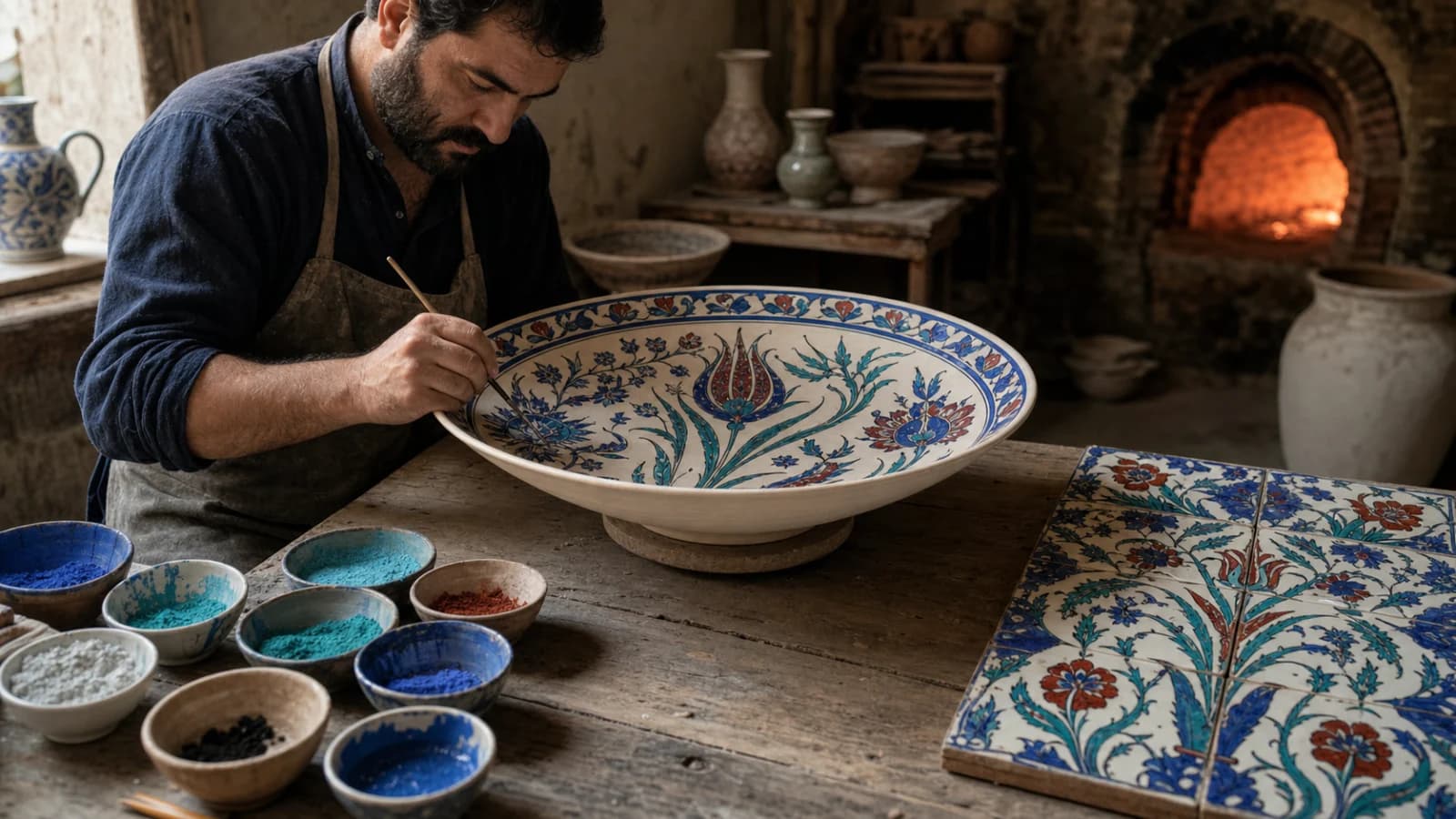
The cover image is an original AI-assisted craft visualization, not a photograph of a specific historic workshop or museum object.
Why “fritware” matters
The body is not porcelain and not ordinary clay-rich earthenware. Ottoman potters used a stonepaste or fritware mixture dominated by ground quartz, with smaller amounts of glassy frit and clay. Once fired, it produced a light-colored ground suitable for brilliant painted decoration, though forming and firing such a quartz-rich mixture required skill.
A white slip could refine the surface. Designs were painted with pigments that had to survive firing beneath a transparent glaze. The finished brilliance depends on the relationship among body, slip, pigment, glaze and kiln atmosphere—not on pigment alone.
Blue-and-white was a beginning, not a copy
Fifteenth- and early sixteenth-century wares often use cobalt blue on white and respond to Chinese blue-and-white porcelain. Ottoman designers did not simply reproduce Chinese objects. Cloud bands, lotus-derived forms and other imported motifs were recombined with arabesques, calligraphy and local court styles. Turquoise, green, black outlines and other colors later expanded the palette.
By the mid-sixteenth century, tulips, carnations, roses, hyacinths and long serrated saz leaves animate both dishes and architectural tiles. Similar motifs circulate among ceramics, manuscripts, textiles and court workshops, but a ceramic painter still had to adapt them to a curved vessel or a tiled wall.
The famous raised red
A vivid iron-rich red, often called Armenian bole red or “tomato red,” became a hallmark of later sixteenth-century Iznik. In strong examples it sits slightly raised beneath the glaze. It was technically demanding: composition and firing had to preserve saturation and relief without muddying the surrounding colors.
Red is useful for dating and classification, but it is not a perfect clock. Quality varies, pieces can imitate earlier palettes, and museum attributions change with research. Material examination, inscriptions, excavation and architectural context matter alongside style.
Vessels and buildings belonged to one industry
Iznik workshops made dishes, bowls, bottles and tankards, as well as tiles for Ottoman mosques, tombs, palaces and other commissions. Tile production could demand repeated units and large coordinated programs; vessels allowed other formats and markets. The town name identifies a major center, not proof that every Ottoman underglaze ceramic was made there.
European collectors once mislabeled many wares as Persian, “Damascus” or “Rhodian.” The V&A notes that the Ottoman origin gained broad scholarly acceptance only in the twentieth century. Those obsolete labels are part of collecting history, not neutral facts about manufacture.
How to look at an Iznik object
- Check whether the body is pale fritware rather than porcelain.
- Look for painting beneath a clear glaze, not enamel applied on top.
- Follow black outlines and observe where colors pool or blur.
- Compare rim, well and reverse decoration on vessels.
- Separate production place, style, excavation findspot and later collection history.
The beauty of Iznik lies in controlled risk. Quartz, pigment and glaze entered the kiln as a prediction; the finished object records whether material knowledge, drawing and heat held together.
Sources
- V&A: An A–Z of Ceramics, “I is for Iznik” — attribution history and Ottoman context.
- British Museum: Iznik dish, about 1540–60 — underglaze cobalt-blue object record.
- The Met: Iznik ware — quartz-based stonepaste, forms and visual influences.
- The Met: Dish with scale-patterned saz leaves — material and design evidence from the collection.
Related reading
- Islamic geometric patterns
- Ottoman architecture and Sinan


